---
url: /guide/basic/intro.md
---
# 介绍 {#intro}
## Mpx是什么? {#what-is-mpx}
Mpx是一款致力于提高小程序开发体验和开发效率的增强型小程序框架,通过Mpx,我们能够高效优雅地开发出具有极致性能的优质小程序应用,并将其输出到各大小程序平台、Web和React Native环境中运行。
Mpx的核心设计理念在于增强,这意味着Mpx是对小程序原生开发标准的补强和扩充,同时也兼容了原生开发标准。Mpx的一个设计理念在于尽可能地依赖小程序原生的自有能力,如路由系统,自定义组件,事件系统和slot等能力,因此用户在使用Mpx开发小程序时,需要对原生小程序开发有一定程度的掌握。所幸小程序开发本身并不困难,我们也会在本文档中对必要的原生小程序开发知识进行一定程度地说明。
微信小程序作为小程序的开山鼻祖,具有最完善的生态和最全面的特性支持,后来的所有小程序平台在技术方案和代码语法上都与微信小程序高度相似,Mpx目前完善支持了以微信小程序增强语法为base的跨平台输出能力,本文档在介绍原生小程序开发相关的部分时也会以微信小程序为例。
最后,Mpx是一个开发框架,不是组件库,这一点经常会有开发者搞混。Mpx兼容业内已有的小程序组件库,如vant/iview等,我们之后也会开源内部基于Mpx开发的跨端组件库。
## Mpx提供了哪些能力? {#what-mpx-provides}
### 单文件开发(SFC) {#sfc}
Mpx使用类似Vue的单文件开发模式,小程序原本的template/js/style/json都可以写在单个的.mpx文件中,清晰便捷,详情查看[这里](sfc.md)
### 数据响应 {#data-reactivity}
数据响应是Mpx提供的核心增强能力,该能力主要受Vue的启发,主要包含数据赋值响应,watch api和computed计算属性等能力,关于该能力更详细的介绍可以查看[这里](reactive.md)
### 增强的模板语法 {#enhanced-template-syntax}
同样受到Vue的启发,Mpx提供了很多增强模板语法便于开发者方便快捷地进行视图开发,主要包含以下:
* [wx:style动态样式](class-style-binding.md#style-binding)
* [wx:class动态类名](class-style-binding.md#class-binding)
* [wx:model双向绑定](two-way-binding.md)
* [wx:model-prop双向绑定属性](two-way-binding.md#change-two-way-binding-event-prop)
* [wx:model-event双向绑定事件](two-way-binding.md#change-two-way-binding-event-prop)
* [wx:model-value-path双向绑定数据路径](two-way-binding.md#change-two-way-binding-path)
* [wx:model-filter双向绑定过滤器](two-way-binding.md#two-way-binding-filter)
* [wx:ref获取实例](refs.md)
* [wx:show隐藏显示](conditional-render.md)
* [component动态组件](component.md#dynamic-component)
* [事件处理内联传参](event.md)
* [模板条件编译](conditional-render.md)
### 极致性能 {#extreme-performance}
Mpx在性能上做到了极致,我们在框架中通过模板数据依赖收集进行了深度的setData优化,做到了程序上的最优,让用户能够专注于业务开发;
其次,Mpx的编译构建完全基于依赖收集,支持按需进行的npm构建,能够自动根据用户的分包配置抽离共用模块,确保用户最终产出项目的包体积最优;
最后,Mpx的运行时框架部分仅占用51KB;
Mpx和业内其他框架的运行时性能对比可以参考[这篇文章](https://github.com/hiyuki/mp-framework-benchmark/blob/master/README.md)
### 状态管理 {#state-management}
Mpx借鉴Vuex的设计实现一套与框架搭配使用的状态管理(store)工具,除了支持Vuex中已有的特性外,我们还创新地提出了一种多实例store的跨团队状态管理模式,我们在业务中实际使用后普遍认为该设计比原有的modules更加灵活方便,更多详情可以[查看这里](../advance/store.md)
在Mpx2.8版本中,我们引入了Vue3.0的组合式API开发模式,同时也将与之配套的Pinia状态管理库引入,用户可以在Mpx项目中使用Pinia进行状态管理,更多详情可以[查看这里](../advance/pinia.md)
### 编译构建 {#compile-build}
Mpx的编译构建以webpack为基础,针对小程序项目结构深度定制开发了一个webpack插件和一系列loaders,整个构建过程完全基于依赖收集按需打包,兼容大部分webpack自身能力及生态,此外Mpx的编译构建还支持以下能力:
* [npm构建](../advance/npm.md)
* [分包构建](../advance/subpackage.md)
* [分包异步化](../advance/async-subpackage.md)
* [包体积分析](../advance/size-report.md)
* [原生组件支持](../advance/progressive.md#native-integration)
* [原生能力兼容(custom-tab-bar/workers/云开发等)](../advance/ability-compatible.md)
* [小程序插件](../advance/plugin.md)
* [TypeScript支持](../advance/ts.md)
* [原子CSS](../advance/utility-first-css.md)
* [模板预编译](template.md#template-precompile)
* [CSS预处理](css.md)
* [静态资源处理](../advance/image-process.md)
* [资源路径获取](../advance/resource-resolve.md)
* [自定义输出路径](../advance/custom-output-path.md)
* [DllPlugin](../advance/dll-plugin.md)
### 跨平台能力 {#cross-platform-ability}
Mpx支持全部小程序平台(微信,支付宝,百度,头条,qq)的增强开发,同时支持将一份基于微信增强的业务源码输出到主流小程序平台、Web和React Native环境中运行,更多详情请[查看这里](../advance/platform.md)
### 完善的周边能力 {#complete-ecosystem}
除了上述的核心能力外,Mpx还提供了丰富的周边能力支持,主要包括以下能力:
* [脚手架工具](../advance/cli.md)
* [网络请求](../extend/fetch.md)
* [跨平台环境API](../../api-proxy/index.md)
* [I18n国际化](../advance/i18n.md)
* [webview桥](../extend/webview-bridge.md)
* [单元测试](../tool/unit-test.md)
* [E2E测试](../tool/e2e-test.md)
## 对比其他小程序框架 {#compare-other-frameworks}
目前业内的小程序框架主要分为两类,一类是以uniapp,taro2为代表的静态编译型框架,这类框架以静态编译为主要手段,将React和Vue开发的业务源码转换到小程序环境中进行适配运行。这类框架的主要优点在于web项目迁移方便,跨端能力较强。但是由于React/Vue等web框架的DSL与小程序本身存在较大差距,无法完善支持原web框架的全部能力,开发的时候容易踩坑。
另一类是以kbone,taro3为代表的运行时框架,这类框架利用小程序本身提供的动态渲染能力,在小程序中模拟出web的运行时环境,让React/Vue等框架直接在上层运行。这类框架的优点在于web项目迁移方便,且在web框架语法能力的支持上比静态编译型的框架要强很多,开发时遇到的坑也会少很多。但是由于模拟的web运行时环境带来了巨大的性能开销,这类框架并不适合用于大型复杂的小程序开发。
不同于上面两类框架,Mpx以小程序本身的DSL为基础,通过编译和运行时手段结合对其进行了一系列拓展增强,没有复杂庞大的转译和环境抹平,在提升用户开发体验和效率的同时,既能保障开发的稳定和可预期性,又能保障接近原生的良好性能,非常适合开发大型复杂的小程序应用。
在跨端方面,Mpx重点保障跨小程序平台的跨端能力,由于各家小程序标准具有很强的相似性,Mpx在进行跨端输出时,以静态编译为主要手段,辅以灵活便捷的条件编译,保障了跨端输出的性能和可用性。
---
---
url: /guide/basic/start.md
---
# 快速开始 {#quick-start}
## 安装脚手架 {#install-scaffold}
::: code-group
```sh [npm]
npm i -g @mpxjs/cli
```
```sh [pnpm]
pnpm add -g @mpxjs/cli
```
```sh [yarn]
yarn global add @mpxjs/cli
```
:::
> @mpxjs/cli 文档 https://github.com/mpx-ecology/mpx-cli
## 创建项目安装依赖 {#create-project-install-dep}
在当前目录下创建 mpx 项目。
```shell
mpx create mpx-project
```
也可以使用 npx 在不全局安装脚手架情况下创建项目。
```shell
npx @mpxjs/cli create mpx-project
```
执行命令后会弹出一系列问题进行项目初始配置,根据自身需求进行选择,完成后进入项目目录进行依赖安装。
```shell
npm install
```
> 创建`插件项目`由于微信限制必须填写插件的`AppID`,创建`普通项目`无强制要求。
补充提示:
* 推荐的 IDE 配置是 [VS Code](https://code.visualstudio.com) + [Mpx (Official)](https://marketplace.visualstudio.com/items?itemName=mpxjs.mpx-official) 扩展。如果使用其他编辑器,参考 [IDE 支持章节](ide.md)。
## 编译构建 {#compile-build}
相关命令
```json
{
"serve": "mpx-cli-service serve", // 开发模式
"build": "mpx-cli-service build" // 构建模式
}
```
使用 npm script 执行 mpx 的编译构建,在开发模式下我们执行 serve 命令,将项目源码构建输出到`dist/${平台目录}`下,并且监听源码的改动进行重新编译。
```shell
npm run serve
```
### CLI 命令 {#cli-commands}
#### build
```sh
用法:mpx-cli-service build [options]
选项:
--targets 编译目标(默认值: wx)
--mode 指定环境模式 development | production (默认值:production)
--env 自定义 __mpx_env__
--watch 监听文件变化
--report 生成包分析报告
```
```sh
# 构建小程序,默认微信 {#build-miniprogram-wechat}
mpx-cli-service build --targets=wx,ali
```
**目前支持的平台**
| 平台 | target |
| ------ | ------- |
| 微信 | wx |
| 阿里 | ali |
| 百度 | swan |
| QQ | qq |
| 头条 | tt |
| 浏览器 | web |
| 快应用 | qa |
| 安卓 | android |
| iOS | ios |
| 鸿蒙 | harmony |
#### serve
```sh
用法:mpx-cli-service serve [options]
选项:
--targets 编译到小程序目标(默认值: wx)
--mode 指定环境模式 (默认值:production)
--env 自定义 __mpx_env__
```
## 预览调试 {#preview-debug}
使用小程序开发者工具打开 dist 下对应平台的目录,对你的小程序进行预览、调试,详情可参考[小程序开发指南](https://developers.weixin.qq.com/miniprogram/dev/framework/quickstart/getstart.html)
> 开启小程序开发者工具的 watch 选项,配合 mpx 本身的 watch,能够得到很好的开发调试体验。
## 开始 code {#start-code}
在 Mpx 中,我们使用`@mpxjs/core`提供的 createApp、createPage 和 createComponent 函数(分别对应原生小程序中的 App、Page 和 Component)来创建 App、页面和组件,我们下面根据脚手架创建出的初始项目目录,进行简单的介绍。
进入 src/app.mpx,我们可以看到里面的结构和.vue 文件非常类似,三个区块分别对应了小程序中的 js/wxss/json 文件。
js 区块中调用 createApp 用于注册小程序,传入的配置可以参考[小程序 App 构造器](https://developers.weixin.qq.com/miniprogram/dev/reference/api/App.html),由于 app.js 是小程序全局最早执行的 js 模块,一般 mpx 插件安装等初始化操作也在这里进行。
style 区块对应 app.wxss 定义了全局样式,可以自由使用 sass/less/stylus 等 css 预编译语言。
json 区块完全支持小程序原生的[app.json 配置](https://developers.weixin.qq.com/miniprogram/dev/reference/configuration/app.html),还额外支持了[packages 多人合作](../advance/subpackage.md#packages)等增强特性。
```html
```
进入 src/pages/index.mpx,可以看到同样是.vue 风格的单文件结构,比起上面的 app.mpx 多了一个 template 区块,用于定义页面模板,除了支持小程序本身的全部模块语法和指令外,mpx 还参考 vue 提供了大量[模板增强指令](../../api/directives.md),便于用户更快速高效地进行界面开发。
在 js 中调用 createPage 创建页面时,除了支持原本小程序支持的[Page 配置](https://developers.weixin.qq.com/miniprogram/dev/reference/api/Page.html)外,我们还支持以[数据响应](reactive.md)为核心的一系列增强能力。
在 json 中,我们同样支持原生的[页面 json 配置](https://developers.weixin.qq.com/miniprogram/dev/reference/configuration/page.html),此外,我们能够直接在`usingComponents`中填写 npm 地址引用 npm 包中的组件,mpx 组件和原生小程序组件均可引用,无需调用开发者工具 npm 编译,且能够通过依赖收集按需进行打包。
> 为了保障增强能力的完整性,在支持的平台中 Mpx 优先使用 Component 构造器创建页面,支持全部 Component 生命周期;在某些特殊情况下,你可以在[@mpxjs/webpack-plugin](../../api/compile.md#forceusepagector)中传入 forceUsePageCtor:true 配置来禁用掉这个行为。
```html
```
最后,我们进入 src/components/list.mpx 文件,可以看到其构成与页面文件十分相似,对于组件,Mpx 提供了和页面完全一致的增强能力
```html
{{item}}
```
更多用法可以查看我们的官方实例:
## 跨平台输出 {#cross-platform-output}
如果你选择的 base 平台为微信,mpx 提供了强大的跨平台输出能力,能够将你的小程序源码输出到目前业内的全部小程序平台(微信/支付宝/百度/头条/QQ)中和 web 平台中运行。
执行以下命令进行跨平台输出
```shell
npm run build:cross
```
关于跨平台能力的更多详情请查看[这里](../advance/platform.md)
---
---
url: /guide/basic/ide.md
---
# IDE 支持 {#ide-support}
## VS Code
推荐使用的 IDE 是 [VS Code](https://code.visualstudio.com),配合官方维护的新版本 [**Mpx (Official)**](https://marketplace.visualstudio.com/items?itemName=mpxjs.mpx-official) 插件。该插件提供了语法高亮、TypeScript 支持,以及模板内表达式与组件 props 的智能提示,提供更好的开发体验。
::: tip 注意
Mpx (Official) 现在取代了我们过去提供的插件 [mpx](https://marketplace.visualstudio.com/items?itemName=pagnkelly.mpx)、[mpx-template-features](https://marketplace.visualstudio.com/items?itemName=wangshun.mpx-template-features)。历史插件将不再维护逐步废弃,请大家及时切换到新版插件。更多历史背景及功能差异请参考[说明](https://github.com/mpx-ecology/language-tools?tab=readme-ov-file#why-new-extension)。
:::
Mpx (Official) 插件一大亮点功能是为 `` 模板中的变量支持 TS 智能提示,包括类型提示、类型检查、自动补全、定义跳转等等功能。如下图所示:


有关更多插件详细功能介绍和使用说明,请参阅我们的[插件文档](https://github.com/mpx-ecology/language-tools/wiki)。
## Open VSX 插件生态 IDE {#open-vsx-ide}
[Open VSX](https://open-vsx.org/) 是 Visual Studio Marketplace(VS Code 官方插件市场)的开源替代方案,可以为兼容 VS Code 的 IDE 提供插件市场支持。[Mpx (Official)](https://open-vsx.org/extension/mpxjs/mpx-official) 插件支持在 Open VSX 同步发版。
目前主流的 AI IDE 比如 [Cursor](https://cursor.com/cn)、[Trae](https://www.trae.cn)、[windsurf](https://windsurf.com/) 等等,基于都是 fork VS Code 开发,内部插件市场一般由 Open VSX 提供支持。如果您使用此类 IDE 或者其他支持 Open VSX 插件源的 IDE,可直接搜索安装 Mpx (Official)。
## IntelliJ
如果使用 IntelliJ 系 IDE 开发,可将 `.mpx` 后缀文件关联到 `vue` 模板类型,按 `vue` 模板解析。

但会报一个 `warning` 提示有重复的 `script` 标签,关闭该警告即可。

---
---
url: /guide/basic/project-structure.md
---
# 项目结构 {#project-structure}
一个标准的 Mpx 项目由app、pages和components组成,其中app描述整体应用的行为,pages描述应用中的各个页面,components描述构成各个页面的可复用组件。
```text
├── src
│ ├── app.mpx # 应用入口
│ ├── pages # 页面目录
│ │ └── index.mpx
│ └── components # 组件目录
│ └── list.mpx
```
## 页面注册 {#page-registration}
页面需要在 `app.mpx` 的 json 配置中通过 `pages` 字段进行注册。
```json
```
## 组件注册 {#component-registration}
组件需要在页面或组件的 json 配置中通过 `usingComponents` 字段进行注册。
```json
```
---
---
url: /guide/basic/app.md
---
# 创建 App {#create-app}
Mpx 应用需要在 `app.mpx` 中调用 `createApp` 方法注册App实例,绑定生命周期回调函数、错误监听和页面不存在监听函数等。
## createApp
`createApp` 是 Mpx 提供的用于注册小程序实例的方法,它接受一个 Object 类型的参数,指定小程序的生命周期回调等。
```html
```
### 生命周期 {#lifecycle}
* **onLaunch(Object object)**
小程序初始化完成时触发,全局只触发一次。
* `object` (Object): 启动参数
* **onShow(Object object)**
小程序启动,或从后台进入前台显示时触发。
* `object` (Object): 启动参数
* **onHide()**
小程序从前台进入后台时触发。
* **onError(String error)**
小程序发生脚本错误或 API 调用报错时触发。
* `error` (String): 错误信息
* **onPageNotFound(Object object)**
小程序要打开的页面不存在时触发。
* `object` (Object): 页面不存在的详细信息
* **onUnhandledRejection(Object object)**
小程序有未处理的 Promise 拒绝时触发。
* `object` (Object): 拒绝的详细信息
* **onThemeChange(Object object)**
系统切换主题时触发。
* `object` (Object): 主题信息
## getApp
整个小程序只有一个 App 实例,是全部页面共享的。开发者可以通过 `getApp` 方法获取到全局唯一的 App 实例,获取 App 上的数据或调用开发者注册在 App 上的函数。
```js
// xxx.js
const appInstance = getApp()
console.log(appInstance.globalData) // I am global data
```
> **注意**
>
> * 不要在定义于 `App()` 内的函数中,或调用 `App` 前调用 `getApp()` ,使用 `this` 就可以拿到 app 实例。
> * 通过 `getApp()` 获取实例之后,不要私自调用生命周期函数。
## App 样式 {#app-style}
在 `app.mpx` 中定义的样式为全局样式,会作用于应用中的所有页面。
```html
```
> **注意**
>
> * 全局样式会影响所有页面,但页面局部样式(在页面的 `
```
### 页面构造选项 {#page-constructor-options}
Mpx 中页面的构造选项与组件高度一致,支持 `data`、`computed`、`watch`、`methods` 等选项。
| 选项 | 说明 | 详细介绍 |
| :--- | :--- | :--- |
| data | 页面的初始数据 | [data](component.md#data) |
| computed | 计算属性,用于声明依赖于其他数据的计算属性 | [computed](component.md#computed) |
| watch | 侦听器,用于监听数据的变化并执行相应的回调 | [watch](component.md#watch) |
| methods | 页面方法,包括事件响应函数和任意的自定义方法 | [methods](component.md#methods) |
| provide / inject | 依赖注入,用于跨层级组件分发数据 | [provide / inject](./component.md#provide-inject) |
| setup | 组合式 API 入口,返回页面所需的数据和方法 | [setup](component.md#setup) |
> **注意**
>
> * Mpx 底层默认使用 Component 构造器创建页面,因此自定义方法需要放置在 `methods` 选项中,这与原生小程序 Page 构造器直接挂载在配置对象下不同。
> * Mpx 对 `data` 进行了响应式处理,直接修改 `this.text = 'xxx'` 即可驱动视图更新,无需调用 `this.setData`。
### 页面生命周期 {#page-lifecycle}
* **onLoad(Object query)**
页面加载时触发。一个页面只会调用一次,可以在 onLoad 的参数中获取打开当前页面路径中的参数。
* `query` (Object): 打开当前页面路径中的参数
* **onShow()**
页面显示/切入前台时触发。
* **onReady()**
页面初次渲染完成时触发。一个页面只会调用一次,代表页面已经准备妥当,可以和视图层进行交互。
* **onHide()**
页面隐藏/切入后台时触发。
* **onUnload()**
页面卸载时触发。
* **onPullDownRefresh()**
监听用户下拉刷新事件。
* **onReachBottom()**
监听用户上拉触底事件。
* **onShareAppMessage(Object object)**
监听用户点击页面内转发按钮(button 组件 open-type="share")或右上角菜单“转发”按钮的行为,并自定义转发内容。
* **onPageScroll(Object object)**
监听用户滑动页面事件。
* **onResize(Object object)**
页面尺寸改变时触发。
* **onTabItemTap(Object object)**
当前是 tab 页时,点击 tab 时触发。
### 页面实例方法 {#page-instance-methods}
页面实例除了具备组件实例的大部分方法外,还具有一些特有的属性和方法。
| 方法/属性 | 说明 | 详细介绍 |
| :--- | :--- | :--- |
| route | 当前页面的路径,类型为 String | - |
| getPageId | 返回页面标识符 | [getPageId](component.md#getpageid) |
| selectComponent | 使用选择器选择组件实例节点 | [selectComponent](component.md#selectcomponent) |
| selectAllComponents | 使用选择器选择组件实例节点,返回全部匹配节点 | [selectAllComponents](component.md#selectallcomponents) |
| createSelectorQuery | 创建一个 SelectorQuery 对象 | [createSelectorQuery](component.md#createselectorquery) |
| createIntersectionObserver | 创建一个 IntersectionObserver 对象 | [createIntersectionObserver](component.md#createintersectionobserver) |
| $watch | 动态创建一个侦听器 | [$watch](component.md#watch) |
| $forceUpdate | 强制更新视图 | [$forceUpdate](component.md#forceupdate) |
| $nextTick | 延迟到下次 DOM 更新循环之后执行 | [$nextTick](component.md#nexttick) |
| $set | 向响应式对象中添加一个 property | [$set](component.md#set) |
| $delete | 删除对象的 property | [$delete](component.md#delete) |
## 页面样式 {#page-style}
页面样式主要用于控制页面内的元素外观,在 Mpx 中,样式直接编写在 `.mpx` 单文件中的 `
```
### 样式导入 {#style-import}
可以使用 `@import` 语句导入外联样式表。
```html
```
## 页面配置 {#page-config}
`app.json` 中的部分配置,也支持对单个页面进行配置,可以在页面对应的 `
```
更多配置项细节请参考[小程序页面配置](https://developers.weixin.qq.com/miniprogram/dev/reference/configuration/page.html)
---
---
url: /guide/basic/component.md
---
# 创建组件 {#create-component}
在 Mpx 中也可以使用类似 Vue 中的单文件自定义组件,我们可以在每个组件内封装自定义内容和逻辑。
在 Mpx 中自定义组件,语法默认以微信小程序为基准,与此同时,Mpx 额外提供的数据响应和模版增强语法等一系列增强能力都可以在自定义组件中使用。
> 作为参考,原生小程序自定义组件的规范详情查看[这里](https://developers.weixin.qq.com/miniprogram/dev/reference/api/Component.html),但在 Mpx 中自定义组件所支持的属性和功能还需以当前文档为准。
## 创建与使用 {#create-and-use}
使用 [createComponent](../../api/global-api.md#createcomponent) 方法创建自定义组件,在父组件/页面中通过 `usingComponents` 注册使用。
```html
组件名称: {{ name }}
```
## 组件模板 {#component-template}
组件模板的写法与页面模板相同,具体可参考[模版语法](template.md)。组件模板与组件数据结合后生成的节点树,将被插入到组件的引用位置上。
### 组件模板的 slot {#component-template-slot}
在组件模板中可以包含 slot 节点,用于承载组件使用者提供的模板结构。
默认情况下,一个组件模板中只能有一个 slot 。需要使用多 slot 时,可以在组件 js 中声明启用。
此时,可以在这个组件模板中使用多个 slot ,以不同的 name 来区分。
使用时,用 slot 属性来将节点插入到不同的 slot 上。
```html
这是组件模板
```
> 注意:使用多个 slot 时,需要在组件选项中开启 `multipleSlots: true`。
使用组件时:
```html
我是slot1中的内容
我是slot2中的内容
```
更多关于插槽的使用细节可查看[微信小程序官方文档](https://developers.weixin.qq.com/miniprogram/dev/framework/custom-component/wxml-wxss.html)。
### 动态组件 {#dynamic-component}
Mpx 中提供了使用方法类似于 Vue 的动态组件能力,这是一个基于 wx:if 实现的语法。通过对 `is` 属性进行动态绑定,可以实现在同一个挂载点切换多个组件,前提需要动态切换的组件已经在全局或者组件中完成注册。
使用示例如下:
```html
```
## 组件构造 {#component-construction}
下面详细介绍 `createComponent` 所支持的构造选项。
### data
组件的内部数据,和 properties 一同用于组件的模板渲染。
```ts
interface ComponentOptions {
data?: object | (() => object)
}
```
data 可以是一个函数返回一个普通 JavaScript 对象,也可以是一个普通 JavaScript 对象。
关于 data 的响应式特性及详细使用,请参考 [data](reactive.md#data)。
### properties
用于声明组件接收的外部属性。属性的类型可以为 String、Number、Boolean、Object、Array 其一,也可以为 null 表示不限制类型。
```ts
type PropType =
| StringConstructor // String
| NumberConstructor // Number
| BooleanConstructor // Boolean
| ObjectConstructor // Object
| ArrayConstructor // Array;
| null // null
interface ComponentOptions {
properties?: {
[key: string]: PropOptions | PropType
}
}
interface PropOptions {
type: PropType // type 为必填项
value?: any
optionalTypes?: PropType[] // 属性的类型(可以指定多个)
observer?: string | ((newVal: any, oldVal: any) => void)
}
```
properties 定义包含以下选项:
* **`type`**: 必填,属性的类型
* **`optionalTypes`**: 可选,属性的类型(可以指定多个)
* **`value`**: 可选,属性的初始值
* **`observer`**: 可选,属性值变化时的回调函数
> **注意:**
>
> 1. 属性名应避免以 data 开头,例如 data-xyz="" 会被作为节点 dataset 来处理
> 2. 在组件定义和使用时,属性名和 data 字段相互间都不能冲突
关于 properties 的响应式特性及详细使用,请参考 [properties](reactive.md#properties)。
### computed
用于声明基于现有数据的计算属性。
```ts
type ComputedGetter = () => T
type ComputedSetter = (value: T) => void
interface WritableComputedOptions {
get: ComputedGetter
set: ComputedSetter
}
// 计算属性可以是函数或对象
type ComputedOption = ComputedGetter | WritableComputedOptions
// 组件选项的接口
interface ComponentOptions {
computed?: {
[K: string]: ComputedOption
}
}
```
该选项接收一个对象,其中键是计算属性的名称,值是一个计算属性 getter,或一个具有 get 和 set 方法的对象 (用于声明可写的计算属性)。
关于 computed 的缓存特性及详细使用,请参考 [计算属性 (Computed)](reactive.md#computed)。
### watch
用于对响应性数据变化调用的侦听回调。
```ts
// flush 选项的可选值类型
type FlushMode = 'sync' | 'post' | 'pre'
interface ComponentOptions {
watch?: {
[key: string]: WatchOption | WatchCallback | string
}
}
type WatchCallback = (newValue: any, oldValue: any) => void
interface WatchOption {
handler: WatchCallback | string
immediate?: boolean // 是否立即执行
deep?: boolean // 是否深度监听
flush?: FlushMode // 回调的执行时机
}
```
watch 选项用于监听数据的变化并执行相应的回调函数。支持以下功能:
* 监听单个或多个数据源
* 深度监听(deep)
* 立即执行(immediate)
* 执行时机控制(flush)
* `'sync'`: 同步执行,立即触发回调
* `'post'`: 视图更新后执行(默认值)
* `'pre'`: 视图更新前执行
关于 watch 的详细使用及异步更新策略,请参考 [侦听器 (Watch)](reactive.md#watch)。
### methods
用于声明组件的方法。
```ts
interface ComponentOptions {
methods?: {
[key: string]: (...args: any[]) => any
}
}
```
methods 选项用于声明组件实例可以访问的方法。所有方法的 this 上下文会自动绑定为组件实例。
```js
createComponent({
methods: {
handleClick() {
// 访问数据
console.log(this.message)
// 调用其他方法
this.otherMethod()
},
otherMethod() {
// ...
},
},
})
```
### provide / inject
`provide` 和 `inject` 提供了一种跨层级组件分发数据的方法。
父组件作为依赖提供者,其后代组件(无论层级多深)都可以注入该依赖。
```js
// 父组件
createComponent({
data: {
s: 'foo'
},
provide() {
return {
s: this.s
}
}
})
// 后代组件
createComponent({
inject: ['s'],
ready() {
console.log(this.s) // "foo"
}
})
```
详情请查看[依赖注入](../advance/provide-inject.md)
### mixins
一个包含组件选项对象的数组,这些选项都将被混入到当前组件的实例中。
详情请查看[mixins](../advance/mixin.md)
### setup
`setup` 函数在组件创建时执行,返回组件所需的数据和方法,是组合式 API 的核心。
```js
import { createComponent, ref, onMounted, onUnmounted } from '@mpxjs/core'
createComponent({
properties: {
user: String,
},
setup(props) {
const repositories = ref([])
const getUserRepositories = async () => {
repositories.value = await fetchUserRepositories(props.user)
}
// 注册生命周期钩子
onMounted(() => {
console.log('Component mounted.')
getUserRepositories()
})
onUnmounted(() => {
console.log('Component unmounted.')
})
return {
repositories,
getUserRepositories,
}
},
})
```
详情请查看[组合式 API](../composition-api/composition-api.md)
### relations
用于定义组件间的关系,支持父子、祖孙等关系,实现组件间的通信与控制。
该特性 base 微信小程序平台,在 Mpx 中使用该特性需要注意,输出微信小程序平台时能力完全支持,跨端输出其他平台时受制于平台底层能力,无法完全做抹平支持。
| 平台 | 支持情况 | 说明 |
| ------------ | -------- | ------------------------------------------- |
| 微信小程序 | 完全支持 | 完全支持 relations 能力 |
| 支付宝小程序 | 部分支持 | 部分支持,不支持 linkChanged 和 target 能力 |
| 百度小程序 | 不支持 | 不支持使用 relations |
| QQ 小程序 | 完全支持 | 完全支持 relations 能力 |
| 字节小程序 | 部分支持 | 部分支持,不支持 linkChanged 能力 |
| Web | 部分支持 | 部分支持,不支持 linkChanged 和 target 能力 |
| RN | 不支持 | 不支持使用 relations |
因此需要注意,在使用 realtions 能力跨平台时需要做好平台条件编译。
```ts
interface RelationOption {
type: 'parent' | 'child' | 'ancestor' | 'descendant' // 关系类型
linked?: (target: any) => void // 关系建立时的回调
linkChanged?: (target: any) => void // 关系变化时的回调
unlinked?: (target: any) => void // 关系解除时的回调
target?: string // 关联的 behavior
}
interface ComponentOptions {
relations?: {
[componentPath: string]: RelationOption
}
}
```
relations 支持以下功能:
* 定义组件间的层级关系
* 监听关系的生命周期
* 获取关联的组件实例
* 关联使用相同 behavior 的组件
详情可参考[微信小程序-relations](https://developers.weixin.qq.com/miniprogram/dev/framework/custom-component/relations.html)
```js
// custom-ul 组件
import { createComponent } from '@mpxjs/core'
createComponent({
relations: {
'./custom-li': {
type: 'child', // 关联的目标节点应为子节点
linked(target) {
// 每次有 custom-li 被插入时执行
console.log('li linked', target)
},
unlinked(target) {
// 每次有 custom-li 被移除时执行
console.log('li unlinked', target)
},
},
},
})
// custom-li 组件
import { createComponent } from '@mpxjs/core'
createComponent({
relations: {
'./custom-ul': {
type: 'parent', // 关联的目标节点应为父节点
linked(target) {
// 每次被插入到 custom-ul 时执行
console.log('ul linked', target)
},
},
},
})
```
### options
开启组件的部分特性时需要设置的选项,例如 virtualHost 、 multipleSlots 之类特性。
```ts
interface ComponentOptions {
options?: {
virtualHost?: boolean // 设置组件是否为虚拟节点
styleIsolation?:
| 'isolated'
| 'apply-shared'
| 'shared'
| 'page-isolated'
| 'page-apply-shared'
| 'page-shared' // 设置样式隔离选项
multipleSlots?: boolean // 启用多 slot 支持
addGlobalClass?: boolean // 允许组件的样式影响到外部
}
}
```
options 支持以下配置:
* **virtualHost**: 设置组件是否存在实体 Host 根节点
* **styleIsolation**: 设置组件样式隔离选项
* **multipleSlots**: 是否启用多 slot 支持,仅微信和 QQ 需要配置
* **addGlobalClass**: 是否允许组件的样式影响外部
但需要注意的是,此处的 options 配置为 base 微信小程序的语法特性,在跨端输出其他平台时,由于依赖平台底层能力支持与否,因此无法做到全部功能抹平。
| 选项 | 微信 | 支付宝 | 百度 | QQ | 字节 | Web | RN | 说明 |
| -------------- | ---- | -------- | ---- | --- | ---- | -------- | -------- | ----------------------------------------------------------------------------------------------------------------------------------------------------------------------------------------------------- |
| virtualHost | ✓ | 依赖编译 | ✗ | ✓ | ✓ | 依赖编译 | 依赖编译 | Mpx 跨端输出支付宝、web 和 RN 时需要通过[autoVirtualHostRules 编译配置](../../api/compile.md#autovirtualhostrules)控制在编译时模拟实现该行为 |
| styleIsolation | ✓ | 依赖编译 | ✗ | ✓ | ✗ | 依赖编译 | ✗ | 微信默认开启样式隔离,输出支付宝和 web 可以通过[autoScopeRules 编译配置](../../api/compile.md#autoscoperules)或在 style 标签中添加 scoped 属性模拟实现样式隔离,输出 RN 目前强制样式隔离 |
| multipleSlots | ✓ | - | - | ✓ | - | - | - | 目前仅微信和 QQ 使用多个 slot 需要配置 multipleSlots,其他平台默认支持使用多 slot |
> **注意:**
> virtualHost 在支付宝平台默认为 false
> options 中的特性以微信小程序为 base,随着微信小程序的持续迭代,此处列出的特性可能会存在部分缺失。
### 生命周期 {#lifecycle}
在 Mpx 内组件生命周期可以使用[框架内置生命周期](框架内置生命周期),也可以使用以微信原生 base 的生命周期,在使用微信原生 base 的生命周期时,在跨平台输出时,框架会对生命周期进行映射抹平,将不同小程序平台的生命周期转换映射为内置生命周期后再进行统一的驱动,以抹平不同小程序平台生命周期钩子的差异。
在选项式 API 中,可以使用微信 base 或者 Mpx 框架暴露的内置生命周期。
微信原生生命周期:
| 生命周期 | 说明 |
| -------- | ---------------------------- |
| created | 在组件实例初始化完成时调用 |
| attached | 在组件挂载开始之前调用 |
| ready | 在组件在视图层布局完成后调用 |
| detached | 在组件实例销毁时调用 |
在组合式 API 中,需要使用框架暴露的统一的[生命周期钩子](../../api/composition-api.md#lifecycle-hooks)
### 页面生命周期 {#page-lifecycle}
组件中访问页面生命周期
在选项式中可以直接使用 pageLifetimes.show 之类的配置:
| 生命周期 | 说明 |
| -------- | ------------------------ |
| show | 组件所在页面显示 |
| hide | 组件所在页面隐藏 |
| resize | 组件所在页面尺寸发生变化 |
在组合式 API 中,需要使用框架暴露的 onShow、onHide、onResize,详情可[查看](../../api/composition-api.md#lifecycle-hooks)
## 组件实例方法 {#component-instance-methods}
### triggerEvent
触发事件,参见[组件间通信与事件](https://developers.weixin.qq.com/miniprogram/dev/framework/custom-component/events.html)。
```ts
interface ComponentInstance {
triggerEvent(
name: string,
detail?: object,
options?: {
bubbles?: boolean
composed?: boolean
capturePhase?: boolean
}
): void
}
```
### getPageId
返回页面标识符(一个字符串),可以用来判断几个自定义组件实例是不是在同一个页面内。
```ts
interface ComponentInstance {
getPageId(): string
}
```
### selectComponent
使用选择器选择组件实例节点,返回匹配到的第一个组件实例对象。
> Web 输出仅支持 id、class 及其组合和逗号分组,不支持后代、子代等关系选择器。匹配依据是调用方写在组件标签上的 id/class,支持静态 class 和字符串、对象、嵌套数组形式的动态 class。组件内部根 DOM 的属性及直接修改 DOM 添加的 id/class 不参与匹配;动态绑定更新后,需在 `nextTick` 后查询更新结果。
```ts
interface ComponentInstance {
selectComponent(selector: string): object
}
```
### selectAllComponents
使用选择器选择组件实例节点,返回匹配到的全部组件实例对象组成的数组
> Web 输出的匹配规则与 `selectComponent` 相同。即使多个组件共享根 DOM,也分别按各自调用标签上的 id/class 匹配。
```ts
interface ComponentInstance {
selectAllComponents(selector: string): object[]
}
```
### createSelectorQuery
创建一个 SelectorQuery 对象,选择器选取范围为这个组件实例内。
```ts
interface ComponentInstance {
createSelectorQuery(): SelectorQuery
}
```
### createIntersectionObserver
创建一个 IntersectionObserver 对象,选择器选取范围为这个组件实例内。
```ts
interface ComponentInstance {
createIntersectionObserver(options?: {
thresholds?: number[]
initialRatio?: number
observeAll?: boolean
}): IntersectionObserver
}
```
### $watch
用于动态地创建一个侦听器,返回一个取消观察函数。
详细用法请参考 [实例方法 $watch](reactive.md#instance-method-watch)。
### $forceUpdate
无视数据响应特性强制更新视图,输出小程序时支持传入 data 参数,精确控制底层 setData 发送的数据。
```ts
interface ComponentInstance {
$forceUpdate(data?: Record): void
}
```
### $nextTick
将回调延迟到下次 DOM 更新循环之后执行。在修改数据之后立即使用它,然后等待 DOM 更新。
详细用法请参考 [异步更新队列](reactive.md#async-update-queue)。
### $set
向响应式对象中添加一个 property,并确保这个新 property 同样是响应式的,且触发视图更新。
详细用法请参考 [检测变化的注意事项 - 对象](reactive.md#objects)。
### $delete
删除对象的 property。如果对象是响应式的,确保删除能触发更新视图。
详细用法请参考 [检测变化的注意事项 - 对象](reactive.md#objects)。
## 组件样式 {#component-style}
组件对应 wxss 文件的样式,只对组件模板内的节点生效。编写组件样式时,需要注意以下几点:
* 组件和引用组件的页面不能使用 id 选择器(#a)、属性选择器(\[a])和标签名选择器,请改用 class 选择器。
* 组件和引用组件的页面中使用后代选择器(.a .b)在一些极端情况下会有非预期的表现,如遇,请避免使用。
* 子元素选择器(.a>.b)只能用于 view 组件与其子节点之间,用于其他组件可能导致非预期的情况。
* 继承样式,如 font 、 color ,会从组件外继承到组件内。
* 除继承样式外, app.wxss 中的样式、组件所在页面的的样式对自定义组件无效(除非更改组件样式隔离选项)。
```css
#a {
} /* 在组件中不能使用 */
[a] {
} /* 在组件中不能使用 */
button {
} /* 在组件中不能使用 */
.a > .b {
} /* 除非 .a 是 view 组件节点,否则不推荐使用 */
```
除此以外,组件可以指定它所在节点的默认样式,使用 :host 选择器。
```css
/* 组件 custom-component.wxss */
:host {
color: yellow;
}
```
### 外部样式类 {#external-style-class}
有时,组件希望接受外部传入的样式类。此时可以在 Component 中用 externalClasses 定义段定义若干个外部样式类。
这个特性可以用于实现类似于 view 组件的 hover-class 属性:页面可以提供一个样式类,赋予组件的 hover-class ,这个样式类本身定义在页面中而非组件中。
```ts
interface ComponentOptions {
externalClasses?: string[]
}
```
externalClasses 支持以下功能:
* 定义多个外部样式类
* 在组件 template 中使用外部样式类,同时支持在同一个节点上使用多个外部样式类
```html
外部传入的样式类
另一个外部传入的样式类
```
使用组件:
```html
```
```css
/* 页面 page style */
.red-text {
color: red;
}
.large-text {
font-size: 20px;
}
.active {
background: #f0f0f0;
}
```
关于 externalclasses 的更多描述也可以查看[微信小程序-外部样式类](https://developers.weixin.qq.com/miniprogram/dev/framework/custom-component/wxml-wxss.html#%E5%A4%96%E9%83%A8%E6%A0%B7%E5%BC%8F%E7%B1%BB)
> **注意:**
>
> * 该功能默认在微信小程序可用,在跨平台输出时,需要在 @mpxjs/webpack-plugin 中配置相关的 externalClasses, 否则跨平台时该能力不生效,具体配置请[查看](../../api/compile.md#externalclasses)。
## 组件配置 {#component-config}
在组件的 `json` 文件中,可以配置以下字段:
| 属性 | 类型 | 必填 | 描述 |
| :---------------- | :------ | :--- | :--------------------------------------- |
| component | Boolean | 是 | 声明这是一个自定义组件,必须设为 true |
| usingComponents | Object | 否 | 引用自定义组件,组件名为键,值为组件路径 |
| componentGenerics | Object | 否 | 组件泛型(抽象节点)声明 |
### componentGenerics
组件泛型(抽象节点)用于在组件中声明一个节点,其对应的实际组件由组件的使用者决定。这使得组件可以接受不同的子组件,增强了组件的复用性。
#### 在组件中使用 {#use-in-component}
首先,在组件的 JSON 中声明抽象节点:
```json
{
"componentGenerics": {
"selectable": true
}
}
```
其中 `"selectable"` 是抽象节点的名称。
然后,在组件模板中直接使用该名称:
```html
```
#### 使用包含抽象节点的组件 {#use-component-with-abstract-node}
在使用该组件的页面或父组件中,需要通过 `generic:xxx="yyy"` 属性来指定具体的组件:
```html
```
注意:
1. `custom-radio` 必须在当前页面的 JSON `usingComponents` 中注册。
2. `generic:xxx` 的值只能是静态字符串,不支持数据绑定。
#### 指定默认组件 {#specify-default-component}
可以在声明抽象节点时指定一个默认组件,当使用者未指定具体组件时,将使用默认组件:
```json
{
"componentGenerics": {
"selectable": {
"default": "path/to/default/component"
}
}
}
```
---
---
url: /guide/basic/single-file.md
---
# 单文件开发 {#single-file-development}
小程序规范中每个页面和组件都是由四个文件描述组成的,wxml/js/wxss/json,分别描述了组件/页面的视图模板,执行逻辑,样式和配置,由于这四个部分彼此之间存在相关性,比如模板中的组件需要在json中注册,数据需要在js中定义,这种离散的文件结构在实际开发的时候体验并不理想;受Vue单文件开发的启发,Mpx也提供了类似的单文件开发模式,拓展名为.mpx。
从下面的简单例子可以看出,.mpx中的四个区块分别对应了原生规范中的四个文件,Mpx在执行编译构建时会通过内置的`mpx-loader`收集依赖,并将.mpx的文件转换输出为原生规范中的四个文件。
```html
```
---
---
url: /guide/basic/reactive.md
---
# 数据响应 {#reactivity}
Mpx 的核心特性之一是其非侵入性的响应式系统。数据模型仅仅是普通的 JavaScript 对象。而当你修改它们时,视图会进行更新。这使得状态管理非常简单直接。
Mpx 参考了 Vue 2 的设计,在内部实现了一套精简高效的数据响应系统。
## 响应式原理 {#reactivity-principle}
当你把一个普通的 JavaScript 对象传入 Mpx 实例作为 `data` 选项,Mpx 将遍历此对象所有的属性,并使用 [Object.defineProperty](https://developer.mozilla.org/zh-CN/docs/Web/JavaScript/Reference/Global_Objects/Object/defineProperty) 把这些属性全部转为 getter/setter。
这些 getter/setter 对用户来说是不可见的,但是在内部它们让 Mpx 追踪依赖,在属性被访问和修改时通知变更。
每个组件实例都对应一个 **watcher** 实例,它会在组件渲染的过程中把“接触”过的数据属性记录为依赖。之后当依赖项的 setter 触发时,会通知 watcher,从而使它关联的组件重新渲染。
## data
* **类型**:`Object | Function`
`data` 选项用于声明组件的初始响应式数据。
`data` 可以是一个普通 JavaScript 对象,也可以是一个返回对象的函数。
```js
createComponent({
// 方式一:使用对象
data: {
message: 'Hello'
}
})
createComponent({
// 方式二:使用函数
data() {
return {
message: 'Hello'
}
}
})
```
### 响应式代理 {#reactive-proxy}
Mpx 会递归地将 `data` 的 property 转换为 getter/setter,从而让 `data` 的 property 能够响应数据变化。对象必须是纯粹的对象 (含有零个或多个的 key/value 对)。
实例创建之后,可以通过 `this.key` 直接访问 `data` 中的数据,也可以通过 `this.key = value` 修改数据。
```js
createComponent({
data: {
a: 1
},
ready() {
console.log(this.a) // 1
this.a = 2
console.log(this.a) // 2
}
})
```
> **注意**:
> 只有当实例被创建时就已经存在于 `data` 中的 property 才是**响应式**的。也就是说,如果你在 `data` 中没有声明 `b`,然后通过 `this.b = 'hi'` 来添加它,那么对 `b` 的改动将不会触发任何视图更新。
## properties
`properties` 选项用于定义组件的对外属性,与微信小程序原生组件的 `properties` 定义类似。
与 `data` 类似,Mpx 也会对 `properties` 进行响应式处理,将其代理到组件实例上。这意味着你可以直接通过 `this.propertyName` 访问这些属性,它们同样遵循响应式规则,可以作为计算属性的依赖或被侦听器监听。
```js
createComponent({
properties: {
title: {
type: String,
value: 'Default Title'
}
},
computed: {
upperTitle() {
return this.title.toUpperCase()
}
},
watch: {
title(newVal, oldVal) {
console.log('Title changed:', newVal)
}
},
ready() {
// 与访问 data 数据一样,可以直接通过 this 访问 properties
console.log(this.title)
}
})
```
## 计算属性 (Computed) {#computed}
对于任何复杂逻辑,你都应当使用**计算属性**。计算属性是基于它们的响应式依赖进行缓存的。只在相关响应式依赖发生改变时它们才会重新求值。这就意味着只要 `message` 还没有发生改变,多次访问 `reversedMessage` 计算属性会立即返回之前的计算结果,而不必再次执行函数。
### 基础用法 {#computed-basic-usage}
最常见的用法是提供一个 getter 函数:
```js
createComponent({
data: {
message: 'Hello'
},
computed: {
// 计算属性的 getter
reversedMessage: function () {
// `this` 指向组件实例
return this.message.split('').reverse().join('')
}
}
})
```
### Computed Setter {#computed-setter}
计算属性默认只有 getter,不过在需要时你也可以提供一个 setter:
```js
createComponent({
data: {
firstName: 'Foo',
lastName: 'Bar'
},
computed: {
fullName: {
// getter
get() {
return this.firstName + ' ' + this.lastName
},
// setter
set(newValue) {
var names = newValue.split(' ')
this.firstName = names[0]
this.lastName = names[names.length - 1]
}
}
}
})
// 运行 this.fullName = 'John Doe' 时,setter 会被调用,
// this.firstName 和 this.lastName 也会相应地被更新。
```
## 侦听器 (Watch) {#watch}
虽然计算属性在大多数情况下更合适,但有时也需要一个自定义的侦听器。这就是为什么 Mpx 通过 `watch` 选项提供了一个更通用的方法,来响应数据的变化。当需要在数据变化时执行异步或开销较大的操作时,这个方式是最有用的。
### 基础用法 {#watch-basic-usage}
```js
createComponent({
data: {
question: '',
},
watch: {
// 只要 question 发生改变,这个函数就会执行
question(newQuestion, oldQuestion) {
console.log('new question is: ' + newQuestion)
}
}
})
```
### 侦听器选项 {#watch-options}
除了直接传入回调函数外,`watch` 还支持对象格式,提供更丰富的选项控制。
#### immediate
如果需要在侦听器创建时立即触发回调,可以设置 `immediate: true`。
```js
watch: {
question: {
handler(newQuestion, oldQuestion) {
console.log('new question is: ' + newQuestion)
},
immediate: true
}
}
```
#### deep
默认情况下,侦听器只监听数据本身的引用变化。如果需要监听对象内部值的变化(嵌套监听),需要设置 `deep: true`。
```js
createComponent({
data: {
user: {
name: 'John',
age: 20
}
},
watch: {
user: {
handler(val) {
console.log('user changed')
},
deep: true
}
}
})
```
> **注意**:`deep` 选项会递归遍历所有嵌套属性,开销较大,请按需使用。
#### flush
`flush` 选项用于控制回调的触发时机。
* `'post'` (默认): 在视图更新之后触发。
* `'sync'`: 同步触发,在数据变化时立即执行。
* `'pre'`: 在视图更新之前触发。
```js
watch: {
count: {
handler(val) {
console.log('count changed')
},
flush: 'sync'
}
}
```
### 监听多路径 {#watch-multi-path}
Mpx 支持在 watch 的 key 中使用逗号分隔的字符串来同时监听多个数据源。当其中任意一个数据源发生变化时,回调函数都会被执行。
此外,你也可以监听嵌套路径,或者传入一个数组来同时执行多个回调:
```js
watch: {
// 监听多个数据源
'a, b': function (val, oldVal) {
console.log('a or b changed')
},
// 监听嵌套路径
'user.name': function (val) {
console.log('user.name changed')
},
// 多个回调
count: [
'methodName', // 方法名
function (val) {
console.log('callback 2')
}
]
}
```
### 实例方法 $watch {#instance-method-watch}
除了在组件选项中定义 `watch`,你还可以使用组件实例方法 `this.$watch` 动态创建一个侦听器:
```js
// 键路径
this.$watch('a.b.c', function (newVal, oldVal) {
// 做点什么
})
// 函数
this.$watch(
function () {
return this.a + this.b
},
function (newVal, oldVal) {
// 做点什么
}
)
```
`$watch` 返回一个取消观察函数,用来停止触发回调:
```js
var unwatch = this.$watch('a', cb)
// 之后取消观察
unwatch()
```
## 异步更新队列 {#async-update-queue}
可能你还没有注意到,Mpx 在更新视图时是**异步**的。只要侦听到数据变化,Mpx 将开启一个队列,并缓冲在同一事件循环中发生的所有数据变更。如果同一个 watcher 被多次触发,只会被推入到队列中一次。这种在缓冲时去除重复数据对于避免不必要的计算和视图更新是非常重要的。然后,在下一个的事件循环“tick”中,Mpx 刷新队列并执行实际 (已去重的) 工作。
例如,当你设置 `vm.someData = 'new value'`,该组件不会立即重新渲染。当刷新队列时,组件会在下一个事件循环“tick”中更新。如果你想基于更新后的 DOM 状态来做点什么,这就可能会有些棘手。为了在数据变化之后等待 Mpx 完成更新,可以在数据变化之后立即使用 `this.$nextTick(callback)`。这样回调函数将在更新完成后被调用。
```js
createComponent({
methods: {
updateMessage () {
this.message = '已更新'
// 此时视图尚未更新
this.$nextTick(function () {
// 此时视图已更新
console.log('视图已更新')
})
}
}
})
```
## 检测变化的注意事项 {#change-detection-caveats}
由于 JavaScript 的限制,Mpx **不能检测**数组和对象的变化。尽管如此,我们还是有一些办法来回避这些限制并保证它们的响应性。
### 对象 {#objects}
Mpx 无法检测 property 的添加或移除。由于 Mpx 会在初始化实例时对 property 执行 getter/setter 转化,所以 property 必须在 `data` 对象上存在才能让 Mpx 将它转换为响应式的。
```js
createComponent({
data: {
a: 1
},
ready() {
// `this.a` 是响应式的
this.a = 2
// `this.b` 是非响应式的
this.b = 2
}
})
```
对于已经创建的实例,Mpx 不允许动态添加根级别的响应式 property。但是,可以使用 `this.$set(object, propertyName, value)` 方法向嵌套对象添加响应式 property。
```js
// this.$set(object, key, value)
this.$set(this.someObject, 'b', 2)
```
您还可以使用 `this.$delete(object, propertyName)` 方法来删除对象的 property,如果对象是响应式的,确保删除能触发更新视图。
```js
// this.$delete(object, key)
this.$delete(this.someObject, 'b')
```
### 数组 {#arrays}
Mpx 不能检测以下数组的变动:
1. 当你利用索引直接设置一个 array item 时,例如:`vm.items[indexOfItem] = newValue`
2. 当你修改数组的长度时,例如:`vm.items.length = newLength`
为了解决第一类问题,你可以使用:
```js
// Mpx.set
this.$set(this.items, indexOfItem, newValue)
// Array.prototype.splice
this.items.splice(indexOfItem, 1, newValue)
```
为了解决第二类问题,你可以使用 `splice`:
```js
this.items.splice(newLength)
```
## 示例 {#example}
下面是一个相对完整的数据响应示例:
```html
Num: {{num}}
Minus num: {{mnum}}
Num plus: {{nump}}
{{info.name}}
{{info.age}}
```
---
---
url: /guide/basic/lifecycle.md
---
# Mpx 生命周期 {#lifecycle}
Mpx 作为跨端小程序框架,提供了一套统一的生命周期系统,抹平不同小程序平台生命周期的差异。本章节详细介绍 Mpx 中的各种生命周期钩子及其使用方法。
## 生命周期概述 {#lifecycle-overview}
Mpx 的生命周期体系包含以下几个层面:
* **组件生命周期**:组件实例的创建、挂载、更新、销毁过程
* **页面生命周期**:页面的加载、显示、隐藏、卸载过程
* **应用生命周期**:应用的启动、显示、隐藏、错误处理等
* **SSR 生命周期**:服务端渲染特有的生命周期钩子
## 生命周期体系概览 {#lifecycle-system-overview}
Mpx 提供了两套生命周期使用方式:
* **选项式 API**:使用原生小程序生命周期或框架内置生命周期常量
* **组合式 API**:使用统一的 Vue 风格生命周期钩子
### 生命周期对应关系 {#lifecycle-mapping}
| 框架内置生命周期 | 选项式 API 用法 | 组合式 API 钩子 | 微信原生生命周期 |
|:--------------|:-------------|:-------------|:-------------|
| BEFORECREATE | 页面: onLoad 组件:attached | - (可直接在 setup 中编写) | 页面: onLoad 组件:attached|
| CREATED | 页面: onLoad 组件:attached | - (可直接在 setup 中编写) | 页面: onLoad 组件:attached |
| BEFOREMOUNT | 页面:onReady 组件:ready | onBeforeMount | 页面:onReady 组件:ready |
| MOUNTED | 页面:onReady 组件:ready | onMounted | 页面:onReady 组件:ready |
| BEFOREUPDATE | - | onBeforeUpdate | - |
| UPDATED | - | onUpdated | - |
| BEFOREUNMOUNT | 页面:onUnload 组件:detached | onBeforeUnmount | 页面:onUnload 组件:detached|
| UNMOUNTED | 页面:onUnload 组件:detached | onUnmounted | 页面:onUnload 组件:detached|
| ONSHOW | onShow | onShow | onShow |
| ONHIDE | onHide | onHide | onHide |
| ONRESIZE | onResize | onResize | onResize |
| SERVERPREFETCH | serverPrefetch | onServerPrefetch | - |
> **说明**:
>
> * 选项式 API 主要使用原生小程序生命周期(如 `attached`、`ready`、`detached`)
> * 也可以使用框架内置生命周期常量(如 `[CREATED]() {}`、`[MOUNTED]() {}` )来保持跨平台一致性
> * 组合式 API 提供了统一的 Vue 风格生命周期钩子
## Options 语法(选项式 API) {#options-api}
选项式 API 支持两种生命周期写法:
1. **原生小程序生命周期**:直接使用各平台的原生生命周期名称
2. **框架内置生命周期常量**:使用统一的框架内置生命周期常量
### 组件生命周期 {#component-lifecycle}
**原生小程序生命周期:**
* `created` - 组件实例刚被创建时执行,此时不能调用 setData
* `attached` - 组件实例进入页面节点树时执行
* `ready` - 组件在视图层布局完成后执行
* `detached` - 组件实例被从页面节点树移除时执行
* `pageLifetimes.show` - 组件所在页面显示时执行
* `pageLifetimes.hide` - 组件所在页面隐藏时执行
**示例:**
```js
import { createComponent } from '@mpxjs/core'
createComponent({
data: {
message: 'Hello Mpx'
},
// 微信小程序原生组件生命周期
created() {
console.log('组件实例刚被创建')
// 此时不能调用 setData,通常用于给组件 this 添加一些自定义属性字段
},
attached() {
console.log('组件实例进入页面节点树时')
// 可以访问 data,相当于 Vue 的 created + mounted
console.log(this.data.message) // 'Hello Mpx'
},
ready() {
console.log('组件在视图层布局完成后')
// 可以访问 DOM 元素,类似 Vue 的 mounted
},
detached() {
console.log('组件实例被从页面节点树移除时')
// 清理定时器、事件监听器等,类似 Vue 的 beforeUnmount
},
pageLifetimes: {
// 在组件中监听页面生命周期
show() {
console.log('组件所在页面被展示时')
},
hide() {
console.log('组件所在页面被隐藏时')
}
}
})
```
**组件生命周期常量:**
* `BEFORECREATE` - 实例初始化之后,数据观测初始化之前同步调用
* `CREATED` - 实例创建完成,数据观测已完成
* `BEFOREMOUNT` - 挂载开始之前被调用
* `MOUNTED` - 实例被挂载后调用
* `BEFOREUPDATE` - 数据更新时调用,发生在视图更新之前
* `UPDATED` - 数据更新导致的重新渲染和更新完毕之后被调用
* `BEFOREUNMOUNT` - 实例销毁之前调用
* `UNMOUNTED` - 实例销毁后调用
**示例:**
```js
import { createComponent, CREATED, MOUNTED, BEFOREUNMOUNT } from '@mpxjs/core'
createComponent({
data: {
timer: null
},
[CREATED]() {
console.log('组件创建完成')
// 初始化数据
},
[MOUNTED]() {
console.log('组件挂载完成')
// 启动定时器
this.timer = setInterval(() => {
console.log('定时任务执行')
}, 1000)
},
[BEFOREUNMOUNT]() {
console.log('组件即将销毁')
// 清理定时器
if (this.timer) {
clearInterval(this.timer)
this.timer = null
}
}
})
```
### 页面生命周期 {#page-lifecycle}
* `onLoad` - 页面加载时触发,只会调用一次
* `onReady` - 页面初次渲染完成时触发,只会调用一次
* `onShow` - 页面显示/切入前台时触发
* `onHide` - 页面隐藏/切入后台时触发
* `onUnload` - 页面卸载时触发
* `onResize` - 监听页面尺寸变化
**示例:**
```js
import { createPage, ONLOAD, ONSHOW, ONHIDE } from '@mpxjs/core'
createPage({
data: {
userInfo: null
},
// 使用原生页面生命周期
onLoad(options) {
console.log('页面加载', options)
// 获取页面参数,初始化数据
},
onShow() {
console.log('页面显示')
// 页面显示时的逻辑
},
onHide() {
console.log('页面隐藏')
// 页面隐藏时的逻辑
},
onReady() {
console.log('页面初次渲染完成')
// 可以进行 DOM 操作
},
onUnload() {
console.log('页面卸载')
// 清理资源
},
})
```
**页面生命周期常量:**
* `ONLOAD` - 页面加载
* `ONSHOW` - 页面显示
* `ONHIDE` - 页面隐藏
* `ONRESIZE` - 页面尺寸变化
**示例:**
```js
import { createPage, ONLOAD, ONSHOW, ONHIDE, ONRESIZE } from '@mpxjs/core'
createPage({
data: {
userInfo: null
},
// 使用框架内置生命周期常量
[ONLOAD](options) {
console.log('使用内置常量 - 页面加载', options)
// 获取页面参数,初始化数据
},
[ONSHOW]() {
console.log('使用内置常量 - 页面显示')
// 页面显示时的逻辑
},
[ONHIDE]() {
console.log('使用内置常量 - 页面隐藏')
// 页面隐藏时的逻辑
},
[ONRESIZE](res) {
console.log('使用内置常量 - 页面尺寸变化', res)
// 处理页面尺寸变化
}
})
```
### 应用生命周期 {#app-lifecycle}
应用生命周期用于 App 实例:
**原生应用生命周期:**
* `onLaunch` - 应用初始化完成时触发,全局只触发一次
* `onShow` - 应用启动,或从后台进入前台显示时触发
* `onHide` - 应用从前台进入后台时触发
* `onError` - 应用发生脚本错误或 API 调用报错时触发
**示例:**
```js
import { createApp } from '@mpxjs/core'
createApp({
// 应用生命周期
onLaunch(options) {
console.log('应用启动', options)
// 应用初始化
},
onShow(options) {
console.log('应用显示', options)
// 应用从后台进入前台显示
},
onHide() {
console.log('应用隐藏')
// 应用从前台进入后台
},
onError(error) {
console.log('应用错误', error)
// 应用发生脚本错误或 API 调用报错时触发
}
})
```
**注意:** 应用生命周期暂不支持框架内置生命周期常量,只能使用原生小程序应用生命周期。
## Setup 语法(组合式 API) {#setup-api}
组合式 API 使用统一的 Vue 风格生命周期钩子。
### 组件/页面通用生命周期 {#component-page-common-lifecycle}
**组件和页面都可用的生命周期钩子:**
* `onBeforeMount` - 挂载开始之前被调用
* `onMounted` - 被挂载后调用
* `onBeforeUpdate` - 数据更新时调用
* `onUpdated` - 数据更新导致的重新渲染后调用
* `onBeforeUnmount` - 在卸载实例之前调用
* `onUnmounted` - 卸载实例后调用
* `onShow` - 页面显示/切入前台时触发
* `onHide` - 页面隐藏/切入后台时触发
* `onResize` - 页面尺寸变化时触发
> **注意**:`setup` 函数本身相当于 `beforeCreate` + `created`,可以直接在其中编写初始化逻辑。
**示例:**
```js
import {
createComponent,
onBeforeMount,
onMounted,
onBeforeUpdate,
onUpdated,
onBeforeUnmount,
onUnmounted,
onShow,
onHide,
onResize
} from '@mpxjs/core'
createComponent({
setup() {
console.log('setup 执行 - 相当于 beforeCreate + created')
// 组件挂载前
onBeforeMount(() => {
console.log('组件即将挂载')
})
// 组件挂载后
onMounted(() => {
console.log('组件已挂载')
// 可以访问 DOM 元素和 refs
})
// 数据更新前
onBeforeUpdate(() => {
console.log('数据即将更新')
})
// 数据更新后
onUpdated(() => {
console.log('数据更新完成')
// 注意:onUpdated 不保证所有子组件都重新渲染完毕
// 如果需要等待整个视图渲染完毕,使用 nextTick
})
// 组件卸载前
onBeforeUnmount(() => {
console.log('组件即将卸载')
// 清理定时器、事件监听器等
})
// 组件卸载后
onUnmounted(() => {
console.log('组件已卸载')
})
// 页面相关生命周期(组件中监听页面的生命周期)
onShow(() => {
console.log('页面显示时,组件需要处理的逻辑')
})
onHide(() => {
console.log('页面隐藏时,组件需要处理的逻辑')
})
onResize((res) => {
console.log('页面尺寸变化时,组件需要处理的逻辑', res)
})
return {
// 暴露给模板的数据和方法
}
}
})
```
### 页面特有生命周期 {#page-specific-lifecycle}
**仅页面可用的生命周期钩子:**
* `onLoad` - 页面加载时触发,接收页面参数
**示例:**
```js
import {
createPage,
onLoad,
// 其他通用生命周期钩子请参考上面的"组件页面通用生命周期"部分
} from '@mpxjs/core'
createPage({
setup() {
// 页面特有生命周期
onLoad((options) => {
console.log('页面加载', options)
// 处理页面参数
})
return {}
}
})
```
### 应用生命周期 {#app-lifecycle-1}
**注意:** 应用实例暂不支持 setup 语法,只能使用选项式 API。
## SSR 生命周期 {#ssr-lifecycle}
Mpx 2.9+ 版本提供了专门的 [web SSR](../advance/ssr.md)(服务端渲染)生命周期钩子:
### 通用生命周期 {#common-lifecycle}
**[serverPrefetch](../advance/ssr.md#serverprefetch) / [SERVERPREFETCH](../advance/ssr.md#serverprefetch)**
> 可在应用/页面/组件中使用,仅在服务端执行
用于服务端数据预取,支持两种定义方式:
**选项式 API:**
```js
import { createPage, SERVERPREFETCH } from '@mpxjs/core'
import useStore from '../store/index'
createPage({
data: {
articleList: []
},
// 方式1:使用方法名
serverPrefetch() {
const store = useStore(this.$pinia)
return store.fetchArticleList(this.$route.query.category)
.then(data => {
this.articleList = data
})
},
// 方式2:使用内置生命周期常量(等价于上面)
// [SERVERPREFETCH]() {
// // 与 serverPrefetch 完全等价
// }
})
```
**组合式 API:**
```js
import { createPage, onServerPrefetch, ref } from '@mpxjs/core'
import useStore from '../store/index'
createPage({
setup() {
const articleList = ref([])
const store = useStore()
onServerPrefetch(() => {
return store.fetchArticleList()
.then(data => {
articleList.value = data
})
})
return { articleList }
}
})
```
### 应用生命周期 {#app-lifecycle-2}
**应用级别的 SSR 生命周期钩子:**
* [`onAppInit`](../advance/ssr.md#onappinit) - 应用初始化(服务端和客户端都执行)
* [`onSSRAppCreated`](../advance/ssr.md#onssrappcreated) - 应用创建完成(仅服务端执行)
```js
// app.mpx
import { createApp } from '@mpxjs/core'
import { createPinia } from '@mpxjs/pinia'
createApp({
// 应用初始化,创建全局状态管理实例
onAppInit() {
const pinia = createPinia()
return { pinia }
},
// 应用创建完成,进行路由匹配和状态同步
onSSRAppCreated({ app, router, pinia, context }) {
return router.push(context.url).then(() => {
context.state = { pinia: pinia.state.value }
return app
})
}
})
```
## 最佳实践 {#best-practice}
### 1. 选择合适的生命周期 {#choose-lifecycle}
#### 选项式 API(原生小程序生命周期) {#options-api-native}
```js
// ✅ 正确:在 attached 中初始化数据
attached() {
this.fetchUserInfo()
}
// ✅ 正确:在 ready 中操作 DOM
ready() {
// 操作组件节点
this.createSelectorQuery().select('.chart').boundingClientRect().exec()
}
// ✅ 正确:在 detached 中清理资源
detached() {
clearInterval(this.timer)
// 移除事件监听,定时器等
}
```
#### 组合式 API(Vue 风格生命周期) {#setup-api-vue}
```js
// ✅ 正确:在 setup 中初始化数据,onMounted 中操作 DOM
setup() {
// 数据初始化可以直接在 setup 中进行
const userInfo = ref(null)
onMounted(() => {
// DOM 操作
})
onBeforeUnmount(() => {
// 清理资源
clearInterval(timer)
})
}
```
---
---
url: /guide/basic/template.md
---
# 模板语法 {#template-syntax}
Mpx中的模板语法以小程序模板语法为基础,支持小程序的全部模板语法,同时提供了一系列增强的模板指令及语法。
小程序原生模板语法请参考[这里](https://developers.weixin.qq.com/miniprogram/dev/reference/wxml/)
Mpx提供的增强指令语法如下:
* [wx:style动态样式](class-style-binding.md#style-binding)
* [wx:class动态类名](class-style-binding.md#class-binding)
* [wx:model双向绑定](two-way-binding.md)
* [wx:model-prop双向绑定属性](two-way-binding.md#change-two-way-binding-event-prop)
* [wx:model-event双向绑定事件](two-way-binding.md#change-two-way-binding-event-prop)
* [wx:model-value-path双向绑定数据路径](two-way-binding.md#change-two-way-binding-path)
* [wx:model-filter双向绑定过滤器](two-way-binding.md#two-way-binding-filter)
* [wx:ref获取实例](refs.md)
* [wx:show隐藏显示](conditional-render.md)
* [component动态组件](component.md#dynamic-component)
* [事件处理内联传参](event.md)
* [模板条件编译](template.md)
下面是使用了模板增强语法的一个简单实例,许多在原生小程序上很繁琐的模板描述在增强语法的帮助下变得清晰简洁:
```html
{{title}}
{{reversedTitle}}
{{item.content}}
wx env
ali env
```
## 模板预编译 {#template-precompile}
Mpx还支持开发者使用插值语法与小程序不冲突第三方的模板引擎语法来编写template,如pug:
```html
view(class="list")
view(class="list-item") red
view(class="list-item") blue
view(class="list-item") green
```
---
---
url: /guide/basic/data-binding.md
---
# 数据绑定 {#data-binding}
Mpx遵循了微信小程序的数据绑定规则,支持在模版中使用`{{}}`绑定数据。
使用示例:
```html
{{ message }}
```
## 可选链表达式 {#optional-chaining}
Mpx在基础数据绑定的基础上增强支持了可选链`?.`能力,用法和JS可选链基本一致,可以在任意被`{{}}`所包裹的数据绑定表达式中使用。
> 实现原理是在编译时将使用`?.`的部分转化为`wxs`函数调用,运行时通过`wxs`访问变量属性,模拟出可选链的效果。
使用示例:
```html
{{ a?.c + a?.d }}
{{ a?.d ? 'a' : 'b' }}
{{ a?.g[e?.d] }}
```
---
---
url: /guide/basic/class-style-binding.md
---
# 类名样式绑定 {#class-style-binding}
Mpx利用wxs完整实现了Vue中的类名样式绑定,性能优良且没有任何使用限制(很多小程序框架基于字符串解析来实现该能力,只支持在模板上写简单的字面量,大大限制了使用场景)
## 类名绑定 {#class-binding}
类名绑定的增强指令是wx:class,可以与普通的class属性同时存在,在视图渲染中进行合成。
### 对象语法 {#object-syntax}
wx:class中传入对象,key值为类名,value值控制该类名是否生效。
```html
```
### 数组语法 {#array-syntax}
wx:class中传入字符串数组,字符串为类名。
```html
```
## 样式绑定 {#style-binding}
样式的增强指令是wx:style,可以与普通的style属性同时存在,在视图渲染中进行合成。
### 对象语法 {#object-syntax-1}
wx:style中传入用样式对象,带有横杠的样式名可以用驼峰写法来代替
```html
```
### 数组语法 {#array-syntax-1}
wx:style同样支持传入数组将多个样式合成应用到视图上
```html
```
---
---
url: /guide/basic/conditional-render.md
---
# 条件渲染 {#conditional-render}
Mpx中的条件渲染与原生小程序中完全一致,详情可以查看[这里](https://developers.weixin.qq.com/miniprogram/dev/reference/wxml/conditional.html)
简单示例如下:
```html
A
B
C
very good!
```
---
---
url: /guide/basic/list-render.md
---
# 列表渲染 {#list-render}
Mpx中的列表渲染与原生小程序中完全一致,详情可以查看[这里](https://developers.weixin.qq.com/miniprogram/dev/reference/wxml/list.html)
> 值得注意的是wx:key与Vue中的key属性的区别,不能使用数据绑定,只能传递普通字符串将数组item中的对应属性作为key,或者传入保留关键字\*this将item本身作为key
下面是简单示例:
```html
{{item.id}}: {{item.name}}
```
## 特殊处理 {#special-handling}
当列表中一些需要特殊二次处理的数据,可参考下列两种方式
### computed方式 {#computed-way}
```html
{{item.id}}: {{item.name}}
```
### wxs方式 {#wxs-method}
```html
var formatName = function (item, nameMap) {
// 这里区别string和number
var id = ''+item.id
if(nameMap[id]){
return nameMap[id];
}
return item.name;
}
module.exports = {
formatName: formatName
};
{{item.id}}: {{foo.formatName(item, nameMap)}}
```
---
---
url: /guide/basic/event.md
---
# 事件处理 {#event-handling}
Mpx 在事件处理上基于原生小程序,支持原生小程序的全部事件处理技术规范,在此基础上新增了事件处理内联传参的增强机制。
## 事件分类 {#event-classification}
事件分为冒泡事件和非冒泡事件:
1. 冒泡事件:当一个组件上的事件被触发后,该事件会向父节点传递
2. 非冒泡事件:当一个组件上的事件被触发后,该事件不会向父节点传递
常用事件如下:
| 事件类型 | 触发条件 |
| ----------- | -------------------------------------------------------------- |
| touchstart | 手指触摸动作开始 |
| touchmove | 手指触摸后移动 |
| touchcancel | 手指触摸动作被打断,如来电提醒,弹窗 |
| touchend | 手指触摸动作结束 |
| tap | 手指触摸后马上离开 |
| longpress | 手指触摸后,超过 350ms 再离开,推荐使用 longpress 代替 longtap |
| longtap | 手指触摸后,超过 350ms 再离开 |
## 事件绑定方式 {#event-binding}
### 基础绑定 {#basic-binding}
事件绑定的写法同组件的属性,以 key、value 的形式:
1. `bind` 绑定:
```html
点击事件
点击事件
```
2. `catch` 绑定(阻止冒泡):
```html
阻止冒泡的点击事件
阻止冒泡的点击事件
```
### 捕获阶段绑定 {#capture-binding}
捕获阶段位于冒泡阶段之前,且在捕获阶段中,事件到达节点的顺序与冒泡阶段恰好相反。需要在捕获阶段监听事件时,可以采用 `capture-bind`、`capture-catch` 关键字:
```html
捕获阶段事件
捕获阶段且停止传递
```
### 动态事件绑定 {#dynamic-event-binding}
```html
{{item}}
```
## 事件对象 {#event-object}
当事件回调触发时,会收到一个事件对象,它的详细属性如下:
| 属性 | 类型 | 说明 |
| -------------- | ------- | -------------------------------------------- |
| type | String | 事件类型 |
| timeStamp | Integer | 事件生成时的时间戳 |
| target | Object | 触发事件的组件的一些属性值集合 |
| currentTarget | Object | 当前组件的一些属性值集合 |
| detail | Object | 额外的信息 |
| touches | Array | 触摸事件,当前停留在屏幕中的触摸点信息的数组 |
| changedTouches | Array | 触摸事件,当前变化的触摸点信息的数组 |
### Target 和 CurrentTarget {#target-and-currenttarget}
* `target` 是触发事件的源组件
* `currentTarget` 是事件绑定的当前组件
两者都具备以下属性:
| 属性 | 类型 | 说明 |
|------|------|------|
| id | String | 元素的 id 属性 |
| dataset | Object | 包含所有以 data- 开头的自定义属性的对象集合,dataset 属性会自动将 data- 后面的属性名转换为驼峰命名。 例如:data-user-name 会变成 dataset.userName |
```html
outer-view
inner-view
```
上述示例中,点击 inner-view 时:
* `e.target.id` 为 inner-view
* `e.currentTarget.id` 为 outer-view
### touches 和 changedTouches {#touches-and-changedtouches}
touches 数组中每个元素包含以下属性
| 属性 | 说明 |
|------|------|
| identifier | 触摸点的标识符 |
| pageX, pageY | 距离文档左上角的距离 |
| clientX, clientY | 距离页面可显示区域左上角的距离 |
### detail
自定义事件所携带的数据,如表单组件的提交事件会携带用户的输入,媒体的错误事件会携带错误信息等。点击事件的 detail 带有的 x, y 同 pageX, pageY 代表距离文档左上角的距离。
## 事件参数传递 {#event-param-passing}
Mpx 提供了比原生小程序更强大的事件传参能力,支持以下几种传参方式:
### 基础传参 {#basic-param-passing}
使用data-\*属性进行事件传参
```html
基础传参
```
### 模板内联传参 {#template-inline-param-passing}
Mpx增强语法,支持在模板中使用方法调用的形式直接传递参数,方便简洁。参数支持传递字面量、组件数据以及 for 作用域下的 item/index。
```html
内联传参
{{text}}
{{item}}
```
#### 内联传参中访问 event 对象 {#use-event-object}
```html
获取event对象
```
## Mpx 事件代理 {#event-proxy-enhancement}
在 Mpx 中,当使用了事件内联传参、`wx:model` 双向绑定等框架增强特性时,Mpx 会自动使用事件代理的方式进行事件绑定。在这种模式下,除了触发用户绑定的事件处理函数外,还会调用 `mpx.config.proxyEventHandler` 全局事件处理函数。
此外,Mpx 也支持通过添加 `.proxy` 修饰符来强行使用事件代理模式。当你希望通过 `proxyEventHandler` 全局拦截某些普通事件时,可以使用该方式强制开启事件代理。
示例:
```html
代理事件
```
当点击时,除了执行 `handleTap`,还会触发 `Mpx.config.proxyEventHandler(event, componentIns)`。
更多细节见 [proxyEventHandler](../../api/app-config.md#proxyeventhandler)。
---
---
url: /guide/basic/two-way-binding.md
---
# 双向绑定 {#two-way-binding}
Mpx针对表单组件提供了`wx:model`双向绑定指令,类似于`v-model`,该指令是一个语法糖指令,监听了组件抛出的输入事件并对绑定的数据进行更新,默认情况下会监听表单组件的`input`事件,并将`event.detail.value`中的数据更新到组件的`value`属性上。
简单实用示例如下:
```html
{{message}}
```
## 对自定义组件使用 {#use-on-custom-component}
对自定义组件使用双向绑定时用法与原生小程序组件完全一致
```html
{{message}}
```
## 更改双向绑定的监听事件及数据属性 {#change-two-way-binding-event-prop}
如前文所述,`wx:model`指令默认监听组件抛出的`input`事件,并将声明的数据绑定到组件的`value`属性上,该行为在一些原生组件和自定义组件上并不成立,因为这些组件可能不存在`input`事件或`value`属性。对此,我们提供了`wx:model-event`和`wx:model-prop`指令来修改双向绑定的监听事件和数据属性,使用示例如下:
```html
当前选择: {{country}}
{{message}}
```
## 更改双向绑定事件数据路径 {#change-two-way-binding-path}
Mpx中双向绑定默认使用event对象中的`event.detail.value`作为用户输入来更新组件数据,该行为在一些原生组件和自定义组件中也不成立,例如vant中的field输入框组件,用户的输入直接存储在`event.detail`当中,当然用户也可以将其存放在detail中的其他数据路径下,对此,我们提供了`wx:model-value-path`指令让用户声明在事件当中应该访问的数据路径。
由于小程序triggerEvent的Api设计,事件的用户数据都只能存放在`event.detail`中,因此`wx:model-value-path`的值都是相对于`event.detail`的数据路径,我们支持两种形式进行声明:
* 一种是点语法,如传入`current.value`时框架会从`event.detail.current.value`中取值作为用户输入,为空字符串时`wx:model-value-path=""`代表直接使用`event.detail`作为用户输入;
* 第二种是数组字面量的JSON字符串,如`["current", "value"]`与上面的`current.value`等价,传入`[]`时与上面的空字符串等价。
使用示例如下:
```html
```
## 双向绑定过滤器 {#two-way-binding-filter}
用户可以使用`wx:model-filter`指令定义双向绑定过滤器,在修改数据之前对用户输入进行过滤,来实现特定的效果,框架内置了`trim`过滤器对用户输入进行trim操作,传入其他字符串时会使用当前组件中的同名方法作为自定义过滤器,使用示例如下:
```html
{{message}}
```
---
---
url: /guide/basic/refs.md
---
# 获取组件实例/节点信息 {#get-component-instance-node-info}
微信小程序中原生提供了`selectComponent/SelectorQuery.select`方法获取自定义组件实例和wxml节点信息,但是该api使用起来不太方便,并且不具备平台无关性,我们提供了增强指令`wx:ref`用于获取组件实例及节点信息,该指令的使用方式同vue中的ref类似,在模板中声明了`wx:ref`后,在组件ready后用户可以通过`this.$refs`获取对应的组件实例或节点查询对象(NodeRefs),调用响应的组件方法或者获取视图节点信息。
> `wx:ref`其实也是模板编译和运行时注入结合实现的语法糖,本质还是通过原生小程序平台提供的能力进行获取,其实现的主要意义在于抹平跨平台差异以及提升用户的使用体验。
简单的使用示例如下:
```html
```
## 在列表渲染中使用`wx:ref` {#use-wx-ref-in-list}
在列表渲染中定义的`wx:ref`存在多个实例/节点,Mpx会在模板编译中判断某个`wx:ref`是否存在于列表渲染`wx:for`中,是的情况下在注入`this.$refs`时会通过`selectAllComponents/SelectQuery.selectAll`方法获取组件实例数组或数组节点查询对象,确保开发者能拿到列表渲染中所有的组件实例/节点信息。
使用示例如下:
```html
{{item.name}}
```
---
---
url: /guide/basic/css.md
---
# 样式定义 {#style-definition}
## 基础语法 {#basic-syntax}
Mpx 中的样式定义遵循 WXSS (WeiXin Style Sheets) 规范,WXSS 具有 CSS 大部分特性,同时为了更适合开发微信小程序,对 CSS 进行了扩充以及修改。
### 尺寸单位 {#size-units}
`rpx`(responsive pixel): 可以根据屏幕宽度进行自适应。规定屏幕宽为 750rpx。如在 iPhone6 上,屏幕宽度为 375px,共有 750 个物理像素,则 750rpx = 375px = 750物理像素,1rpx = 0.5px = 1物理像素。
**设备 rpx 换算 px (屏幕宽度/750)**
| 设备 | rpx换算px (屏幕宽度/750) | px换算rpx (750/屏幕宽度) |
| :--- | :--- | :--- |
| iPhone5 | 1rpx = 0.42px | 1px = 2.34rpx |
| iPhone6 | 1rpx = 0.5px | 1px = 2rpx |
| iPhone6 Plus | 1rpx = 0.552px | 1px = 1.81rpx |
> **建议**:开发微信小程序时设计师可以用 iPhone6 作为视觉稿的标准。
### 样式导入 {#style-import}
使用 `@import` 语句可以导入外联样式表,`@import` 后跟需要导入的外联样式表的相对路径,用 `;` 表示语句结束。
```css
/** common.wxss **/
.small-p {
padding:5px;
}
```
```css
/** app.wxss **/
@import "common.wxss";
.middle-p {
padding:15px;
}
```
### 选择器 {#selectors}
目前支持的选择器有:
| 选择器 | 样例 | 样例描述 |
| :--- | :--- | :--- |
| .class | .intro | 选择所有拥有 class="intro" 的组件 |
| #id | #firstname | 选择拥有 id="firstname" 的组件 |
| element | view | 选择所有 view 组件 |
| element, element | view, checkbox | 选择所有文档的 view 组件和所有的 checkbox 组件 |
| ::after | view::after | 在 view 组件后边插入内容 |
| ::before | view::before | 在 view 组件前边插入内容 |
> **注意**
>
> * 当需要跨端输出 React Native 时,仅支持类选择器(.class)。
## CSS 预编译 {#css-precompile}
Mpx 支持 CSS 预编译处理,你可以通过在 style 标签上设置 `lang` 属性,来指定使用的 CSS 预处理器,此外需要在对应的 webpack 配置文件中
加入对应的 loader 配置
```html
// getRules 配置文件
rules: [
{
test: /\.styl(us)?$/,
use: [
MpxWebpackPlugin.wxssLoader(),
'stylus-loader'
]
}
]
```
```html
// getRules 配置文件
rules: [
{
test: /\.scss$/,
use: [
'css-loader',
'sass-loader'
]
}
]
```
```html
// getRules 配置文件
rules: [
{
test: /\.less$/,
use: [
'css-loader',
'less-loader'
]
}
]
```
## 公共样式复用 {#common-style-reuse}
为了达到最大限度的样式复用,Mpx 提供了以下两种方式实现公共样式抽离,但是最终打包的效果有所区别。
```styl
// styles/mixin.styl
.header-styl
width 100%
height 100px
background-color #f00
```
### style src 复用 {#style-src-reuse}
通过给 style 标签添加 src 属性引入外部样式,最终公共样式代码只会打包一份。
```html
```
```html
```
Mpx 将 common.styl 中的代码经过 loader 编译后生成一份单独的 wxss 文件,这样既实现了样式抽离,又能节省打包后的代码体积。
### @import 复用 {#import-reuse}
如果指定 style 标签的 lang 属性并且使用 @import 导入样式,那么这个文件经过对应的 loader 处理之后的内容会重复打包到引用它的文件目录下,并不会抽离成单独的文件,这样无形中增加了代码体积。
```html
```
```html
```
如果导入的是一份 css 文件,则最终打包后的效果与 style src 一致。
```styl
// styles/mixin.css
.header-css {
width: 100%;
height: 100px;
background-color: #f00;
}
```
```html
```
```html
```
对于多个页面或组件公用的样式,建议使用 style src 形式引入,避免一份样式被内联打成多份,同时还能使用 less、scss 等提升编码效率。
## CSS 压缩 {#css-compress}
在 production 模式下,框架默认会使用 [`cssnano`](https://www.cssnano.cn/) 对 css 内容进行压缩。
框架默认内置 cssnano 的 default 预设,默认配置为:
```js
cssnanoConfig = {
preset: ['cssnano-preset-default', minimizeOptions.optimisation || {}]
}
```
以上配置为框架内置,开发者无需手动配置。
如果你想要使用 cssnano advanced 预设,则需要在 wxssLoader 中传入配置开启
```js
{
test: /\.(wxss|acss|css|qss|ttss|jxss|ddss)$/,
use: [
MpxWebpackPlugin.wxssLoader({
minimize: {
advanced: true, // 使用 cssnano advanced preset
optimisation: {
'autoprefixer': true,
'discardUnused': true,
'mergeIdents': true
}
}
})
]
},
```
同时也需要安装 advanced 依赖:
```bash
npm i -D cssnano-preset-advanced
```
optimisation 配置可以点击[详情](https://www.cssnano.cn/docs/what-are-optimisations/)查看更多配置项。
## 原子类 {#utility-class}
Mpx 框架内置了基于 [unocss](https://unocss.dev/) 的原子类支持,让小程序开发也能使用原子类。用户可以在 Mpx 页面/组件模板中直接使用一些预定义的基础样式类,诸如 `flex`,`pt-4`,`text-center` 和 `rotate-90` 等,对样式进行组合定义。
### 简单示例 {#simple-example}
```html
Erin Lindford
Product Engineer
Message
```
更多详细用法请查看[使用原子类](../advance/utility-first-css.md)。
---
---
url: /guide/advance/store.md
---
# 状态管理(store) {#store}
Mpx 参考 vuex 设计实现了外部状态管理系统(store),其中的概念与 api 与 vuex 保持一致,为了更好地支持状态模块管理和跨团队合作场景,我们提出多实例 store 作为 vuex 中 modules 的替代方案,该方案在模块拆分及合并上的灵活性远高于 modules。
## 介绍 {#intro}
`Store` 是一个全局状态管理容器,能够轻松实现复杂场景下的组件通信需求,store 与简单的全局状态对象主要有以下两点不同:
1. Store 中存放的状态是响应式的。当用户将 store 中的状态注入到组件以后,若 store 中状态发生变化,那么对应的组件也会得到更新。
2. 你不能直接改变 store 中的状态。改变 store 中的状态的唯一途径是显式地提交变更(commit mutation),这种方式能使整个应用中的状态变更变得可回朔可追踪,同时也更加安全。
### 创建 store {#create-store}
让我们来创建一个简单 store。创建过程直截了当,仅需要提供一个初始 state 对象和一些 mutation 方法,并调用 Mpx 暴露的 `createStore` 方法进行创建:
```js
import {createStore} from '@mpxjs/core'
const store = createStore({
state: {
count: 0
},
mutations: {
increment (state) {
state.count++
}
}
})
export default store
```
现在,你可以通过 store.state 来获取状态对象,以及通过 store.commit 方法触发状态变更:
```js
store.commit('increment')
console.log(store.state.count) // 1
```
接下来,我们将会更深入地探讨一些 store 的核心概念。让我们先从 [State](#state) 开始。
## State
State 存放了 store 中的原始状态数据,可以通过 `store.state` 进行访问。
### 在组件中获取 state {#get-state-in-component}
Mpx 在小程序组件中实现了数据响应,而刚才提到 store 中的状态也是响应式的,组件中获取 store 状态最简单的方法就是建立一个计算属性,在计算属性中访问 store 中需要的状态数据并返回:
```js
// store.js
import {createStore, createComponent} from '@mpxjs/core'
const store = createStore({
state: {
count: 0
},
mutations: {
increment (state) {
state.count++
}
}
})
createComponent({
computed: {
count () {
return store.state.count
}
}
})
```
当 store.state.count 发生变化时, 组件中访问了 count 计算属性的 watcher 将得到响应。
> 于 vuex 中的不同的地方在于,vuex 奉行`单一状态树`,一个应用当中只存在一个 store 示例,用户能够在组件中通过`this.$store`隐式地访问到当前应用的 store;而 Mpx 当中为了追求灵活便捷的状态模块化管理及跨团队合作的能力,支持了多实例 store,用户需要显式地引入 store 实例,并通过计算属性将其注入到组件当中。
### MapState 辅助函数 {#map-state-helper}
当一个组件需要获取多个状态时候,将这些状态都声明为计算属性会有些重复和冗余。为了解决这个问题,我们可以使用 `mapState` 辅助函数帮助我们生成计算属性
```js
import store from '../store'
import {createComponent} from '@mpxjs/core'
createComponent({
computed: store.mapState({
// 箭头函数可使代码更简练
count: state => state.count,
// 传字符串参数 'count' 等同于 state => state.count
countAlias: 'count',
// 为了能够使用 `this` 获取局部状态,必须使用常规函数
countPlusLocalState (state) {
return state.count + this.localCount
}
})
})
```
当映射的计算属性的名称与 state 的子节点名称相同时,我们也可以给 mapState 传一个字符串数组。
```js
import store from '../store'
import {createComponent} from '@mpxjs/core'
createComponent({
computed: store.mapState([
// 映射 this.count 为 store.state.count
'count'
])
})
```
### 对象展开运算符 {#object-spread-operator}
MapState 函数返回的是一个对象。我们如何将它与局部计算属性混合使用呢?通常,我们需要使用一个工具函数将多个对象合并为一个,以使我们可以将最终对象传给 computed 属性。但是自从有了[对象展开运算符](https://github.com/sebmarkbage/ecmascript-rest-spread),我们可以极大地简化写法:
```js
import store from '../store'
import {createComponent} from '@mpxjs/core'
createComponent({
computed: {
localComputed () { /* ... */ },
// 使用对象展开运算符将 mapState 返回的对象合并到计算属性中
...store.mapState([
'count',
// ...
])
}
})
```
> 使用 store 并不意味着你需要将所有的状态放入 store。如果有些状态严格属于单个组件,最好将其放到组件内部的 data 当中。
## Getter
有时候我们需要从 state 中派生出一些状态,例如经过过滤的列表:
```js
createComponent({
computed: {
doneTodos () {
return store.state.todos.filter(todo => todo.done)
}
}
})
```
如果有多个组件需要用到此属性,我们要么复制这个函数,或者抽取到一个共享函数然后在多处导入它,无论哪种方式都不是很理想。
这个时候我们可以在 store 中定义 `getter` 来完成这个功能,getter 可以简单认为是 store 中的计算属性。同计算属性一样,getter 的返回值会根据它的依赖被缓存起来,只有当它的依赖发生变化时才会被重新计算。
Getter 接受 state 作为第一个参数:
```js
import {createStore} from '@mpxjs/core'
const store = createStore({
state: {
todos: [
{ id: 1, text: 'sth1', done: true },
{ id: 2, text: 'sth2', done: false }
]
},
getters: {
doneTodos: state => {
return state.todos.filter(todo => todo.done)
}
}
})
export default store
```
定义好的 getter 可以通过 `store.getters` 访问:
```js
store.getters.doneTodos // -> [{ id: 1, text: '...', done: true }]
```
Getter 也可以接受其他 getters 作为第二个参数, rootState作为第三个参数,rootState是模块化中引入的概念,之后会详细介绍:
```js
getters: {
// ...
doneTodosCount: (state, getters, rootState) => {
return getters.doneTodos.length
}
}
```
```js
store.getters.doneTodosCount // -> 1
```
我们采用与state类似的方法将其注入到组件中进行访问:
```js
computed: {
doneTodosCount () {
return store.getters.doneTodosCount
}
}
```
### MapGetters 辅助函数 {#map-getters-helper}
`MapGetters` 的作用与使用方法同上面提到的 `mapState` 高度类似,唯一的区别在于 mapGetters 用于映射 store 中的 getter:
```js
import store from '../store'
import {createComponent} from '@mpxjs/core'
createComponent({
// ...
computed: {
// 使用对象展开运算符将 getter 混入 computed 对象中
...store.mapGetters([
'doneTodosCount',
'anotherGetter',
// ...
])
}
})
```
如果你想将一个 getter 在组件中映射为另一个名字,使用对象形式:
```js
store.mapGetters({
// 映射 this.doneCount 为 store.getters.doneTodosCount
doneCount: 'doneTodosCount'
})
```
## Mutation
更改 store 中的状态的唯一方法是提交 mutation。Mutation 非常类似于事件:每个 mutation 都有一个字符串的**类型(type)** 和 一个**回调函数(handler)**。这个回调函数就是我们实际进行状态更改的地方,它接受 state 作为第一个参数:
```js
import {createStore} from '@mpxjs/core'
const store = createStore({
state: {
count: 1
},
mutations: {
increment (state) {
// 变更状态
state.count++
}
}
})
export default store
```
当你需要触发某个 mutation 时,你需要使用对应的 `type` 调用 `store.commit` 方法,就像触发某个事件一样:
```js
store.commit('increment')
```
### 提交载荷(Payload) {#commit-payload}
你可以向 `store.commit` 传入额外的参数,作为 mutation 的**载荷(payload)**:
```js
// ...
mutations: {
increment (state, n) {
state.count += n
}
}
```
```js
store.commit('increment', 10)
```
在大多数情况下,载荷应该是一个对象,这样可以包含多个字段并且增强 mutation 的可读性:
```js
// ...
mutations: {
increment (state, payload) {
state.count += payload.amount
}
}
```
```js
store.commit('increment', {
amount: 10
})
```
### Mutation 必须是同步函数 {#mutation-sync}
一条重要的原则就是要记住 **mutation 必须是同步函数**
### 在组件中提交 Mutation {#commit-mutation-in-component}
你可以在组件中使用 `store.commit('increment')` 提交 mutation,或者使用 `store.mapMutations` 辅助函数将组件中名为 `increment` 的 `method` 映射为 `store.commit('increment')` 调用。
```js
import { createComponent } from '@mpxjs/core'
import store from '../store'
createComponent({
// ...
methods: {
...store.mapMutations([
// 将 this.increment() 映射为 store.commit('increment')
'increment',
// mapMutations 也支持载荷:将 this.incrementBy(amount) 映射为 store.commit('incrementBy', amount)
'incrementBy'
]),
// mapMutations同样支持传入对象形式的参数进行别名映射
...store.mapMutations({
// 将 this.add() 映射为 store.commit('increment')
add: 'increment'
})
}
})
```
## Action
Action 类似于 mutation,不同在于:
* Action 不能直接变更状态,但是可以提交 mutation 进行状态变更
* Action 可以包含任意异步操作
让我们来创建一个简单的 action:
```js
import {createStore} from '@mpxjs/core'
const store = createStore({
state: {
count: 0
},
mutations: {
increment (state) {
state.count++
}
},
actions: {
increment (context) {
context.commit('increment')
}
}
})
export default store
```
Action 函数接受一个 `context` 对象,因此你可以调用 `context.commit` 提交一个 mutation,调用 `context.dispatch` 触发其他的 action 调用,或者通过 `context.rootState`、`context.state` 和 `context.getters` 来获取全局state、局部state 和 全局 getters。
实践中,我们会经常用到 ES2015 的[参数解构](https://github.com/lukehoban/es6features#destructuring)来简化代码:
```js
actions: {
increment ({ commit }) {
commit('increment')
}
}
```
### 调用 action {#dispatch-action}
Action 可以通过 `store.dispatch` 方法进行调用:
```js
store.dispatch('increment')
```
乍一眼看上去感觉多此一举,我们直接分发 mutation 岂不更方便?实际上并非如此,还记得 **mutation 必须同步执行**这个限制么?Action 就不受约束!我们可以在 action 内部执行**异步**操作:
```js
actions: {
incrementAsync ({ commit }) {
setTimeout(() => {
commit('increment')
}, 1000)
}
}
```
Action 同样支持载荷:
```js
// 调用载荷
store.dispatch('incrementAsync', {
amount: 10
})
```
来看一个更加实际的购物车示例,涉及到**调用异步 API** 和**提交多个 mutation**:
```js
actions: {
checkout ({ commit, state }, products) {
// 把当前购物车的物品备份起来
const savedCartItems = [...state.cart.added]
// 发出结账请求,然后乐观地清空购物车
commit(types.CHECKOUT_REQUEST)
// 购物 API 接受一个成功回调和一个失败回调
shop.buyProducts(
products,
// 成功操作
() => commit(types.CHECKOUT_SUCCESS),
// 失败操作
() => commit(types.CHECKOUT_FAILURE, savedCartItems)
)
}
}
```
注意我们进行了一系列异步操作,并且通过提交 mutation 来记录 action 产生的副作用(即状态变更)。
### 在组件中调用 Action {#dispatch-action-in-component}
你可以在组件中使用 `store.dispatch('increment')` 进行 action 调用,或者使用 `store.mapActions` 辅助函数将组件中名为 `increment` 的 `method` 映射为 `store.dispatch('increment')`:
```js
import { createComponent } from '@mpxjs/core'
import store from '../store'
createComponent({
// ...
methods: {
...store.mapActions([
// 将 this.increment() 映射为 store.dispatch('increment')
'increment',
// mapActions 也支持载荷:将 this.incrementBy(amount) 映射为 store.dispatch('incrementBy', amount)
'incrementBy'
]),
// mapActions 同样支持传入对象形式的参数进行别名映射
...store.mapActions({
// 将 this.add() 映射为 store.dispatch('increment')
add: 'increment'
})
}
})
```
### 组合 Action {#compose-action}
Action 通常是异步的,那么如何知道 action 什么时候结束呢?更重要的是,我们如何才能组合多个 action,以处理更加复杂的异步流程?
在 Mpx 中,action 永远返回一个 Promise,你可以在定义 action 手动返回一个 Promise,即使你没有这样做,框架也会对你 action 的返回值进行 `Promise.resolve(returned)` 包装,确保你可以使用 Promise 的方式处理多个 action 之间的异步组合:
```js
actions: {
actionA ({ commit }) {
return new Promise((resolve, reject) => {
setTimeout(() => {
commit('someMutation')
resolve()
}, 1000)
})
}
}
```
现在你可以通过 `then` 方法获取 `actionA` 执行完毕的时机:
```js
store.dispatch('actionA').then(() => {
// ...
})
```
在另外一个 action 中也可以通过这种方式进行一系列异步调用:
```js
actions: {
// ...
actionB ({ dispatch, commit }) {
return dispatch('actionA').then(() => {
commit('someOtherMutation')
})
}
}
```
如果我们利用 [async / await](https://tc39.github.io/ecmascript-asyncawait/),我们能够更方便地对一系列异步操作进行组合:
```js
// 假设 getData() 和 getOtherData() 返回的是 Promise
actions: {
async actionA ({ commit }) {
commit('gotData', await getData())
},
async actionB ({ dispatch, commit }) {
await dispatch('actionA') // 等待 actionA 完成
commit('gotOtherData', await getOtherData())
}
}
```
## Modules
> Mpx 虽然支持了 modules,但并不推荐使用。在 Mpx 中,我们更推荐使用[多实例模式](#multi-instance-store)进行对应用状态进行模块划分
在 Mpx 中,modules 的设计与 vuex 中基本保持一致,在 createStore 中将子模块配置传入 modules 配置项中即可使用:
```js
import {createStore} from '@mpxjs/core'
const moduleA = {
state: { ... },
mutations: { ... },
actions: { ... },
getters: { ... }
}
const moduleB = {
state: { ... },
mutations: { ... },
actions: { ... }
}
const store = createStore({
modules: {
moduleA,
moduleB
}
})
store.state.moduleA // -> moduleA 的状态
store.state.moduleB // -> moduleB 的状态
export default store
```
> Mpx 并未实现 vuex 中的命名空间,除 state 外的所有属性(getters / mutations / actions)将被平铺展开到根 store 的对应空间下。在多实例 store 中,我们的实现方式则与命名空间高度相似。
### 模块的局部状态 {#module-local-state}
对于模块内部的 mutation 和 getter,接收的第一个参数是模块的局部状态对象。
```js
const moduleA = {
state: { count: 0 },
mutations: {
increment (state) {
// 这里的 state 对象是模块的局部状态
state.count++
}
},
getters: {
doubleCount (state) {
return state.count * 2
}
}
}
```
对于模块内部的 action,局部状态通过 `context.state` 访问,根状态则通过 `context.rootState` 访问:
```js
const moduleA = {
// ...
actions: {
incrementIfOddOnRootSum ({ state, commit, rootState }) {
if ((state.count + rootState.count) % 2 === 1) {
commit('increment')
}
}
}
}
```
对于模块内部的 getter,根状态能通过第三个参数访问:
```js
const moduleA = {
// ...
getters: {
sumWithRootCount (state, getters, rootState) {
return state.count + rootState.count
}
}
}
```
### 模块在组件中的引入方式 {#module-import-in-component}
```js
const store = createStore({
modules: {
a: {
state: {
name: 1
},
getters: {
getName: s => s.name
}
},
b: moduleB
}
})
createComponent({
// 我们支持了多种方式引入子模块中的 state
computed: {
// 通过函数引入
...store.mapState({
nameA: state => state.a.name
}),
// 通过路径字符串引入
...store.mapState({
nameA2: 'a.name'
}),
// 通过传入模块路径引入
...store.mapState('a', ['name']),
// 对于 getters / mutations / actions,由于我们没有实现 namespace,子模块当中定义的 getters / mutations / actions 都能在根空间下直接访问,正常调用映射方法即可
...store.mapGetters('getName')
}
})
```
## 多实例 store {#multi-instance-store}
在 Mpx 中,我们允许在一个应用下创建多个 store 实例,进行模块化分布式的数据管理,同时提供了 deps 声明模块依赖的机制,让用户自由组合多个 store 实例并基于这些已有的 store 创建新的继承 store。在实际业务使用中,我们发现多实例模式的灵活性远高于 module,更加适合跨团队合作当中的数据管理。
使用多实例 store 的方式非常简单,你只需要多次调用 `createStore` api 创建出多个 store 示例,并分别将其注入到组件中即可使用,简单示例如下:
```js
import { createComponent, createStore } from '@mpxjs/core'
const storeA = createStore({
state: {
countA: 0
},
mutations: {
incrementA (state) {
state.countA++
}
}
})
const storeB = createStore({
state: {
countB: 0
},
mutations: {
incrementB (state) {
state.countB++
}
}
})
createComponent({
computed: {
// ...
...storeA.mapState(['countA']),
...storeB.mapState(['countB'])
},
methods: {
// ...
...storeA.mapMutations(['incrementA']),
...storeB.mapMutations(['incrementB'])
}
})
```
> 可以看到 Mpx 中的 map 辅助方法都挂载在 store 实例上,正是为了支持多实例 store 的实现
### 合并继承多实例 store {#merge-inherit-store}
在实际的跨团队业务当中,我们既希望不同团队间的数据管理尽量解耦,也希望一些共同的部分能够复用,这就要求我们的 store 实例可以以某种方式组合起来使用,我们提供了 deps 能来实现多实例 store 的合并与继承。
承接上面的示例,我们基于 storeA 和 storeB 创建一个新的 storeC,在 storeC 当中可以定义自身的独立状态,也能基于 storeA 和 storeB 进行状态衍生:
```js
import { createComponent, createStore } from '@mpxjs/core'
const storeA = createStore({
state: {
countA: 0
},
mutations: {
incrementA (state) {
state.countA++
}
}
})
const storeB = createStore({
state: {
countB: 0
},
mutations: {
incrementB (state) {
state.countB++
}
}
})
const storeC = createStore({
state: {
countC: 0
},
getters: {
abc (state) {
// 此处 state.storeA 指向了原始的 storeA.state
return state.storeA.countA + state.storeB.countB + state.countC
}
},
mutations: {
incrementC (state) {
state.countC++
}
},
actions: {
incrementB ({ commit }) {
// storeC内部也可以通过命名空间路径的方式提交 storeB 的 mutation
commit('storeB.incrementB')
}
},
// 此处 deps 声明了 storeC 的依赖,依赖中的 state / getters / mutations / actions 都会以 deps 中的 key 为命名空间存放在 storeC 对应的域下
deps: {
storeA,
storeB
}
})
// 通过继承合并得到的 storeC,我们可以完整访问其依赖 storeA / storeB
createComponent({
computed: {
// ...
// 使用路径字符串或函数映射,可以看出和 modules 中 mapState 的方式非常类似
...storeC.mapState({
countA: 'storeA.countA',
countA2: state => state.storeA.countA
}),
// 传入命名空间参数映射 storeB 中的 countB
...storeC.mapState('storeB', ['countB']),
// 映射基于 storeA/B/C 衍生得到的 getters
...storeC.mapGetters(['abc'])
},
methods: {
// ...
// mutation不支持函数映射
// 下面代码以三种方式分别映射了increment、incrementB和incrementC
...storeC.mapMutations({
incrementA: 'storeA.incrementA'
}),
...storeC.mapMutations('storeB', ['incrementB']),
...storeC.mapMutations(['incrementC'])
}
})
```
> 简单来讲,作为 deps 的 store 会以注册在 deps 中的 key 值作为命名空间,将其原始的 state / getters / mutations / actions 存放在新生成 store 对应的域下,便于新 store 对其进行访问并衍生出新的数据或操作,如上述示例中,storeA.state 会存放在 storeC.state.storeA 中,对于 getters / mutations / actions 亦然。
## 在 Typescript 中使用 store {#use-store-in-ts}
Mpx 自 2.2 版本开始支持 Typescript,为了更好地支持 store 中的类型推导,我们针对 Typescript 环境提供了变种的 store api `createStoreWithThis` 进行 store 创建,该 api 最主要的变化在于定义 getters,mutations 和 actions 时,自身的 state,getters 等属性不再通过参数传入,而是会挂载到函数的执行上下文 `this` 当中,通过 this.state 或 this.getters 的方式进行访问,简单的使用示例如下:
```js
const store = createStoreWithThis({
state: {
aa: 1,
bb: 2
},
getters: {
cc() {
// 使用 this.state 访问 state
return this.state.aa + this.state.bb
}
},
actions: {
doSth3() {
// 使用 this.getters 访问 getter
console.log(this.getters.cc)
return false
}
}
})
```
详细的使用方式及推导规则请查看 [Typescript 支持](../tool/ts.md)章节。
## 在组合式 API 中使用 store {#use-store-in-composition-api}
Mpx 自 2.8 版本完整支持了组合式 API 的开发方式,虽然在组合式 API 中我们首推使用 [pinia](pinia.md) 作为外部状态管理方案,不过旧的 store 在组合式 API 中仍然可以使用,我们提供了新的 `mapStateToRefs` 和 `mapGettersToRefs` 便于用户在组合式 API 中访问 `state` 和 `getters`,而对于 `mutations` 和 `actions`,用户可以直接调用 store 实例上的 `commit` 和 `dispatch` 方法进行调用,或者使用原有的 `map*` API 进行映射访问,简单使用示例如下:
```js
import { createPage, createStoreWithThis, watchEffect } from '@mpxjs/core'
const store = createStoreWithThis({
state: {
count: 123
},
getters: {
doubleCount () {
return this.state.count * 2
}
},
mutations: {
addCount () {
this.state.count++
},
subCount () {
this.state.count--
}
}
})
createPage({
setup () {
const { count } = store.mapStateToRefs(['count'])
const { doubleCount } = store.mapGettersToRefs(['doubleCount'])
const { addCount } = store.mapMutations(['addCount'])
watchEffect(() => {
console.log(count.value, doubleCount.value)
})
return {
count,
doubleCount,
addCount,
subCount () {
// 两种方式均可以进行 mutations 调用,actions 同理
store.commit('subCount')
}
}
}
})
```
---
---
url: /guide/advance/pinia.md
---
# 状态管理(pinia) {#pinia}
Mpx 参考 [Pinia](https://pinia.vuejs.org/) 设计实现了一套外部状态逻辑管理系统(pinia),允许跨页面/组件共享状态,其中的概念与 api 与 Pinia 保持一致,同时支持在 Mpx 组合式 API(Composition API)和选项式 API(Options API)模式下使用。
## 介绍 {#intro}
`pinia` 是一个状态管理容器,可支持复杂场景下的组件通信机制,与`Vuex`状态管理不同之处在于:
1. mutations 不再存在,使用 actions 来支持应用中状态的同步和异步变更。
2. 动态创建 store,使用`useStore`实现运行时动态创建 store。
3. 扁平架构,不再有 modules 嵌套结构,支持不同 store 之间的交叉组合方式使用。
### 创建 pinia {#create-pinia}
`@mpxjs/pinia` 将 `pinia`、`vue` 和 `vue-demi` 声明为可选的 peer dependencies,仅输出 Web 时需要安装:
```sh
npm install pinia@^2.0.14 vue@^2.7.10 vue-demi@^0.14.6
```
首先在应用中调用`createPinia`方法来创建全局 pinia 实例。
```js
// app.mpx
import mpx from '@mpxjs/core'
import { createPinia } from '@mpxjs/pinia'
const pinia = createPinia()
```
如果你的应用需要输出 Web 并使用 SSR 渲染模式,请将 pinia 的创建放在 `onAppInit` 钩子中执行并返回。
```js
// app.mpx
import mpx, { createApp } from '@mpxjs/core'
import { createPinia } from '@mpxjs/pinia'
createApp({
// ...
onAppInit () {
const pinia = createPinia()
return {
pinia
}
}
})
```
### 创建 store {#create-store}
然后调用`defineStore`方法,传入 store 唯一标识(id),来创建一个 store,支持 Setup 和 Options 两种风格的 store。
#### Setup store
与组合式 API 的 setup 函数类似,我们可以传入一个函数,该函数定义了一些响应式属性和方法,并返回一个带有我们想暴露出去的属性和方法的对象。
```js
// setup.js
import { defineStore } from '@mpxjs/pinia'
import { ref, computed } from '@mpxjs/core'
export const useSetupStore = defineStore('setup', () => {
const count = ref(0)
const name = ref('pinia')
const myName = computed(() => {
return name.value
})
function increment() {
count.value++
}
return { count, name, myName, increment }
})
```
在 Setup Store 中:
* `ref()` 就是 `state` 属性
* `computed()` 就是 `getters`
* `function()` 就是 `actions`
#### Options store
```js
// options.js
import { defineStore } from '@mpxjs/pinia'
import { ref } from '@mpxjs/core'
export const useOptionsStore = defineStore('options', {
state : () => {
return {
count: 0,
name: 'pinia'
}
},
getters: {
myName(state) {
return state.name
}
},
actions: {
increment () {
this.$patch((state) => {
state.count++
})
}
}
})
```
### 使用 store {#use-store}
在选项式 API 中使用,如果你不能使用组合式 API,但你可以使用 `computed`, `methods`, '...',那你可以使用 `mapState()`, `mapActions()` 辅助函数
来将 `state`, `getter`, `action` 等映射到你的组件中。
无论是 optionsStore、还是 setupStore,我们都可以在选项式组件中使用,且使用方式并无差异,下方例子我们统一使用 useSetupStore 来作为示范例
```js
import { createComponent } from '@mpxjs/core'
import { storeToRefs, mapState, mapActions } from '@mpxjs/pinia'
import { useOptionsStore } from 'xxx/options'
import { useSetupStore } from 'xxx/setup'
// 选项式API(Options API)风格下通过mapHelper函数使用
createComponent({
computed: {
// 可以访问组件中的 this.name
// 此处与直接从 useSetupStore 中读取的数据相同
...mapState(useSetupStore, ['name', 'count']),
// 也可以将state修改别名,例如将name 注册为 otherName
...mapState(useSetupStore, {
otherName: 'name',
// 也可以写一个函数来获取对 useSetupStore 的访问权
double: store => store.count * 2,
// 也可以通过访问 `this` 拿到数据
magicValue() {
return this.count + this.double
}
}),
// 在pinia中,getter 也是通过 mapState 来进行映射
...mapState(useSetupStore, ['myName'])
},
methods: {
...mapActions(useSetupStore, ['increment']),
// 也可以将其注册问题 this.setupIncrement 方法
...mapActions(useSetupStore, {
setupIncrement: 'increment'
})
}
})
```
**注意:** 在 `pinia` 中,getter 也是通过 mapState 来进行映射
在组合式API (Setup API) 风格下使用
```js
import { useSetupStore } from 'xxx/setup'
import { storeToRefs, mapState, mapActions } from '@mpxjs/pinia'
createComponent({
setup (props, context) {
const setupStore = useSetupStore()
setupStore.count = 2
// 作为 store 的一个属性,我们可以直接访问任何 getter(与 state )
setupStore.myName // pinia
function onIncrementClick() {
// 调用 action 方法
setupStore.increment()
console.log('New Count:', setupStore.count)
}
return {
onIncrementClick,
...storeToRefs(setupStore)
}
}
})
```
> 注意:在组合式 API(Setup API)模式下,直接解构获取到的 store 数据会失去响应性,需要通过 storeToRefs 方法处理赋予数据响应性。另外`storeToRefs`方法只会返回 state 或 getter。
## 使用插件 {#use-plugin}
Mpx pinia 支持使用插件扩展当前 store 实例的功能,用法如下:
```js
// onStoreAction.js,订阅所有store实例的方法
export const onStoreAction: context => {
context.store.$onAction((
{
name,
store,
args,
after,
onError
}) => {
after(name => {
console.error('after', name, store, args)
})
onError(error => {
console.log('onError', error)
})
}, false)
}
// app.mpx
import mpx from '@mpxjs/core'
import { createPinia } from '@mpxjs/pinia'
import { onStoreAction } from 'xxx/onStoreAction'
const pinia = createPinia()
pinia.use(onStoreAction)
```
---
---
url: /guide/advance/provide-inject.md
---
# 依赖注入(Provide/Inject) {#provide-inject}
## 适用场景 {#usage-scenarios}
通常情况下,从父组件向子组件传递数据时,我们会使用 props 向下传递。如果在一颗组件层级嵌套很深的组件树中,某个深层的子组件依赖一个较远的祖先组件中的部分数据。在这种情况下,如果仅使用 props 则必须将其沿着组件链路逐级传递下去,这就是 **prop 逐级透传(prop-drilling)** 问题。
使用 `provide` 和 `inject` 可以帮助我们解决这一麻烦问题:一个父组件相对于其所有的后代组件,会作为**依赖提供者**。任何后代的组件树,无论层级有多深,都可以**注入**由父组件提供给整条链路的依赖。
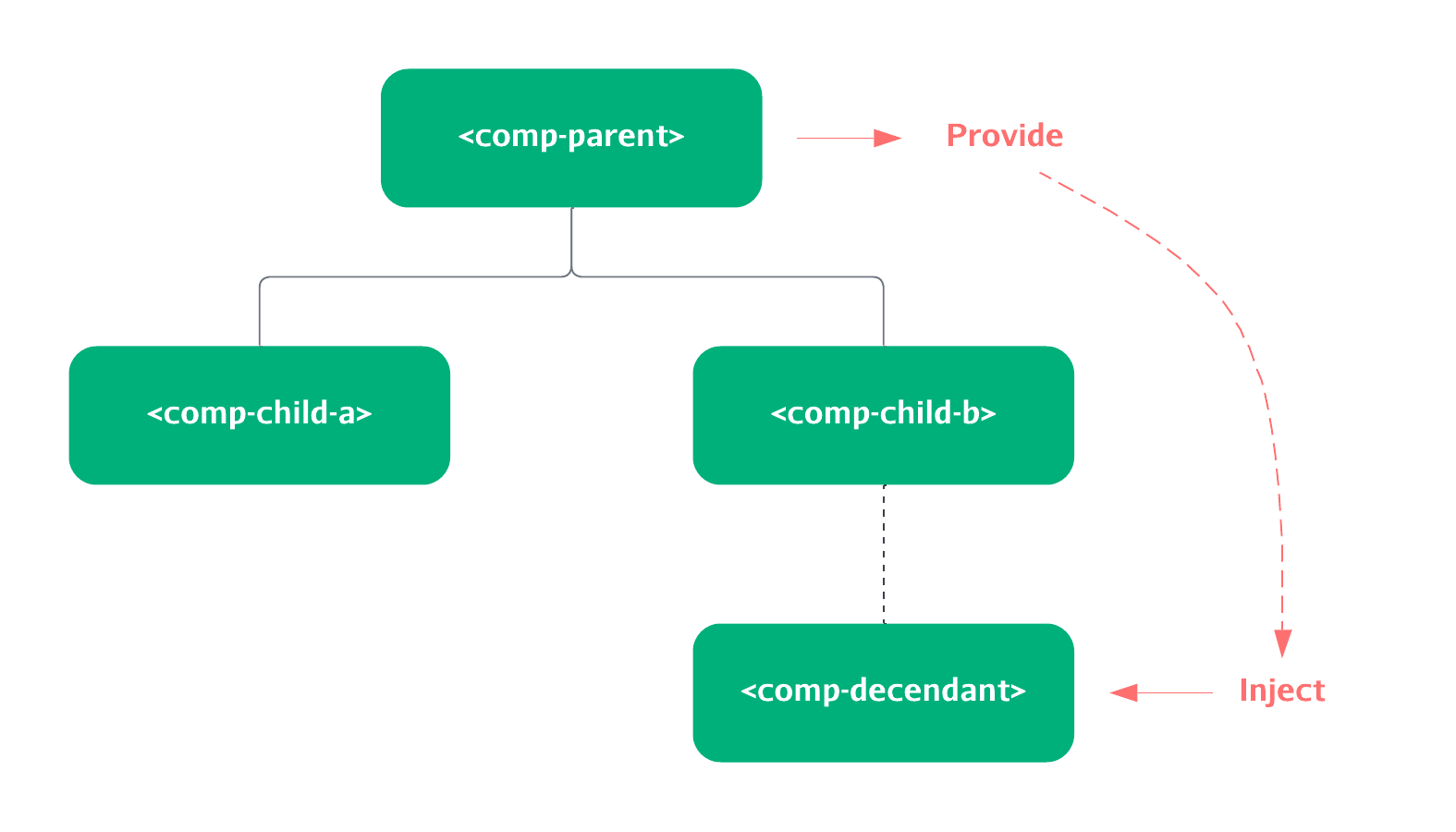
## Provide 提供 {#provide}
### 组合式语法 {#composition-syntax}
在组合式语法中,需要使用到 `provide()` 函数,`provide()` 函数接收两个必填参数:
1. 第一个参数表示**注入名**,是一个字符串或者 `Symbol`。后代组件会用注入名来查找期望注入的值,一个组件可以多次调用 `provide()`,使用不同的注入名,注入不同的依赖值。使用 `Symbol` 作为注入名时,只能使用组合式语法而非选项式语法。
2. 第二个参数表示**提供值**,值可以是任意类型,包括响应式的状态,比如一个 `ref`、`reactive` 或者 `computed` 计算值。
```ts
```
### 选项式语法 {#options-syntax}
选项式语法的 `setup()` 中,用法和组合式 API 一致。另外针对选项式语法,我们也提供了 `provide` 选项,它是**一个对象或返回一个对象的函数**。
对于 `provide` 对象上的每一个属性,后代组件会用其 key 为注入名查找期望注入的值,属性的值就是要提供的数据。
如果我们需要提供依赖当前组件实例的状态 (比如在 `data` 属性中定义的数据),那么需要使用函数形式的 `provide` 选项。需要注意的是,这 **并不会** 使注入保持响应性,如果需要保证注入方和供给方之间的响应性链接,我们需要使用 `computed()` 函数提供一个计算属性。
```ts{17}
```
### 应用级顶层 provide {#app-level-provide}
前面介绍的是在一个组件中提供依赖,我们还可以在整个应用层面提供依赖,这样整个应用中所有组件都可以使用。
```ts
import { createApp } from '@mpxjs/core'
createApp({
// 应用层 provide
provide() {
return {
'appMessage': 'provide from App scope!'
}
}
})
```
## Inject 注入 {#inject}
### 组合式语法 {#composition-syntax-1}
`inject()` 函数最多接收三个参数:
* 第一个参数必填,表示**注入名**,字符串类型。
* 第二个参数可选,表示**默认值**。
* 如果在注入一个值时不确定是否有提供者,那么应该声明一个默认值。如果既没有提供者也没有默认值,则会抛出一个运行时警告。
* 第三个参数可选,表示**是否将默认值视为工厂函数**,布尔类型。
* 某些场景下,默认值可能需要通过调用一个函数或初始化一个类来生成,或者某些非基础类型数据创建开销比较大,请使用工厂函数来创建默认值。
```ts
```
如果提供的值是一个 ref,注入进来的会是该 ref 对象,而不会自动解包为其内部的值。这使得注入方能够通过 ref 对象和提供方保持响应性链接。
### 选项式语法 {#options-syntax-1}
选项式语法的 `setup()` 中,用法和组合式 API 一致。另外针对选项式语法,我们也提供了 `inject` 选项,它是**一个数组或一个对象**。
1. **数组**形式使用。数组中的每一项对应一个注入名,注入的属性会以同名的 key 暴露到组件实例上。如下示例中,注入名 `"message"` 在注入后以 `this.message` 的形式暴露。另外,`inject` 会在组件自身的状态**之前**被解析,意味着你可以在 `data()` 中访问到注入的属性。
```ts{6}
```
2. **对象**形式使用。相比数组形式,对象形式支持注入**别名**和**默认值**。如下示例,通过 `from` 属性指定原注入名,通过 `default` 属性指定默认值。
```ts
```
## 避免注入名潜在冲突 {#avoid-injection-name-conflict}
如果你正在构建大型的应用,包含非常多的依赖提供,那么随处定义的注入名容易存在潜在的同名冲突。在 Mpx 实现中,同名的注入名会覆盖之前已有的注入名对应的提供值。
针对大型应用的最佳实践,我们通常推荐在一个单独的文件中导出这些注入名,可以结合业务模块功能来统一注入名的命名和管理规范。*以下示例仅供参考,具体实现请依据自身实际场景确定。*
```ts
/** 推荐创建一个单独的文件来管理和导出注入名 */
// 1. 使用枚举类型
export const InjectionKeys = {
user: 'user',
auth: 'auth',
product: 'product',
}
// 2. 按业务模块功能划分命名,不容易命名冲突,可读性高
export const InjectionKeys = {
user: {
service: 'user:service',
store: 'user:store',
},
auth: {
service: 'auth:service',
token: 'auth:token',
},
product: {
list: 'product:list',
details: 'product:details',
},
}
// 3. 使用 Symbol 创建唯一注入名,或再结合命名空间
export const InjectionKeys = {
user: Symbol('user'),
auth: Symbol('auth'),
product: Symbol('product'),
}
// 4. 自行实现类似 Symbol polyfill 的命名生成函数
export const createInjectionKey = (module, key) => `${module}:${key}`
export const InjectionKeys = {
user: createInjectionKey('user', 'service'),
auth: createInjectionKey('auth', 'token'),
product: createInjectionKey('product', 'list'),
}
```
## TS 类型支持 {#ts-support}
直接使用字符串注入 key 时,注入值的类型默认推导会是 `unknown`,需要通过泛型参数显式声明。因为无法保证运行时一定存在这个 provide,所以推导类型也可能是 `undefined`。当声明一个默认值后,这个 `undefined` 类型就可以成功被移除。
```ts twoslash
import { inject } from '@mpxjs/core'
const foo1 = inject('foo') // 类型:unknown
const foo2 = inject('foo') // 类型:string | undefined
const foo3 = inject('foo', 'default value') // 类型:string ✅
```
当然,如果你已经确定注入名肯定被提供了,也可以强制断言。
```ts twoslash
import { inject } from '@mpxjs/core'
const foo = inject('foo') as string
```
如果使用 `Symbol` 作为注入名,可以使用我们提供的 `InjectionKey` 泛型接口,使用它对注入名进行注解或者断言后,可以用来在不同组件之间同步注入值的类型。建议将注入 key 放在单独文件,这样方便在多个组件中导入使用。
```ts{4} twoslash
// @errors: 2345 1146 1005
import { provide, inject } from '@mpxjs/core'
import type { InjectionKey } from '@mpxjs/core'
export const key: InjectionKey = Symbol() // 类型注解
// const key = Symbol() as InjectionKey // 类型断言写法等效
provide(key, 'foo') // ✅
provide(key, 123) // 提供值应当为字符串类型
const foo1 = inject(key) // ✅ foo1: string | undefined
const foo2 = inject(key, 'default value') // ✅ foo2: string
const foo3 = inject(key, 123) // 默认值应当为字符串类型
```
> 👀 鼠标悬浮到上面代码可以查看具体 TS 类型
## 跨端差异 {#cross-platform-diff}
* Mpx 输出 **Web** 端,使用规则与 Vue 一致,`provide/inject` 的生效范围严格遵行父子组件关系,只有父组件可以成功向子孙组件提供依赖。
* Mpx 输出 **RN** 端,框架内部基于 React 的 `useContext` 钩子来转换实现,表现和 Web 端一致。
* Mpx 输出 **小程序** 端同样遵循类似 Vue 的父子组件关系,但是在 `slot` 场景下小程序表现会和 Web、RN 端略有差异。举个例子,如下代码所示:在组件 A 的 `template` 模板中包含子组件 B,然后组件 B 通过 `slot` 包含子组件 C,组件 B 和 C 都定义在组件 A 的模板中。该场景下:在 Web 端,组件 A 是 B 的父组件,B 是 C 的父组件,所以 A 和 B 都可以向 C 提供依赖。但在小程序端,B 和 C 的父组件都是 A,组件 B 不能再向 C 提供依赖。这个跨端差异或者说“副作用”可以理解成:Web 端是基于“节点树”,即虚拟组件节点纬度,而小程序的父子组件关系是基于“组件树”,即组件模板维度,也就是说当前组件的创建者(在 WXML/AXML 模板中定义了此组件的组件)才是它的父组件。
```html
组件 A
组件 B
```
---
---
url: /guide/advance/mixin.md
---
# 使用 mixin {#use-mixin}
Mpx 提供了一套完善的 mixin 机制,有人可能要问,原生小程序中已经支持了 behaviors,为何我们还需要提供 mixin 呢?主要有以下两点原因:
1. Behaviors 是平台限度的,只有在部分小程序平台中可以使用,而且内置 behaviors 承载了除了 mixin 外的其他功能,框架提供的 mixin 是一个与平台无关的基础能力;
2. Behaviors 只有组件支持使用,页面不支持,而且只支持局部声明,框架提供的 mixin 与组件页面无关,且支持全局 mixin 声明。
## 局部 Mixin {#local-mixin}
`App`、`Page`、`Component` 接收 mixins 参数,参数格式为\[Mixin1(Object),Mixin2(Object)]
> Mixin 混合实例对象可以像正常的实例对象一样包含选项,相同选项将进行逻辑合并。举例:如果 mixin1 包含一个钩子 ready,而创建组件 Component 也有一个钩子 ready,两个函数将被调用。 Mixin 钩子按照传入顺序(数组顺序)依次调用,并在调用组件自身的钩子之前被调用。
```js
// mixin.js
export default {
data: {
list: {
'phone': '手机',
'tv': '电视',
'computer': '电脑'
}
},
ready () {
console.log('mixins ready:', this.list.phone)
}
}
```
```html
{{item}}
```
```shell
// 输出结果为
mixins ready: 手机
component ready: 手机
```
## 全局 Mixin {#global-mixin}
Mpx 中可以使用 `mpx.injectMixins` 方法配置全局 mixin,能够按照 App / 组件 / 页面维度自由配置,简单示例如下:
```js
import mpx from '@mpxjs/core'
// 第一个参数为 mixins,可以混入任意配置,第二个参数为混入生效范围,可传递 'app' / 'page' / 'component' 字符串或由其组成的数组
mpx.injectMixins([
{
data: {
customData: '123'
}
}
], ['page'])
// mpx.mixin 为 mpx.injectMixins 的别名,混入单个 mixin 时可以直接传递对象,生效范围可传递字符串
mpx.mixin({
methods: {
useCustomData () {
console.log(this.customData)
}
}
}, 'component')
// 当未传递生效范围时默认为全局生效,对 app / page / component 都生效
mpx.mixin({
computed: {
processedCustomData () {
return this.customData + '321'
}
}
})
```
---
---
url: /guide/advance/npm.md
---
# 使用npm {#use-npm}
Mpx项目中用户能够方便自然地引用 npm 资源,像 web 开发中一样
在 Mpx 中使用 npm,通过 Webpack 插件在编译时将引用的 npm 包输出为小程序文件,所以 Mpx 的构建产物不需要在开发工具再次进行 npm 构建。
## 下载npm包 {#download-npm-package}
在项目 package.json 所在的目录中执行命令安装项目 npm 包
```js
npm install
```
在项目中安装某个第三方 npm 包
```js
npm install mpx-ui
```
如若之前未接触过 npm,请翻阅 [官方 npm 文档](https://docs.npmjs.com/about-npm/index.html) 进行学习。
## 引用npm模块 {#import-npm-module}
直接使用模块路径引用,可以直接通过 ES6 的 import 语法来引用 JS 文件,并且无需额外执行npm构建
```js
import { createPage } from '@mpxjs/core'
```
## 引用npm组件/页面 {#import-npm-component-page}
在页面 script 标签中的 json 对象中使用 usingComponents 引入第三方组件,直接使用模块路径引用
```js
```
在 app.mpx 中的 script 标签中的 pages/packages/subPackages 中都可以声明引用 npm 包页面
示例:
```js
```
以上这种写法为避免和本地页面路径冲突,Mpx 会将路径进行 hash 化处理,所以使用页面时要在路径后添加 ?resovle 标识符,编译时会被处理成正确的、完整的绝对路径。
```js
import packageIndexPage from '@someGroup/someNpmPackage/pages/view/index.mpx?resolve'
mpx.navigateTo({
url: packageIndexPage
})
```
如果你觉得上述引用 npm 包页面的方式太繁琐,我们也提供了另一种 page 声明方式,可以让你自定义页面路径
```js
// 声明
{
"pages": [
{
"src": "@someGroup/someNpmPackage/pages/view/index.mpx",
"path": "pages/somNpmPackage/index" // 注意保持 path 的唯一性
}
]
}
// 使用
// 可以直接使用你自己声明的 path
mpx.navigateTo({
url: '/pages/somNpmPackage/index'
})
```
同理,我们在使用 subPackages 分包时也可以使用 pages 对象的方式
```js
"subPackages": [
{
"root": "test",
"pages": [
{
"src": "@someGroup/someNpmPackage/pages/view/index.mpx",
"path": "pages/somNpmPackage/index" // 注意保持 path 的唯一性
}
]
}
]
// 使用
mpx.navigateTo({
url: '/test/pages/somNpmPackage/index'
})
```
同时使用 Mpx 引用npm组件/页面时包体积比原生中的 npm 规范更优,好处有:
Mpx npm构建的优势主要有两点:1. 按需构建;2. 支持分包
* 小程序的 npm 规范场景下,组件库需声明miniprogram_dist目录,执行构建npm命令,将整个miniprogram_dist中的代码copy到项目的miniprogram_npm目录下。而 Mpx 的 npm 包引用,借助 Webpack 强大的构建分析能力,loader 在解析 json 中的 pages 域和 usingComponents 域中的路径时,通过动态创建 entry 的方式把这些文件添加进来,同时按需加载被确切使用的文件,降低包体积,借助 CommonsChunkPlugin/SplitChunksPlugin 的能力将复用的 js 模块抽出到一个外部公用的 bundle 中。
* 原生小程序的构建中,所有的 npm 模块都会输出到主包中,Mpx 在编译中,还会进行分包处理,对组件和静态资源,根据用户的分包配置,串行对主包和各个分包进行构建,标记出每个组件及静态资源的归属,根据小程序资源访问策略将其输出到主包或者分包中。
所以使用 Mpx 框架开发小程序,可以享受最舒适最自然最好用的 npm 机制,详细原理介绍请移步[Mpx编译构建原理](../understand/compile.md)
## 兼容原生小程序路径规范 {#compatible-native-path}
组件或者页面的引入有绝对路径和相对路径,或者引入 npm 第三方包,原生小程序中,我们通过相对路径引入一个组件时
```js
{
"usingComponents": {
"component-tag-name": "path/to/the/custom/component"
}
}
```
这种路径形式在 webpack 路径规范中会被当成 npm 包路径来处理,所以要对原生小程序的路径规范做下兼容。
Mpx 提供了两种路径规范的配置模式可供大家选择,具体的使用方式为:
```js
// vue.config.js
module.exports = defineConfig({
pluginOptions: {
mpx: {
plugin: {
resolveMode: 'webpack'
}
}
}
})
```
在 MpxWebpackPlugin 插件中设置 resolveMode 项,默认值为 webpack,可选值有 webpack/native,推荐使用 webpack 模式,更舒服一些,配置项为 webpack 时,json 中的 pages/usingComponents 等需要写相对路径,但是也可以直接写 npm 包路径。例如:
```js
{
"usingComponents": {
"component-tag-name": "./path/to/the/custom/component", // 内部组件路径
"mpx-button": "mpx-ui/src/components/button" // npm 包路径
}
}
```
如果希望使用类似小程序原始那种"绝对路径",可以将 resolveMode 设置为 native,但是 npm 路径需要在前面加一个~,类似 webpack 的样式引入规范,同时必须配合 projectRoot 参数提供项目根目录地址。
resolveMode 为 native 时的使用示例:
```js
// vue.config.js
module.exports = defineConfig({
pluginOptions: {
mpx: {
plugin: {
resolveMode: 'native',
// 当resolveMode为native时可通过该字段指定项目根目录
projectRoot: path.resolve(__dirname, '../src')
}
}
}
})
// 项目page.mpx
{
"usingComponents": {
"mpx-button": "~mpx-ui/src/components/button", // npm 包路径
"component-tag-name": "path/to/the/custom/component" // 内部组件路径
}
}
```
---
---
url: /guide/advance/subpackage.md
---
# 使用分包 {#use-subpackage}
作为一个对 performance 极度重视的框架,分包作为提升小程序体验的重要能力,框架对各种类型的分包能力进行了完善支持。
> 分包是小程序平台提供的原生能力,mpx是对该能力做了部分加强,目前各大主流小程序平台都已支持分包,且框架在可能的情况下进行了抹平。
> 使用分包一定要记得阅读下面的[分包注意事项](#subpackage-notes)
## 原生语法注册分包 {#native-syntax-register-subpackage}
Mpx 支持小程序原生语法注册分包,并且在框架层面对不同平台的的差异进行了抹平,我们以微信小程序原生语法注册分包为例。
```json
{
"pages": [
"pages/index/index"
],
"subPackages": [
{
"root": "test",
"pages": [
"pages/other/other",
"pages/other/other2"
]
}
]
}
```
## packages 语法注册分包 {#packages-syntax-subpackage}
Mpx 提供 packages 语法来对小程序的主包页面和分包划分能力进行增强,使用 packages 语法可以灵活的对业务进行拆分,允许以 npm 包的形式进行
主包页面和分包注册,且分包名和页面路径可自定义,十分有利于大型多团队开发的项目维护。
### 使用方法 {#usage}
Mpx 拓展了 app.json 的语法,新增了 packages 域,用来声明依赖的 packages,packages 可嵌套依赖。
#### 注册主包页面 {#register-main-package-page}
首先我们介绍下 packages 注册主包页面的用法,在 packages 中直接配置资源路径,Mpx 会去读取该资源中 json 区块中的 pages 属性,合并到主包页面配置中。
```html
// @file src/app.mpx
// @file src/packages/index.mpx
// 注意确保页面路径的唯一性
```
打包结果:dist/app.json
```json
{
"pages": [
"pages/index/index",
"pages/other/other",
"pages/other/other2"
]
}
```
#### 注册分包 {#register-subpackage}
Mpx 会将 packages 域下的路径带 root 为 key 的 query 解析注册为分包,使用 packages 语法注册分包,只需要在 packages 中配置资源路径添加 `root=xxx`,root的值即为分包名。
```html
// @file src/app.mpx
// @file src/packages/index.mpx (子包的入口文件)
```
打包结果:dist/app.json
```json
{
"pages": [
"pages/index/index"
],
"subPackages": [
{
"root": "test",
"pages": [
"pages/other/other",
"pages/other/other2"
]
}
]
}
```
由上可见,经过我们的编译过程,packages 中注册的页面可按照原始的路径被合并入主包页面或注册为分包,
这样开发者可以不用考虑自己在被依赖时页面路径是怎么样的,也可以直接将调试用的app.mpx作为依赖入口直接暴露出去,
对于主app的开发者来说也不需要了解依赖内部的细节,只需要在packages中声明自己所需的依赖即可。
### 注意事项 {#notes}
* 依赖的开发者在自己的入口 app.mpx 中注册页面时对于本地页面一定要使用相对路径进行注册,否则在主app中进行编译时会找不到对应的页面
* 不管是用 json 还是 mpx 格式定义 package 入口,编译时永远只会解析 json 且只会关注 json 中的 pages 和 packages 域,其余所有东西在主app编译时都会被忽略
* 由于我们是将 packages 中注册的页面按照原始的路径合并到主 app 当中,有可能会出现路径名冲突。\
这种情况下编译会报出响应错误提示用户解决冲突,为了避免这种情况的发生,依赖的提供者最好将自己内部的页面放置在能够描述依赖特性的子文件夹下。
例如一个包叫login,建议包内页面文件目录为:
```
project
│ app.mpx
└───pages
└───login
│ page1.mpx
│ page2.mpx
│ ...
```
## 独立分包 {#independent-subpackage}
Mpx目前已支持独立分包构建,使用 [packages](#packages) 语法声明分包时只需要在后面添加 `independent=true` query 即可,同时也支持原生语法声明。
如下方示例声明 packageA 分包为独立分包
**示例:**
```json5
// src/app.mpx 文件中 json 块
// Mpx packages 方式
{
"packages": [
"packageA/app.mpx?root=packageA&independent=true"
]
}
```
```json5
// 微信原生方式
{
"subpackages": [
{
"root": "packageA",
"pages": [
"pages/index"
],
"independent": true
},
]
}
```
需要注意的是,由于独立分包可以独立于主包和其他分包运行,从独立分包页面进入小程序时,主包中的相应初始化逻辑并不会执行,如果独立分包中多个页面需要某种通用初始化逻辑时就无法优雅的实现,
Mpx框架针对独立分包场景提供了独立分包初始化逻辑执行能力。
对于使用 packages 方式声明的独立分包,默认将 .mpx 文件自身的 script 块作为初始化逻辑执行。
```html
```
上方代码中 独立分包 packageA 的入口文件 app.mpx 中的 script block 代码会默认在独立分包初始化时执行,Mpx 同时提供了全局变量 `isIndependent` 标识当前代码执行环境是否为独立分包来进行特定逻辑区分
如果你不想走这个默认的初始化逻辑执行规则,想自定义一个 js 文件存储当前独立分包的初始化逻辑,我们支持 independent 配置项直接配置为初始化逻辑文件地址
```json5
// src/app.mpx 文件中 json 块
// Mpx packages 方式
{
"packages": [
"packageA/app.mpx?root=packageA&independent=./common" // 路径上下文为 packageA 文件夹
]
}
```
```json5
// 微信原生方式
{
"subpackages": [
{
"root": "packageA",
"pages": [
"pages/index"
],
"independent": "./common" // 路径上下文为 packageA 文件夹
},
]
}
```
```js
// src/pacakgeA/common.js
import mpx from '@mpxjs/core'
import apiProxy from '@mpxjs/api-proxy'
mpx.use(apiProxy, { usePromise: true })
if (isIndependent) {
// do some in independent package
} else {
// do some not independent package
}
```
注意上方配置 independent 为初始化逻辑文件地址时,路径相对地址上下文为 packageA
## 分包预下载 {#subpackage-preload}
分包预下载是在 json中 新增一个 preloadRule 字段,mpx 打包时候会原封不动把这个部分放到 app.json 中,所以只需要按照 [微信小程序官方文档 - 分包预下载](https://developers.weixin.qq.com/miniprogram/dev/framework/subpackages/preload.html) 或者 [支付宝小程序官方文档 - 分包预下载](https://opendocs.alipay.com/mini/framework/subpackages) 配置即可。
**示例:**
```html
// @file src/app.mpx
// @file src/packages/index.mpx (子包的入口文件)
```
打包结果:dist/app.json
```json
{
"pages": [
"pages/index/index"
],
"subPackages": [
{
"root": "xxx",
"pages": [
"pages/other/other",
"pages/other/other2"
]
}
],
"preloadRule": {
"pages/index": {
"network": "all",
"packages": ["important"]
},
"sub1/index": {
"packages": ["hello", "sub3"]
}
}
}
```
## 分包注意事项 {#subpackage-notes}
当我们使用分包加载时,依赖包内的跳转路径需注意,比如要跳转到other2页面
* 不用分包时会是:/pages/other/other2
* 使用分包后应为:/test/pages/other/other2
即前面会多?root={rootKey}的rootKey这一层
为了解决这个问题,有三种方案:
* import的时候在最后加'?resolve', 例如: `import testPagePath from '../pages/testPage.mpx?resolve'` , 编译时就会把它处理成正确的完整的绝对路径。
* 使用相对路径跳转。
* 定死使用的分包路径名,直接写/{rootKey}/pages/xxx (极度不推荐,尤其在分包可能被多方引用的情况时)
这里我们建议使用第一种方式。
---
---
url: /guide/advance/async-subpackage.md
---
# 分包异步化 {#subpackage-async}
> 在小程序中,不同的分包对应不同的下载单元;因此,除了非独立分包可以依赖主包外,分包之间不能互相使用自定义组件或进行 require。
> 「分包异步化」特性将允许通过一些配置和新的接口,使部分跨分包的内容可以等待下载后异步使用,从而一定程度上解决这个限制。
具体功能介绍和功能目的可 [点击查看](https://developers.weixin.qq.com/miniprogram/dev/framework/subpackages/async.html), Mpx对于分包异步化功能进行了完整支持。
当前 Mpx 框架默认支持以下平台的分包异步化能力:
* 微信小程序
* 支付宝小程序
* 字节小程序
* Web
* RN
在非上述平台,异步分包代码会默认降级。
## 跨分包自定义组件引用 {#cross-subpackage-component}
> 一个分包使用其他分包的自定义组件时,由于其他分包还未下载或注入,其他分包的组件处于不可用的状态。通过为其他分包的自定义组件设置 占位组件,
> 我们可以先渲染占位组件作为替代,在分包下载完成后再进行替换。
在 Mpx 中使用跨分包自定义组件引用通过?root声明组件所属异步分包即可使用,示例如下:
```html
// 这里在分包packageA中即可异步使用分包packageB中的hello组件
```
* 注意项:目前该能力已在微信、支付宝、Web和RN环境下支持,其他环境下框架将进行自动降级。
## 跨分包 JS 代码引用 {#cross-subpackage-js}
> 一个分包中的代码引用其它分包的代码时,为了不让下载阻塞代码运行,我们需要异步获取引用的结果
在 Mpx 中跨分包异步引用 JS 代码时,**需要在引用的 JS 路径后拼接 JS 模块所在的分包名**,此外由于 **require** 不能传入多个参数的限制,在Mpx中无法使用回调函数的
风格跨分包 JS 代码引用,只能使用 Promise 风格。
示例如下:
```js
// subPackageA/index.js
// 或者使用 Promise 风格的调用
require.async('../commonPackage/index.js?root=subPackageB').then(pkg => {
pkg.getPackageName() // 'common'
})
```
* 注意项:目前该能力仅微信平台下支持,其他平台下框架将会自动降级
## 跨分包 Store 引用 {#cross-subpackage-store}
在 Mpx 中如果想要跨分包异步引用 Store 代码,分为三个步骤
* 页面或父组件在 `created` 钩子加载异步 Store
* 异步 Store 加载完成后再渲染使用异步 Store 的组件
* 子组件在框架内部生命周期 `BEFORECREATE` 钩子中动态注入 computed 和 methods
```html
```
---
---
url: /guide/advance/i18n.md
---
# 国际化i18n {#i18n}
Mpx 支持国际化 i18n,使用方式及支持能力与 vue-i18n 非常接近。
Mpx 自带 i18n 能力,无需额外安装插件。由于小程序模板中的 i18n 函数是通过 wxs 编译注入进行实现,我们需要将 i18n 配置传入到 MpxWebpackPlugin 中来使 i18n 生效,这是与 vue-i18n 最大的区别。
## 开启 i18n {#enable-i18n}
I18n 配置传入到 MpxWebpackPlugin 选项中即可生效,额外支持 messagesPath 配置,通过模块路径传入语言集,其余配置参考 vue-i18n。
由于小程序的双线程特性,在选项式 API 场景下,默认情况下模板中调用的 i18n 函数由 wxs 实现,而 js 中调用的 i18n 函数由 js 实现,该设计能够将视图层和逻辑层之间的通信开销降至最低,得到最优的性能表现,但是由于 wxs 和 js 之间无法共享数据,在最终的编译产物中语言集会同时存在于 js 和 wxs 当中,对包体积产生负面影响。
为了平衡上述影响,自2.6.56版本之后我们新增了编译配置项 `i18n.useComputed` ,改配置项开启的情况下对于模板中的 i18n 调用将不再使用 wxs 实现,而是通过在 computed 进行实现,语言集将只存在于 js 逻辑层当中,对于节省了包体积的同时双线程通信成本也会增加,用时间换空间,具体是否开启可以根据实际项目的使用情况及资源瓶颈由开发者自行决定,
另外需要注意的是,**在 Mpx 组合式 API 场景下 i18n 仅支持通过 computed 实现**。
> 开启 `i18n.useComputed` 配置时,由于 computed 技术架构的限制,i18n 函数无法对模板循环渲染中的 `item` 或 `index` 生效。
```js
// vue.config.js
module.exports = defineConfig({
pluginOptions: {
mpx: {
plugin: {
i18n: {
locale: 'en-US',
// messages既可以通过对象字面量传入,也可以通过messagesPath指定一个js模块路径,在该模块中定义配置并导出,dateTimeFormats/dateTimeFormatsPath和numberFormats/numberFormatsPath同理
messages: {
'en-US': {
message: {
hello: '{msg} world'
}
},
'zh-CN': {
message: {
hello: '{msg} 世界'
}
}
},
useComputed: false // 默认 false, 此开关将模板中的 i18n 函数注入 computed,在包体积空间紧张的情况下可以使用
// messagesPath: path.resolve(__dirname, '../src/i18n.js')
}
}
}
}
})
```
## 选项式 API 中使用 {#options-api-usage}
同 vue-i18n,在组件中直接调用翻译函数使用,由于 wxs 执行环境的限制,目前 js 中支持了 vue-i18n 中 $t/$tc/$te 翻译函数,$d/$n 暂不支持,详细使用方法可参考 vue-i18n。
此外类似于 vue-i18n,在组件模板的 Mustache 插值中直接调用翻译函数。
```html
{{ $t('message.hello', { msg: 'hello' }) }}
```
## 在组合式 API 中使用 {#composition-api-usage}
在组合式 API setup 中,`this` 不是该活跃实例的引用,为了继续使用 i18n 的相关能力,我们需要一个新的方法来替代 `this`
,这里 Mpx 提供 `useI18n` 方法支持对 i18n 相关功能的使用。
### 开始使用 {#start-using}
同 vue-i18n, **useI18n** 返回一个 i18n 实例,该实例提供文案翻译 API 例如 **t** 方法,相较于选项式 API 中的翻译方法,在组合式 API 中有部分变化。
1. 翻译方法 $t/t 和 $tc/tc,在组合式 API 中统一使用翻译方法 t
2. 翻译方法 $te/te,在组合式 API 中统一使用 te
3. 翻译方法 $tm/tm,在组合式 API 中统一使用 tm
`useI18n` 方法的执行必须在 `setup` 中的顶层。
i18n 同时也支持传入参数,例如 `locale` 和 `fallbackLocale`,
关于实例的更多信息可移步API章节 [查看](../../api/extend.md#usei18n)
在不给 `useI18n` 传入任何参数时,i18n 实例的上下文将是全局作用域,即翻译函数 `t` 引用的文案来源是我们在 `MpxWebpackPlugin`
中配置的文案。
通过在 **setup** 中返回翻译函数 **t**,我们可以在模版中直接使用它:
```html
{{t("message.hello")}}
```
```js
import {createComponent, useI18n} from '@mpxjs/core'
createComponent({
setup(props, context) {
const { t } = useI18n() // 从返回中解构出 t 方法
return {
t
} // 将 t 方法返回挂载到渲染实例
}
})
```
**注意事项:**
组合式 API 中,Mpx 在编译时对模版进行 ast 遍历分析,检测到对应的翻译函数 t/tc/te 后,将其转换为 computed 方法注入,computed 中调用 setup 中返回的 t 方法进行文案获取,由此引申出来两个注意项:
1.不可对从 **useI18n** 中解构出的 **t** 方法进行重命名,否则模版中将无法正确获取文案。
下方即为错误示例:
```html
{{t1('message.hello')}}
```
2.模版中的 t/tc/te 方法都是使用 computed 实现,由于 computed 技术架构的限制,i18n 函数无法对模板循环渲染中的 `item` 或 `index` 生效。
例如下方示例将会报错 computed 中找不到 item
```html
{{tc('message.hello', {msg: item})}}
```
## 作用域 {#scope}
在 Mpx 组合式 API 中,`useI18n` 返回的 i18n 实例默认是指向全局作用域,文案来源即为 `MpxWebpackPlugin` 中配置的 messages。
如果需要在组合式 API 中使用本地作用域,需要给 `useI18n` 传入响应的配置项,`useI18n` 将根据传入的 locale、messages 等配置项来生成一个全新的
i18n 实例,该实例的文案源即为用户传入的 `messages`。
```html
{{t('message.hello')}}
```
**注意事项:**
在给 `useI18n` 传参时,若只传入 `messages` 属性,则 `locale` 会自动 fallback 到全局 locale,修改 `useI18n` 返回的 `locale` ref 值将改变本地作用域 locale。
若只传入 `locale` 属性,不传入 `messages`,则会自动 fallback 到全局 `locale` 和 `messages`,且修改 `useI18n` 返回的 `locale` 对**全局和本地都不会起作用**,
因此建议不要单独传入 `locale` 属性,若想使用本地 i18n 实例,则必须传入 `messages` 属性。
在 Mpx 选项式 API 中,i18n 实例仅有全局 global i18n 实例,所有 i18n 翻译方法 $t/$tc/$te/$tm 的执行上下文都为全局作用域。
```html
{{$t('message.hello')}}
```
## 动态变更locale {#dynamic-change-locale}
在 Mpx 组合式 API 中,你可以通过修改 `useI18n` 返回的 `locale` 来更换局部或全局语言,或者更改 mpx.i18n 中的 locale 属性更换全局语言集,并自动更新视图。
* 变更全局 locale
```js
import mpx, { createComponent, useI18n } from '@mpxjs/core'
createComponent({
setup () {
// 局部locale变更,生效范围为当前组件内
const {t, locale} = useI18n()
setTimeout(() => {
// 全局locale变更,生效范围为项目全局,locale 是一个 ref 变量
locale.value = 'zh-CN'
// 或者通过mpx.i18n来修改,也能起到全局locale修改作用
mpx.i18n.locale = 'zh-CN'
}, 1000)
return {
t
}
}
})
```
**注意:** 这里通过 mpx.i18n 修改 locale 时,为和 vue3 保持一直,需要通过 global 属性来获取 locale,同时 locale 也是一个 ref 变量,需要使用 `.value` 来修改。
* 变更局部 locale
```js
import mpx, { createComponent, useI18n } from '@mpxjs/core'
createComponent({
setup () {
// 局部locale变更,生效范围为当前组件内
const {t, locale} = useI18n({
locale: 'en-US',
messages: {
'en-US': {
message: {
hello: 'hello'
}
},
'zh-CN': {
message: {
hello: '你好'
}
}
}
})
setTimeout(() => {
// 局部locale变更,生效范围为当前组件/页面,locale 是一个 ref 变量
locale.value = 'zh-CN'
}, 1000)
return {
t
}
}
})
```
在选项式 API 中,仅支持修改全局 locale, 不支持修改局部 locale。
在 Vue3 中,选项式 API 中直接修改 this.$i18n.locale 无任何作用,这里为和 Vue3 拉齐建议使用 mpx.i18n 来进行 locale 修改。
```js
import mpx, { createComponent } from '@mpxjs/core'
createComponent({
ready () {
// 修改全局 locale
mpx.i18n.locale = 'en-US'
}
})
```
## 动态更新语言集 {#dynamic-update-language-set}
在组合式 API 中默认支持动态更新语言集。
在选项式 API 中,当模板中没有使用 i18n 函数或开启了 `i18n.useComputed` 配置时, 可以对语言集进行动态更新。
我们提供了 `mergeLocaleMessage` 对语言集进行动态扩展,`setLocaleMessage` 对语言集进行覆盖更新。
使用方式如下:
```html
{{t('message.hello')}}
{{t('message.hello1')}}
```
同理我们在选项式 API 中可以使用 `mpx.i18n.global.mergeLocaleMessage`, `mpx.i18n.global.setLocaleMessage` 方法来动态更新或扩展语言集。
## 平台支持 {#platform-support}
目前支持业内所有小程序平台(微信/支付宝/qq/百度/头条)。
在输出 web 时,构建会自动引入 vue-i18n 并进行安装配置,无需修改任何代码即可按照预期正常工作。
---
---
url: /guide/advance/size-report.md
---
# 包体积分析 {#bundle-size-analysis}
目前业内主流小程序平台都对小程序的代码包设置了严格的体积限制,微信是单包 2MB,总包 16MB,支付宝是单包 2MB,总包 8MB;包体积作为有限的资源,在小程序业务开发中异常重要,特别对于像滴滴出行这样的大型复杂业务。
Mpx 在包体积控制上做了很多工作,主要包括:
* [完善的分包支持](./subpackage.md#分包)
* [基于依赖声明的按需构建](npm.md)
* [图像资源处理](image-process.md)
* [公共样式复用](../basic/css.md#common-style-reuse)
此外由于 Mpx 的编译构建完全基于 webpack,也能够直接复用webpack生态自带的代码压缩,模块复用,tree shaking,side effects 等能力对代码体积进行优化。
但是系统能做的工作终究有限,在一些人为不规范操作的影响下,最终输出的项目依然可能存在大量优化空间,比如在业务中不会被调用但无法被 tree shaking / side effects 移除的代码,因为 npm 依赖版本不统一造成的重复依赖,未经压缩的图像静态资源等,在大型项目中,这些问题想要被发现会非常困难,因此我们非常需要一个体积分析工具来管控项目体积和发现隐藏的体积问题。
## 与 webpack-bundle-analyzer 的区别 {#diff-webpack-bundle-analyzer}
`webpack-bundle-analyzer` 提供了非常完善的体积分析和可视化展示能力,但是在 Mpx 构建输出小程序场景下,其所提供的能力还是有所缺失:
* 只能对 js 资源进行模块体积分析,而小程序的输出中包含了大量的非 js 静态资源,如 wxss / wxml / json 等,这些资源的体积都不会被统计分析;
* 没有针对某个分包进行体积分析的能力,由于小程序中存在对单一分包的体积限制,我们的体积往往会集中在主包和主要业务分包中,以分包维度进行体积分析的能力非常必要;
* 无法以特定的输入范围为维度进行体积的统计分析,这个能力诉求更多地出现在跨团队合作的复杂小程序当中,如滴滴出行。在这种场景下,接入合作的各方会更加关注己方引入的体积,并进行针对性地优化。
由于上述原因,我们提供了`@mpxjs/size-report`插件提供包体积分析能力,弥补了 `webpack-bundle-analyzer` 的能力缺失,为业务提供了便捷准确的包体积管控优化抓手。
## 使用方法 {#usage}
#### 安装插件 {#install-plugin}
```
npm i @mpxjs/size-report --save-dev
```
#### 配置插件 {#config-plugin}
在项目 webpack.config 文件中配置使用 `@mpxjs/size-report` 插件即可使用,简单示例如下:
```js
// vue.config.js
const MpxSizeReportPlugin = require('@mpxjs/size-report')
module.exports = defineConfig({
configureWebpack() {
return {
plugins: [
new MpxSizeReportPlugin(
{
// 本地可视化服务相关配置
server: {
enable: true, // 是否启动本地服务,非必填,默认 true
autoOpenBrowser: true, // 是否自动打开可视化平台页面,非必填,默认 true
port: 0, // 本地服务端口,非必填,默认 0(随机端口)
host: '127.0.0.1', // 本地服务host,非必填
},
// 体积报告生成后输出的文件地址名,路径相对为 dist/wx 或者 dist/ali
filename: '../report.json',
// 配置阈值,此处代表总包体积阈值为 16MB,分包体积阈值为 2MB,超出将会触发编译报错提醒,该报错不阻断构建
threshold: {
size: '16MB',
packages: '2MB'
},
// 配置体积计算分组,以输入分组为维度对体积进行分析,当没有该配置时结果中将不会包含分组体积信息
groups: [
{
// 分组名称
name: 'vant',
// 配置分组 entry 匹配规则,小程序中所有的页面和组件都可被视为 entry,如下所示的分组配置将计算项目中引入的 vant 组件带来的体积占用
entryRules: {
include: '@vant/weapp'
}
},
{
name: 'pageGroup',
// 每个分组中可分别配置阈值,如果不配置则表示
threshold: '500KB',
entryRules: {
include: ['src/pages/index', 'src/pages/user']
}
},
{
name: 'someSdk',
entryRules: {
include: ['@somegroup/someSdk/index', '@somegroup/someSdk2/index']
},
// 有的时候你可能希望计算纯 js 入口引入的体积(不包含组件和页面),这种情况下需要使用 noEntryRules
noEntryRules: {
include: 'src/lib/sdk.js'
}
}
],
// 是否收集页面维度体积详情,默认 false
reportPages: true,
// 是否收集资源维度体积详情,默认 false
reportAssets: true,
// 是否收集冗余资源,默认 false
reportRedundance: true,
// 展示某些分包资源的引用来源信息,默认为 []
showEntrysPackages: ['main']
}
)
]
}
}
})
```
参考上述示例进行配置后,构建代码后,dist 目录下会产出 report.json 文件,里边是项目的具体体积信息,关于输入 json 的简单示例如下:
```html
{
// 项目体积概要,大部分情况下,我们只需要看这部分就足够了
"sizeSummary": {
// 分组体积概要,与上述配置文件中的 groups 对应
"groups": [
{
"name": "vant",
// 只有该分组包含的模块体积
"selfSize": "164.75KiB",
"selfSizeInfo": {
// 该分组所占 shansong
"shansong": "164.75KiB"
},
"sharedSize": "885.68KiB",
"sharedSizeInfo": {
"main": "885.68KiB"
}
},
],
// 项目各个分包以及主包体积概要
"sizeInfo": {
"main": "1000KiB",
"fenbao1": "200kiB"
},
// 项目总体积
"totalSize": "13468.85KiB",
// 项目静态资源总体积
"staticSize": "4880.58KiB",
// 项目chunk 文件总体积
"chunkSize": "8587.70KiB",
// 非依赖项体积大小
"copySize": "1KiB"
},
// 分组资源详细体积
"groupsSizeInfo": [
{
"name": "groupOne",
// group 自身包含的 module 详情列表
"selfEntryModules": [],
// group 与其他group 共有的 module 详情列表
"sharedEntryModules": [],
// 自身包含 module 体积
"selfSize": "",
// 自身包含 module 体积详情
"selfSizeInfo": {
"main": {},
"homepage": {}
},
// 与其他 group 共有 module 体积
"sharedSize": "",
// 与其他 group 共有 module 体积详情
"sharedSizeInfo": {
"main": {},
"homepage": {}
},
}
],
// 项目资源详细体积报告
"assetsSizeInfo": {
"assets": [{
// 资源类型
"type": "chunk",
"name": "test",
// 分包名
"packageName": "main",
"size": "",
"modules": []
}]
}
}
```
与此同时,如果你开启了本地可视化平台服务,可以直接通过可视化平台查看项目体积构成。默认开启自动打开平台网页或者手动打开后,整体页面展示如下图:
[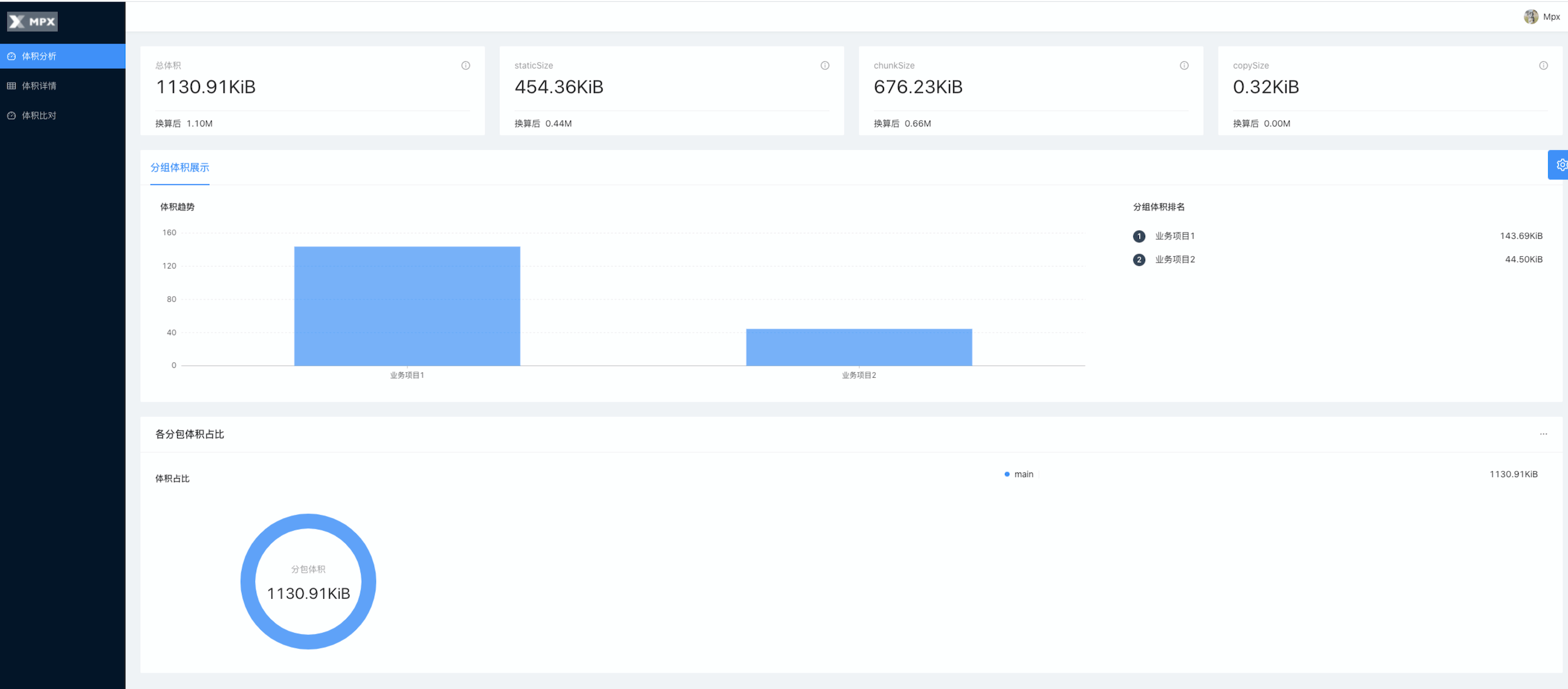](https://mpxjs.cn)
可视化平台中包含三部分功能,第一个体积分析如上图所示,主要是展示整体项目的体积总览,以及 group 体积列表和分包体积列表。
第二个功能是体积详情模块,在该模块中,可以最小颗粒度的查看包体积构成,通过 table 表格的层层展开可看到每个 group 中包含的分包,点击分包可看到该分包包含的静态资源和 js 模块详细列表,同时聚合模式可将分散的模块整合为具体的npm包名,方便宏观查看。此外为了方便用户定向查看某个特定资源的分布情况,列表上方可进行资源路径/名称搜索,该搜索支持模糊匹配,搜索结果为该资源在项目中 group 和 分包的分布情况。
[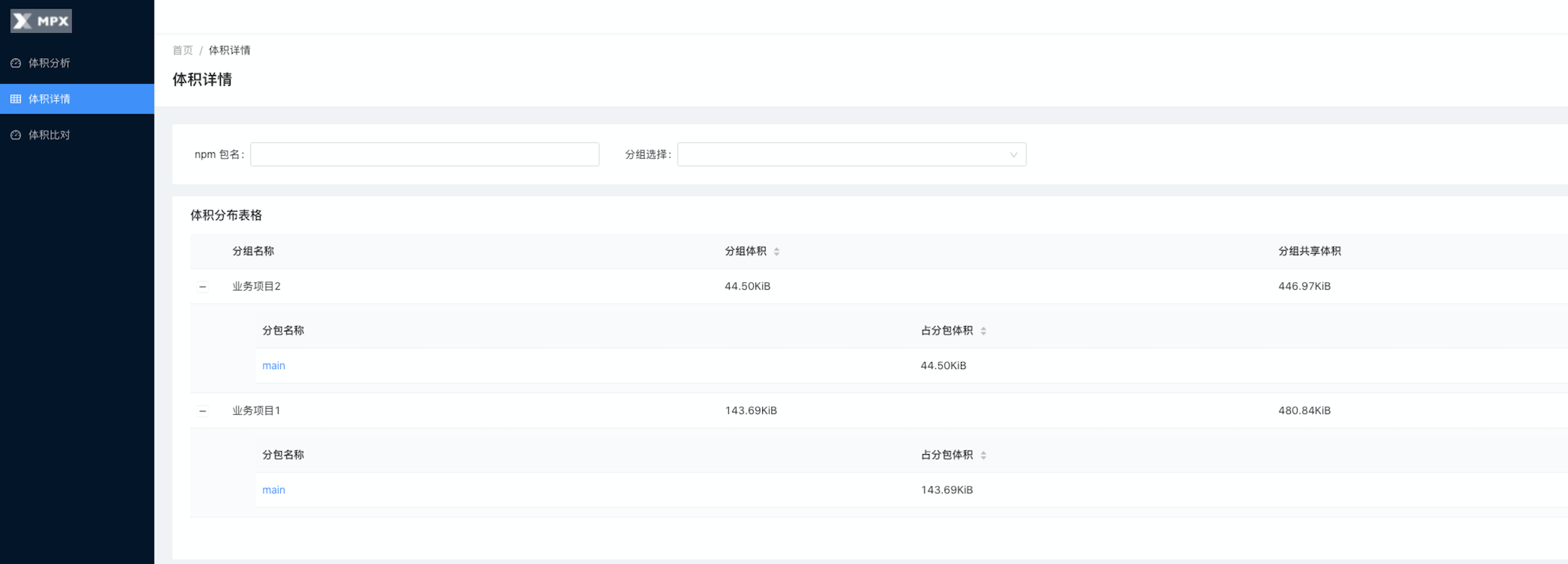](https://mpxjs.cn)
第三个功能为体积对比功能,这里主要进行项目不同版本之间的体积大小变化比较,体积对比依赖插件生成的json文件,通过该功能,可具体的分析出包体积具体增大的group,分包,以及模块,给包体积优化提供定向目标。
[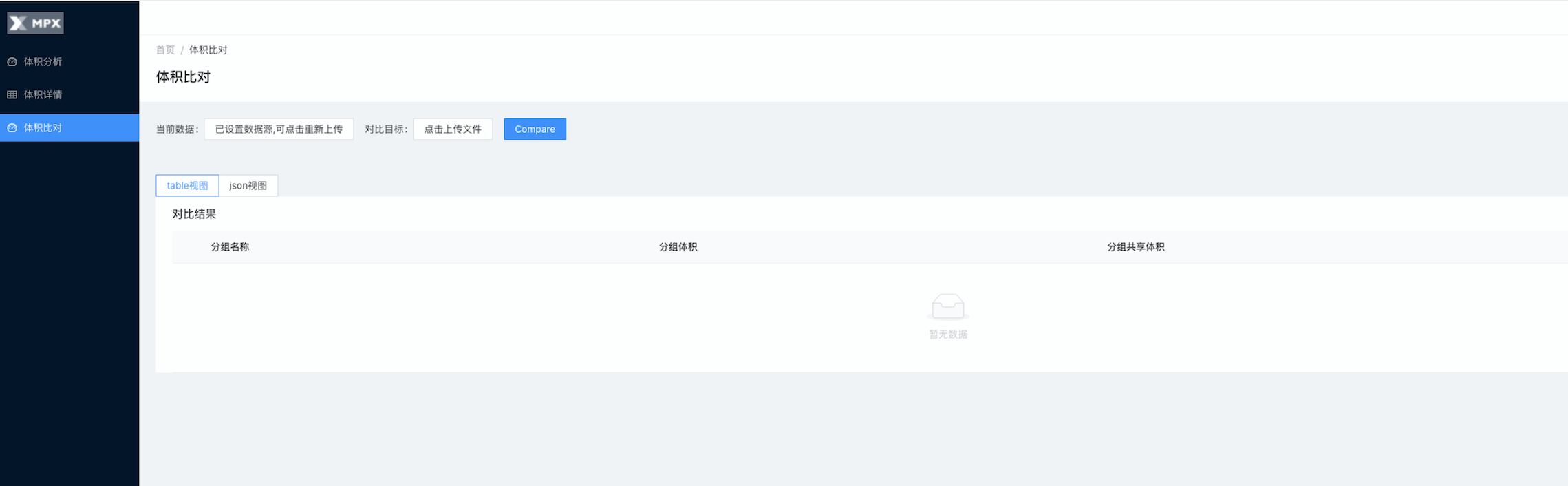](https://mpxjs.cn)
## 业务实践 {#business-practice}
目前 sizeReport 工具在滴滴出行小程序, 花小猪, 青桔骑行, 特惠出行小程序以及一部分外部小程序中使用。
在滴滴出行小程序中,配置使用 @mpxjs/size-report 插件后使包体积管控和优化更加工程化:
* 在 sizeReport 检测结果文件中,通过对 groupsSizeInfo 和 assetsSizeInfo 中assets 与 module 体积分析,我们发现了部分体积较大图片文件和css资源,通过将图片存 CDN 和删除冗余文件;
* 基于各小程序平台对小程序总包,主包,分包有大小限制的原则,给各接入方配置了主包和首页分包体积大小占比阈值,在构建时检测到包体积超过阈值时,抛出 error 阻断构建,开发者可通过 size-report.json 中详细的包体积分析准确的找到体积变动点。
## 总结 {#summary}
Mpx sizeReport 工具对小程序体积计算有更细微(模块级别)的体积展示。 更加适合小程序开发场景的包体积分析。
---
---
url: /guide/advance/perf.md
---
# 跨端运行时按需测速 {#runtime-perf-probe}
Mpx 在小程序、Web、React Native 上都有实例初始化、模板执行、生命周期和卸载等框架热路径,平台 Profiler 难以直接表达 Mpx 自身的语义阶段。`@mpxjs/perf` 提供跨端共用、可按构建关闭且关闭态零残留的显式性能探针。
## 三类统计能力 {#statistics}
| 统计类型 | API | 输出 | 典型用途 |
| --- | --- | --- | --- |
| 区段聚类统计 | `aggrStart` / `aggrEnd` | `Map` | 高频 render、hook、函数的 count/sum/avg/max |
| 区段序列统计 | `traceStart` / `traceEnd` | `TraceTimeline` | 模块火焰图、嵌套调用 profile、异步区段瀑布图 |
| 点序列统计 | `mark` | `MarkTimeline` | 数据就绪、首次渲染、页面可交互等里程碑 |
`start/end` 控制整个录制窗口,Reporter 在窗口结束时同步收到三类结果。聚类统计不保留逐次样本,适合高频热路径;trace 和 mark 会保留事件对象,只适合有限插桩点和诊断窗口。
## 设计原则 {#design-principles}
`@mpxjs/perf` 采用「编译期常量开关 + 运行时探针实现 + tree-shaking 兜底」三层结构:
1. `MpxWebpackPlugin` 通过 `DefinePlugin` 注入 `__mpx_perf__` 和分组常量。
2. 探针调用直接包在 `if (__mpx_perf_framework__)` / `if (__mpx_perf_user__)` 字面量条件里。
3. Terser 消除关闭分组的调用点,webpack tree-shaking 继续剔除失活的实现模块。
关闭态产物中不会保留探针实现、名称字符串或模块依赖。
::: warning 该方案不支持线上动态开关
线上开关意味着探针字节必须进入产物,与关闭态零残留目标冲突。线上诊断需重新构建一个开启探针的内测包。
:::
## 配置入口 {#config}
在 `mpx.config.js` 的 `pluginOptions.mpx.plugin` 下配置 `perf`:
```js
const { defineConfig } = require('@vue/cli-service')
module.exports = defineConfig({
pluginOptions: {
mpx: {
plugin: {
perf: {
enable: !!process.env.MPX_PERF,
probes: ['framework', 'user']
}
}
}
}
})
```
### 配置项说明 {#config-options}
| 字段 | 类型 | 说明 |
| --- | --- | --- |
| `enable` | `boolean` | 总开关。`false` 或不传时整套探针关闭。 |
| `probes` | `string[]` | 当前支持 `'framework'` / `'user'`。空数组等价于关闭,未知分组会在编译期报错。 |
| 分组 | 控制对象 | 典型用途 |
| --- | --- | --- |
| `framework` | 框架内建探针,如 `instance:*` / `scheduler:*` / `lifecycle:*` / 基础组件 render | 调试 Mpx 框架自身热路径 |
| `user` | 业务自定义探针 | 定位业务流程和函数耗时 |
两个分组独立 DCE,但共享同一个录制窗口和 Reporter。
## 录制窗口 {#recording-window}
```ts
import { start, end } from '@mpxjs/perf'
router.beforeEnter('/goods/:id', () => {
if (__mpx_perf__) {
start({
markLimit: 2048,
traceLimit: 4096
})
}
})
router.beforeLeave('/goods/:id', () => {
if (__mpx_perf__) end()
})
```
```ts
interface PerfStartOptions {
markLimit?: number
traceLimit?: number
}
```
* `markLimit` 是 `MarkTimeline` 的总事件上限,包含 start/end 边界,默认 1024,必须是不小于 2 的整数。
* `traceLimit` 是 trace 区段上限,默认 1024,必须是非负整数;传 `0` 可关闭当前窗口的 trace 存储。
* 无效值回退为 1024。
* 录制中重复调用 `start(options)` 保持幂等,不清空数据,也不修改当前容量。
* 新窗口重新读取配置,不继承上一窗口的自定义容量。
`start()` 自动生成 `{ name: 'start', start: 0, timestamp: startedAt }`,`end()` 自动生成同结构的 end 边界。即使没有显式探针,完整窗口也会触发 Reporter。
## 区段聚类统计 {#aggregate}
聚类 API 将同名样本实时合并为 `{ count, sum, avg, max }`,不保存逐次耗时。
### id 模式 {#aggregate-id}
默认 id 模式支持嵌套、乱序结束和同名并发,也是同步高频路径的首选:
```ts
import { aggrStart, aggrEnd } from '@mpxjs/perf'
function expensiveCompute (data) {
let id = -1
if (__mpx_perf_user__) id = aggrStart('myBiz:list:filter')
const result = data.filter(/* ... */).sort(/* ... */)
if (__mpx_perf_user__) aggrEnd(id)
return result
}
```
未录制时 `aggrStart(name)` 返回 `-1` 且不读取时钟。录制中使用数组槽位和 free list,稳态零对象、零闭包分配。
### name 模式 {#aggregate-name}
开始和结束不方便传递 id 时,显式传入 `useName: true`:
```ts
if (__mpx_perf_user__) aggrStart('goods:request', true)
loadPageData().finally(() => {
if (__mpx_perf_user__) aggrEnd('goods:request')
})
```
name 模式允许在录制窗口外保存起点,只有 `aggrEnd(name)` 发生在录制中时样本才会进入结果。后一次同名 start 会覆盖前一次起点,同名并发必须改用 id 模式。
## 区段序列统计 {#trace}
trace 保存每次区段的开始位置和持续时长,可还原模块火焰图或异步瀑布图:
```ts
import { traceStart, traceEnd } from '@mpxjs/perf'
let appId = -1
let routerId = -1
if (__mpx_perf_user__) {
appId = traceStart('module:app')
routerId = traceStart('module:router')
}
if (__mpx_perf_user__) {
traceEnd(routerId, { moduleId: 42 })
traceEnd(appId, { moduleId: 1 })
}
```
trace 在 start 时预留事件位置,在 end 时回填 `duration` / `info`,因此嵌套区段始终按 start 顺序输出。未完成区段在窗口结束时从 `events` 移除,并计入 `incomplete`。
跨作用域且不方便传递 id 时可以使用 name 模式:
```ts
if (__mpx_perf_user__) traceStart('request:goods', true)
loadPageData().finally(() => {
if (__mpx_perf_user__) {
traceEnd('request:goods', { status: 'fulfilled' })
}
})
```
trace 必须在录制窗口中 start。name 模式同名覆盖时,被覆盖的旧区段会计入 `incomplete`;同名并发、递归和严格嵌套必须使用 id 模式。上一窗口未消费的旧 id 不能结束下一窗口的新事件。
## 点序列统计 {#mark}
`mark(name, info?)` 记录瞬时里程碑,不产生聚合桶:
```ts
import { mark } from '@mpxjs/perf'
if (__mpx_perf_user__) {
mark('goods:data-ready', {
source: 'cache',
itemCount: 20
})
}
```
同名 mark 仍是多条独立事件。`info` 按引用保存,不复制、不校验、不序列化;建议只传小型、可序列化的诊断字段,不要传组件实例、完整 props、响应体或大数组。
## 数据结构 {#data-types}
```ts
interface AggrResult {
count: number
sum: number
avg: number
max: number
}
interface MarkEvent {
name: string
start: number
timestamp: number
info?: unknown
}
interface MarkTimeline {
events: MarkEvent[]
dropped: number
}
interface TraceEvent {
name: string
start: number
timestamp: number
duration: number
info?: unknown
}
interface TraceTimeline {
events: TraceEvent[]
dropped: number
incomplete: number
}
```
`start` 是相对当前录制窗口起点的毫秒偏移。`timestamp` 是 `performance.now()`、Hermes `nativePerformanceNow()` 或 `Date.now()` 返回的原始值,不保证是 Unix epoch;同一运行环境和窗口中的值可以直接比较。
mark 和 trace 使用独立容量。达到上限后只增加对应 `dropped`,不保存事件、时间、name 或 info。mark 始终为 end 边界预留最后一个位置。
## Reporter {#reporter}
```ts
type Reporter = (
aggregates: Map,
marks?: MarkTimeline,
traces?: TraceTimeline
) => void
```
通过正常 `start/end` 完成的窗口始终传入 marks 和 traces;后两个参数保持可选,兼容旧的一、二参数 Reporter 和外部手动调用。
```ts
import { setReporter } from '@mpxjs/perf'
import type {
AggrResult,
MarkTimeline,
TraceTimeline
} from '@mpxjs/perf'
if (__mpx_perf__) {
setReporter((
aggregates: Map,
marks?: MarkTimeline,
traces?: TraceTimeline
) => {
MyAPM.report('mpx_perf_aggregates', aggregates)
if (marks) MyAPM.report('mpx_perf_marks', marks)
if (traces) MyAPM.report('mpx_perf_traces', traces)
})
}
```
全局 Reporter 和 `end(localReporter)` 传入的局部 Reporter 会依次收到同一份 Map、marks 和 traces 引用。不要直接修改;需要改写时自行复制。
::: warning 注册时机
`setReporter` 必须直接放在 `if (__mpx_perf__)` 中,确保自定义函数和闭包也能在关闭态被 DCE。
:::
### Console Reporter {#console-reporter}
默认 `consoleReporter` 分别输出 aggregates、traces 和 marks。`createConsoleReporter({ sortBy, filter, header })` 可定制:
* `sortBy` 只影响 aggregates。
* `filter` 同时作用于 aggregate、trace 和显式 mark,内建 start/end 不会隐藏。
* trace 和 mark 保持原始顺序。
* 仅有事件包含 info 时显示 info 列。
* mark dropped、trace dropped 和 trace incomplete 分别提示。
* info 的 JSON 格式化失败不会中断业务或其他统计输出。
### Chrome Trace 对接 {#chrome-trace}
`TraceEvent` 可映射为 Chrome Trace / Perfetto Complete Event:
```ts
const chromeEvents = traces.events.map(event => ({
name: event.name,
ph: 'X',
ts: event.timestamp * 1000,
dur: event.duration * 1000,
args: event.info
}))
```
核心包不内置文件写入或格式转换器,业务 Reporter 可按需补充 `pid` / `tid` / `cat` 等字段。MarkEvent 可用同一 `timestamp * 1000` 规则映射为 Instant Event。
## API 参考 {#api}
| API | 说明 |
| --- | --- |
| `aggrStart(name, useName?)` | 默认返回数字 id;传 `true` 改用 name 配对。 |
| `aggrEnd(idOrName)` | 完成区段并实时聚合;无效或重复目标安全 noop。 |
| `traceStart(name, useName?)` | 默认返回数字 id;传 `true` 改用 name 配对。 |
| `traceEnd(idOrName, info?)` | 完成 trace 并保存可选 info。 |
| `mark(name, info?)` | 追加独立、有序的点事件。 |
| `start(options?)` | 创建录制窗口和三类容器;重复 start 幂等。 |
| `end(reporter?)` | 关闭窗口,回填 avg、压缩未完成 trace 并触发 Reporter。 |
| `setReporter(r)` / `clearReporter()` | 替换或清空全局 Reporter。 |
| `createConsoleReporter(opts?)` | 创建可配置的 Console Reporter。 |
| `consoleReporter` | 默认 Reporter。 |
### 旧 API 兼容 {#legacy-api}
| 旧 API | 内部映射 | 兼容语义 |
| --- | --- | --- |
| `scopeStart(name)` | `aggrStart(name)` | 返回 id;未录制返回 `-1`。 |
| `scopeEnd(id)` | `aggrEnd(id)` | 负 id 和重复结束安全 noop。 |
| `measureStart(name)` | `aggrStart(name, true)` | 后一次同名 start 覆盖前一次。 |
| `measureEnd(name)` | `aggrEnd(name)` | 命中后消费起点。 |
四个旧函数继续导出且没有移除版本,但新代码优先使用 `aggrStart/aggrEnd`。聚合结果类型已由 `AggResult` 更名为 `AggrResult`,不保留旧类型别名;`MarkEvent.at` 已更名为 `start`,并新增 `timestamp` / `info`。
## 内置框架探针事件 schema {#schema}
统一指标只描述 Mpx 语义,不使用 `mini:`、`web:`、`rn:` 平台前缀。Reporter 应结合 `__mpx_mode__` 分平台建立基线;不同平台缺少某个阶段时不会产生该指标。现有框架探针继续通过兼容的 `scopeStart/scopeEnd` 采集聚合耗时。
### 实例、调度与生命周期 {#schema-instance}
| 指标 | 小程序 | Web | RN | 边界 |
| --- | --- | --- | --- | --- |
| `instance:init` | 是 | 是 | 是 | `beforeCreate` 完成后到 `created` 开始前的实例 state 初始化 |
| `instance:init:setup` | 是 | 是 | 是 | 用户 `setup(props, context)` 同步调用 |
| `instance:render` | 是 | 是 | 是 | 平台 render 同步执行;小程序覆盖非 vnode `ReactiveEffect` 主函数,Web 覆盖 Mpx 实例的 Vue `_render`;均从进入到正常返回 |
| `instance:render:getStyle` | 否 | 否 | 是 | RN `__getStyle` 同步执行 |
| `instance:render:getStyle:class` | 否 | 否 | 是 | RN class 样式解析 |
| `instance:render:getStyle:style` | 否 | 否 | 是 | RN inline style 解析 |
| `instance:unmount` | 是 | 是 | 是 | 前置卸载 hook 完成后的实例核心资源释放 |
| `scheduler:flush` | 是 | 否 | 是 | 一次 Mpx scheduler 完整 drain,递归新增任务不重复计样本 |
| `lifecycle:` | 按支持情况 | 按支持情况 | 按支持情况 | 存在真实 option hook 或组合式 hook 时的一次 Page / Component 生命周期调度 |
| `lifecycle:app:` | 按支持情况 | 按支持情况 | 按支持情况 | 一次用户定义的 App 生命周期执行,含用户 mixin、不含内建 mixin |
不采集宿主 `setData` 调用到 callback 的异步耗时,该阶段受宿主调度影响。这些指标存在包含关系,不能直接相加。例如 `instance:init:setup` 是 `instance:init` 的子阶段,RN 的 `instance:render:getStyle` 及其 class/style 子阶段包含在 `instance:render` 中。
内建低频 mark 节点为:
```text
app:onLaunch:start
page:onLoad:start
page:onReady:start
```
三个节点都在对应生命周期开始前产生。`page:onLoad:start` 和 `page:onReady:start` 的 `info` 均为 `{ route }`,用于标识当前页面。`page:onReady:start` 只表示目标平台开始调度 Mpx `onReady` 对应生命周期,不代表统一的 GPU 首帧或可交互时间。
### 基础组件 render {#schema-components}
Web 的 `mpx-view`、`mpx-text`、`mpx-image`、`mpx-scroll-view` 每次真实 render 分别产生 `view:render`、`text:render`、`image:render`、`scroll-view:render`。这些指标代表组件 render 父阶段的同步整体耗时,排除 Vue scheduler、patch、DOM layout/paint、图片网络与解码、滚动事件及 observer callback。
RN 的 getStyle 使用 `instance:render:getStyle` 父阶段及 `instance:render:getStyle:class`、`instance:render:getStyle:style` 子阶段。RN 同时采集 view、simple-view、text、simple-text、image 与 scroll-view 的 `:render` 父阶段和 `:render:` 子阶段;phase 包括组件支持的 `props`、`style`、`innerProps`、`createElement`。所有 RN 组件指标都排除 effect callback、手势 worklet 和事件后续执行、React commit 与 Native layout。组件父阶段与子阶段、父模板 render 可能存在包含关系,不应相加。
## 性能影响评估 {#perf-impact}
| 能力 | 未录制 | 录制中 |
| --- | --- | --- |
| aggr id 模式 | 状态判断后返回 `-1` | 数组槽位 + free list;稳态零对象、零闭包分配 |
| aggr name 模式 | 保存 name 起点 | Map set/get/delete;只保留聚合桶 |
| trace | 状态判断后 noop | 每个被接受区段一个事件对象和一条进行中映射,默认最多 1024 条 |
| mark | 状态判断后 noop | 每个显式 mark 一个事件对象,默认最多 1022 条,加边界后最多 1024 条 |
::: tip 聚合与事件序列的取舍
高频 render 和函数耗时使用 aggr;需要火焰图或逐区段瀑布图时使用 trace;里程碑使用 mark。trace/mark 不能替代渲染循环中的聚类统计。
:::
## 与现有工具的关系 {#vs-others}
* **平台 Profiler**:提供函数或宿主层采样;trace 提供 Mpx 语义明确的区段序列,同一平台内可按 performance 时钟对照分析。
* **Perfetto / Chrome Trace**:Perf 的 trace 是稳定数据源,业务 Reporter 负责转换和补充进程、线程、分类字段。
* **业务 APM**:Perf 不替代 APM,只提供聚合、区段和里程碑数据。
## Terser / Babel 兼容性约束 {#terser-babel}
* 最终构建依赖 `@mpxjs/perf` 的 `dist/index.js` 保留顶层三元、`sideEffects: false` 与使用方 Terser 完成 DCE。
* 探针调用必须直接置于 `if (__mpx_perf_framework__)` / `if (__mpx_perf_user__)` 字面量条件内。
* 接入方需保留默认 Terser 的 `dead_code` / `conditionals` 优化。
* Babel 不应提前破坏 `__mpx_perf__ ? impl.x : noop.x` 顶层三元结构。
---
---
url: /guide/advance/image-process.md
---
# 图像资源处理 {#image-processing}
> Mpx在小程序开发中提供了很好的图像资源处理能力,让开发者可以愉快地在项目中使用图片。
## 图像资源引入有三种方式 {#three-ways-to-import-images}
1. Template 中通过 image src 指定图像资源
* 直接指定图像的远程资源地址
* 资源为本地路径,若配置 publicPath,则 publicPath 与 webpack loader 中配置的 name 进行拼接
2. Style 中通过 src 指定图像资源
3. Style 中通过 class 指定图像资源
Wxss文件中只能用 CDN 地址或 Base64, 针对第二、三种方式引入的资源,可以通过配置决定使用 CDN 还是 Base64,且 Mpx 中图像资源处理会优先检查 Base64,具体配置参数如下:
* publicPath:资源存放 CDN 地址,可选
* limit: 资源大小限制,可根据资源的大小判断走 Base64 还是 CDN, 可选
* publicPathScope: 限制输出 CDN 图像资源的范围,可选 styleOnly、all,默认为 styleOnly。(图像引用方式分两大类 Template, Style)
* outputPathCDN: 设置 CDN 图像对应的本地相对地址(相对于当前编译输出目录的地址,如 dist,或者 dist/wx),可写脚本将本地图像批量上传到 CDN
## Base64 图像资源 {#base64-image}
图像转 Base64的两种方式:
* 未配置 publicPath
* 配置了 publicPath,且用户未自定义图像处理 fallback query,且未配置 limit 或图像资源未超过 limit 的限制时
```js
// webpack.config.js 配置,未配置 publicPath 必走 Base64
const webpackConfig = {
module: {
rules: [{
test: /\.(png|jpe?g|gif|svg)$/,
loader: MpxWebpackPlugin.urlLoader({
name: 'img/[name][hash].[ext]'
})
}]
}
}
```
::: tip @mpxjs/cli 3.x 版本配置如下
```js
// vue.config.js
const { defineConfig } = require('@vue/cli-service')
module.exports = defineConfig({
pluginOptions: {
mpx: {
urlLoader: {
name: 'img/[name][hash].[ext]'
}
}
}
})
```
:::
```css
```
## CDN 图像资源 {#cdn-image}
```js
// webpack.config.js 配置
const webpackConfig = {
module: {
rules: [{
test: /\.(png|jpe?g|gif|svg)$/,
loader: MpxWebpackPlugin.urlLoader({
name: 'img/[name][hash].[ext]',
// CDN 地址
publicPath: 'http://a.com/',
limit: '1024' // Base64 的最大长度,超过则走 CDN
})
}]
}
}
```
::: tip @mpxjs/cli 3.x 版本配置如下
```js
// vue.config.js
const { defineConfig } = require('@vue/cli-service')
module.exports = defineConfig({
pluginOptions: {
mpx: {
urlLoader: {
name: 'img/[name][hash].[ext]',
// CDN 地址
publicPath: 'http://a.com/',
limit: '1024' // Base64 的最大长度,超过则走 CDN
}
}
}
})
```
:::
## CDN 图像资源输出本地目录,用户自行批量上传到CDN服务器 {#cdn-image-local-output}
```js
// webpack.config.js 配置
const webpackConfig = {
module: {
rules: [{
test: /\.(png|jpe?g|gif|svg)$/,
loader: MpxWebpackPlugin.urlLoader({
name: 'img/[name][hash].[ext]',
publicPath: 'http://a.com',
limit: 100,
publicPathScope: 'styleOnly',
outputPathCDN: './cdnImages'
})
}]
}
}
```
::: tip @mpxjs/cli 3.x 版本配置如下
```js
// vue.config.js
const { defineConfig } = require('@vue/cli-service')
module.exports = defineConfig({
pluginOptions: {
mpx: {
urlLoader: {
name: 'img/[name][hash].[ext]',
publicPath: 'http://a.com',
limit: 100,
publicPathScope: 'styleOnly',
outputPathCDN: './cdnImages'
}
}
}
})
```
:::
> 备注:\
> 图像默认编译后会输出到 img 目录下, 当设置 outputPathCDN 后,输出的本地图像地址为 outputPathCDN + img/图像.png\
> CDN 文件地址为 publicPath + img/图像.png,所以当使用脚本上传到 CDN 时,路径要带上 img
## 用户自定义图像处理方式 {#custom-image-processing}
```js
// webpack.config.js 配置
const webpackConfig = {
module: {
rules: [{
test: /\.(png|jpe?g|gif|svg)$/,
loader: MpxWebpackPlugin.urlLoader({
name: 'img/[name][hash].[ext]',
// CDN 地址
publicPath: 'http://a.com/',
limit: '1024' // Base64 的最大长度,超过则走 CDN,
fallback: 'file-loader' // 默认走 file-loader
})
}]
}
}
```
::: tip @mpxjs/cli 3.x 版本配置如下
```js
// vue.config.js
const { defineConfig } = require('@vue/cli-service')
module.exports = defineConfig({
pluginOptions: {
mpx: {
urlLoader: {
name: 'img/[name][hash].[ext]',
// CDN 地址
publicPath: 'http://a.com/',
limit: '1024' // Base64 的最大长度,超过则走 CDN,
fallback: 'file-loader' // 默认走 file-loader
}
}
}
})
```
:::
```css
/*不走 Base64 的情况下*/
```
---
---
url: /guide/advance/progressive.md
---
# 原生渐进迁移 {#native-progressive-migration}
**已有项目** 期望接入 Mpx,可根据项目或人力情况选择如何迁移,Mpx 不要求用户一次性用上框架的所有东西。
1. 项目初始期:可以考虑一次性转为 Mpx,此时迁移成本比较低
2. 项目成熟期:若人力有限,可选择逐步将原生小程序转为Mpx,而且 **`不需要对原有代码做全局重写`**。可参考此demo:[Mpx渐进接入demo](https://github.com/didi/mpx/tree/master/examples/mpx-progressive)。
* 可以保持原有代码不变,新的组件、页面期望使用 Mpx 某些特性时才引入 Mpx。(推荐新模块引 Mpx,老模块逐步迁移 Mpx)
* 用 Mpx 编写新的页面、组件,再局部导出对应的页面、组件,反向应用到现有的原生小程序项目中。见[导出原生](#导出原生)一节。(建议优先考虑老项目渐进改为 Mpx,而不是反向 Mpx 输出原生小程序的模式)
## 原生接入 {#native-integration}
有些时候,我们需要在`Mpx`工程中使用原生小程序组件:
* 通过`npm`引用安装第三包
* 将第三方包源码拷贝到本地`src`目录下
> 注:Mpx并不限制第三方包的格式。开发者可以自己参考小程序官方的[开发第三方自定义组件](https://developers.weixin.qq.com/miniprogram/dev/framework/custom-component/trdparty.html)
### 原理 {#principle}
根据`unsingComponents`中设定的路径,`Mpx`会去查找包入口的js文件。然后提取入口文件所在的**目录**中的`js` `json` `wxss` `wxml`进行编译
编译带来的好处是,常规的拷贝操作,会造成组件内部的依赖缺失,以及冗余代码被打包。而执行了编译,使得`Mpx`可以精确的收集依赖,这表现在:
* `js`文件中的依赖也会被打包,没有被加载的依赖库不会打包,减小体积
* `json`文件的`usingComponents`会被解析,因此原生组件内部可以再引用其他原生组件,甚至是mpx组件
* `wxss`中引用外部样式
* `wxml`中的图片资源会被打包
> 例如:使用第三方组件库时,很多组件可能并未使用,如果按照官方给出的组件库使用方式,会将整个组件库放进项目。\
> 而采用Mpx这种方式则只会引入使用了的组件,所以如果你喜欢vant的按钮,iview的输入框,ColorUI的布局,欢迎尝试mpx。\
> (本段内容具有时效性,未来微信可能会有优化,毕竟一开始微信连npm都不支持)
### 例子 {#example}
**文件目录**
```
node_modules
|-- npm-a-wx-component // npm安装
| --package.json
| --src
| --index.js
| --index.json
| --index.wxss
| --index.wxml
|-- npm-b-wx-component // npm安装
| --package.json
| --src
| --index.js
| --index.json
| --index.wxss
| --index.wxml
component
│-- container.mpx
│-- com-a.mpx
|-- src-wx-component // 手动拷贝
| --index.js
| --index.json
| --index.wxss
| --index.wxml
```
**container.mpx**
```html
```
**node_modules/npm-a-wx-component/src/index.wxml**
```html
this is a native component
```
**node_modules/npm-a-wx-component/src/index.json**
```json
{
"usingComponents": {
"npm-b-wx-component": "npm-b-wx-component"
}
}
```
## 原生page支持 {#native-page-support}
原生自定义组件的支持已经基本能保证第三方 UI 库和 Mpx 的完美结合,但如果是用户存在已经开发好的小程序,在后续的迭代中发现了 Mpx 想使用,就需要用户手工将4个文件变成 Mpx 文件,这不够友好。
Mpx 提供了对原生页面的支持,允许项目中存在原生小程序文件(wxml,js,json,wxss)和 Mpx 文件,两者可以混合使用,通过 webpack 的构建将两者完美混合在一起生成最终的 dist。
使用方式和组件相似。
## 原生导出 {#native-export}
通过导出原生能力,你可以将一个 Mpx 项目融回到原生小程序项目中。有两种做法:
* 一是局部导出部分页面、组件
* 二是完整导出一个 Mpx 项目。
### 导出部分页面/组件 {#export-partial-page-component}
使用 Mpx 开发的页面/组件也可以局部导出为纯粹的普通的原生小程序页面/组件,整合到已有的原生小程序中。
1. 修改 webpack config 中 entry 一项,将 app 改为对应的页面/组件即可。
在路径后追加 ?isPage 来声明独立页面构建,构建产物为该页面的独立原生代码,在路径后追加 ?isComponent 来声明独立组件构建,构建产物为该组件的独立原生代码。
请参考下面的例子,`注意resolve时候最后的query不可以省略,一定要按正确的类型声明这是一个组件or页面。`
例子:
```js
//
module.exports = merge(baseWebpackConfig, {
name: 'main-compile',
// entry point of our application
entry: {
// 此处以mpx脚手架生成的项目为例
// before
// app: resolveSrc('app.mpx')
// after,这里"pages/dindex"代表将原页面导出到output目录下的pages目录,文件名改为dindex.*
'pages/dindex': resolveSrc('./pages/index.mpx?isPage'), // ?后标识导出类型
'components/dlist': resolveSrc('./components/list.mpx?isComponent')
}
})
```
2. 执行 webpack 打包命令
3. 拷贝打包后 dist 里所有文件到原生微信小程序项目根目录即可正常工作。
### 完整导出 {#full-export}
举例:假如我们使用 Mpx 开发了一个完整的项目,这个项目可能包含多个页面,这些页面组合完成一个完整的功能。一般可能是公共需求,比如登录/用户中心等公共模块
如果其它接入方想复用这一公共模块,考虑有以下两种情形
* 接入方也是 Mpx 框架开发的项目,直接迁移
* 接入方是原生开发,这时我们希望能将整个项目完整导出成原生,并让接入方顺利使用。
> 其实观察下 Mpx 项目的打包结构,结构是非常简单的,页面/组件都很规矩地放在对应文件夹里的,所以删掉app.json/app.js/app.wxss/project.config.json几个文件后直接整个拷贝即可。
完整导出整个项目的做法可以是这样:
1. 确认页面路径不要冲突,一般这种公共模块项目,路径上就不要占据`/pages/index/index`,页面路径Mpx是不会修改的,所以定一个`/pages/{模块名}/{页面名}`就好。
2. app.\*的内容都要删掉的,所以全局样式都应该写在独立的文件中(wxss),全局配置有什么特殊的要告知接入方(json),因为App.js会被舍弃,所以入口js要抽出来(js)。
3. 如果有要导出的入口文件,需要给output增加配置:
```js
// webpack.conf
module.exports = {
entry: {
app: resolveSrc('app.mpx'),
index: resolveSrc('index.js') // 导出的入口文件,若没有可不写
},
output: {
libraryTarget: 'commonjs2',
libraryExport: 'default' // 若export default导出需要写这个,module.exports可省略
},
// ... 略
}
```
4. 整个复制进**接入方**的项目里,注册对应的页面,然后就可以正常使用了!
---
---
url: /guide/advance/ability-compatible.md
---
# 原生能力兼容 {#native-ability-compatible}
## custom-tab-bar
Mpx 支持微信小程序原生自定义 tabbar ,关于自定义 tabbar 的详情请查看[这里](https://developers.weixin.qq.com/miniprogram/dev/framework/ability/custom-tabbar.html)
在 Mpx 中使用自定义 tabbar ,需要在 app.mpx 的 json 部分的 tabBar 配置里的 `custom` 为 true 。
```js
// app.mpx
```
在 src 目录下创建 custom-tab-bar 目录,包含 index.mpx 文件,可以在该 index.mpx 文件中编写自定义 tabbar 的模板、js、样式和 json 部分,同时也支持原生写法。
## workers
Mpx 完全支持小程序原生的 worker ,需要在 app.mpx 文件中的 json 部分声明 worker 的目录,Mpx 会将其对应目录进行打包,输出到目标代码目录中。
```js
```
更多详情可查看[这里](https://developers.weixin.qq.com/miniprogram/dev/framework/workers.html)
## 云开发 {#cloud-development}
Mpx 支持微信小程序提供的原生云开发能力。如果需要在项目中使用云开发的能力,可以通过 Mpx 脚手架工具在初始化项目时选择支持云开发。如果需要支持云开发能力,在项目初始化时需要选择是微信平台下,且不能支持跨平台开发。如下图所示:
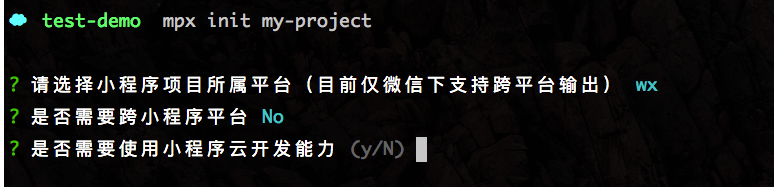
更多关于云开发相关可查看[这里](https://developers.weixin.qq.com/miniprogram/dev/wxcloud/basis/getting-started.html)
## useExtendedLib
Mpx 对于引入扩展库做了相关处理,可以在 app.mpx 中配置使用的扩展库,目前支持 weui 。
```html
```
还需要在 Mpx 的配置文件配置 `externals` 属性,来指定外部依赖,这样 Mpx 在进行打包时,会将其当做外部依赖进行打包。
```js
module.exports = {
// ...
externals: [ 'weui' ]
}
```
---
---
url: /guide/advance/plugin.md
---
# 小程序插件 {#miniprogram-plugin}
插件,是可被添加到小程序内直接使用的功能组件,是对一组 js 接口、自定义组件或页面的封装,。开发者可以像开发小程序一样开发一个插件,供其他小程序使用。同时,小程序开发者可直接在小程序内使用插件,无需重复开发,但是在使用第三那个插件时,无法看到插件的代码。插件适合用来封装自己的功能或服务,提供给第三方小程序进行展示和使用。
开发小程序插件,大致要经过 开通插件功能,填写开发信息,提交审,发布,管理插件使用申请。同时在原生小程序使用插件,要先发出插件申请,等待使用申请通过,插件所有者还可以进行拒绝。
原生小程序开发插件请移步:
* [微信小程序插件开发](https://developers.weixin.qq.com/miniprogram/dev/framework/plugin/development.html)
* [支付宝小程序插件开发](https://opendocs.alipay.com/mini/plugin/create-plugin)
新建插件类型的项目后,如果创建示例项目,则项目中将包含三个目录:
* plugin 目录:插件代码目录。
* miniprogram 目录:放置一个小程序,用于调试插件。
* doc 目录:用于放置插件开发文档。
,插件会同时有多个线上版本,由使用插件的小程序决定具体使用的版本号。
### 如何编写一个插件 {#how-to-write-plugin}
推荐使用 mpx 官方脚手架 @mpxjs/cli 创建一个小程序插件项目来快速的进入插件开发阶段,首先全局安装 @mpxjs/cli
```sh
npm i -g @mpxjs/cli
```
然后使用 cli 初始化项目
```sh
mpx create
? 请选择小程序项目所属平台(目前仅微信下支持跨平台输出) wx
? 是否需要跨小程序平台 No
? 是否需要使用小程序云开发能力 No
? 是否是个插件项目?(不清楚请选 No !什么是插件项目请看微信官方文档!) Yes
? 是否需要typescript No
? 项目描述 A mpx project
? 请输入小程序的Appid touristappid
```
**文件目录**
```
src
|-- miniprogram // 目录:放置一个小程序,用于调试插件。
| --pages
| --app.mpx // 引入插件调试
|-- plugin // 目录:插件代码目录
| --components // 插件组件
| -- list.mpx // 插件提供的列表组件
| --plugin.json // 插件配置文件
```
我们在 plugin/components/list.mpx 中开发插件中的列表组件,开发完成后,在plugin.json中我们向使用者小程序开放的所有自定义组件、页面和 js 接口,格式如下:
**代码示例:**
```html
{
"publicComponents": {
"list": "./components/list" // 使用mpx 中的webpack 路径引入规范
},
"pages": {
"hello-page": "./pages/hello-page"
}
}
```
运行 **npm run build/serve** 构建小程序产物,在 dist 文件夹下,生成最终的小程序插件产物,使用微信开发者工具,打开代码片段菜单栏,选择插件模式,打开 dist 文件夹。
我们可以像小程序一样预览和上传,但插件没有体验版,同时我们通常将 miniprogram 下的代码当做使用插件的小程序代码,来进行插件的调试和测试。
在开发完插件之后,我们可以上传插件代码,在小程序管理后台进行提交发布审核,审核通过后,就可以提供给第三方小程序使用我们的插件了。
使用 mpx 开发插件的优势相似于使用 mpx 开发小程序项目,可以使用 mpx 的各种增强特性以及跨平台输出的特性,提高开发效率和插件性能。
---
---
url: /guide/advance/custom-output-path.md
---
# 自定义路径 {#custom-path}
Mpx在构建时,如果引用的页面不存在于当前 app.mpx 所在的上下文中,例如存在于 npm 包中,为避免和本地声明的其他 page 路径冲突,Mpx 会对页面路径进行 hash 化处理,
同时处理组件路径时也会添加 hash 防止路径名冲突,hash 化处理后最终的文件名是 name+hash+ext 的格式
与此同时,部分开发者希望能够对最终输出的页面路径和组件路径能够自定义,Mpx 对此也提供了相应的配置和Api来支持用户自定义路径
> **注意**:该能力仅在输出小程序时生效
## 页面路径映射 {#page-path-mapping}
针对 Mpx 对 json 中非当前上下文的页面路径 hash 化的特性,如果为提升可读性需要避免路径 hash 化,可以使用该特性,具体为在
json 中配置 pages 时,数组中支持放入 Object,对象中传入两个字段,src 字段表示页面地址,path 字段表示自定义页面路径
* **示例**:
object风格的页面声明
```json5
{
// 主包中的声明
"pages": [
{
"src": "@someGroup/someNpmPackage/pages/view/index.mpx",
"path": "pages/somNpmPackage/index" // 注意保持 path 的唯一性
}
],
// 分包中的声明
"subPackages": [
{
"root": "test",
"pages": [
{
"src": "@someGroup/someNpmPackage/pages/view/test.mpx",
"path": "pages/somNpmPackage/test" // 注意保持 path 的唯一性
}
]
}
]
}
```
使用声明中配置的页面路径进行跳转
```js
mpx.navigateTo({
url: '/pages/somNpmPackage/index'
})
mpx.navigateTo({
url: '/test/pages/somNpmPackage/test'
})
```
## 自定义产物路径 {#custom-output-path}
Mpx 框架 webpack-plugin 也提供了 customOutputPath 方法可以让用户进行页面和组件路径的自定义,
可使用该方法对**非原生组件和非当前文件context的页面**输出路径进行自定义
需要注意的是,该方法需要具有**稳定性和唯一性**,即同样的输入不管什么时候执行都要有同样的返回以及不同的的输入一定会得到不同的输出。
* **示例**:
```js
// vue.config.js
module.exports = defineConfig({
pluginOptions: {
mpx: {
plugin: {
customOutputPath: (type, name, hash, ext, resourcePath) => {
// type: 资源类型(page | component | static)
// name: 资源原有文件名
// hash: 8位长度的hash串
// ext: 文件后缀(.js| .wxml | .json 等)
// resourcePath: 资源路径
// 输出示例: pages/testax34dde3/index.js
return path.join(type + 's', name + hash, 'index' + ext)
}
}
}
}
})
```
基于上方示例,你可以根据需要进行路径定制化,例如缩短hash、使用012代替文件名等各种自定义路径
---
---
url: /guide/advance/ts.md
---
# 使用TypeScript开发小程序 {#use-ts}
## 什么是TypeScript {#what-is-ts}
TypeScript 是一个开源的编程语言,通过在 JavaScript(世界上最常用的语言之一) 的基础上添加静态类型定义构建而成。
类型提供了一种描述对象形状的方法。可以帮助提供更好的文档,还可以让 TypeScript 验证你的代码可以正常工作。
在 TypeScript 中,不是每个地方都需要标注类型,因为类型推断允许您无需编写额外的代码即可获得大量功能。
## TypeScript优势 {#ts-advantage}
1. 静态类型检查
静态类型检查可以避免很多不必要类型的错误,在编译阶段提前发现问题;
2. 强大的类型推断能力
除了类型声明外,`TypeScript` 提供了强大的类型推断能力,该能力能够大大减少我们需要编写的类型声明,有效地减少我们使用 `TypeScript` 的额外压力;
3. IDE 智能提示
目前主流的 IDE 都对 `TypeScript` 提供了良好的支持,基于 `TypeScript` 的类型系统提供友好准确的编码提示与错误检查。
## 使用方式 {#usage}
### 编写ts前的准备工作 {#preparation}
由于对 store 做类型推导使用了最新的 `TypeScript` 特性,因此需要将编辑器的 `TypeScript` 版本升级至 **4.1.3** 及以上版本。以下是 VSCode 配置示例:
1. 更新项目中的TypeScript为 4.1.3 及以上版本。
2. 在VSCode中打开一个 .js/.ts/.tsx 后缀的文件,使用 `Shift+Command+P` 唤出 VSCode 命令行,输入 `TypeScript` ,选择 `Select TypeScript Version`,选择使用工作区版本,将版本切换至 4.1.3 及以上版本。
3) 在 VSCode 编辑器中安装 mpx 插件,来支持在.mpx单文件中编写 ts 时的代码提示和实时报错等优秀体验。
::: warning
使用 @typescript/eslint-plugin 对 ts 代码进行检查,当在.mpx文件中使用全局类型时,eslint 会抛出 no-undef 错误,可以关闭相关 eslint 规则校验
:::
### .mpx中编写ts(推荐) {#write-ts-in-mpx}
目前 Mpx 已经支持在.mpx文件的 script 标签中编写 ts 代码,需要在 script 标签上添加 `lang="ts"` 属性,在编译时会自动这部分 script 中的内容进行 ts 类型检查。
```html
```
当然,由于大部分IDE对 ts 的语法支持都只对 .ts 和 .d.ts 文件生效,因此 Mpx 也支持创建一个 .ts 文件进行 ts 代码编写,在.mpx文件中,通过 src 的方式引入。
```html
```
### 为.ts文件添加loader {#add-ts-loader}
在 Webpack 配置中添加如下 rules 以配置 ts-loader
```js
{
test: /\.ts$/,
use: [
'babel-loader',
'ts-loader'
]
}
```
### 编写tsconfig.json文件 {#write-tsconfig}
对相关配置不熟悉的同学可以直接采用下面配置,能够最大限度发挥 Mpx 中强大的 ts 类型推导能力
```json
{
"compilerOptions": {
"target": "es6",
"allowJs": true,
"noImplicitThis": true,
"noImplicitAny": true,
"strictNullChecks": true,
"moduleResolution": "node",
"lib": [
"dom",
"es6",
"dom.iterable"
]
}
}
```
### 增强类型 {#enhanced-types}
如果需要增加 Mpx 的属性和选项,可以自定义声明 `TypeScript` 补充现有的类型。
例如,首先创建一个 types.d.ts 文件
```ts
// types.d.ts
import { Mpx } from '@mpxjs/core'
declare module '@mpxjs/core' {
// 声明为 Mpx 补充的属性
interface Mpx {
$myProperty: string
}
}
```
之后在任意文件只需引用一次 types.d.ts 声明文件即可,例如在 app.mpx 中引用
```ts
// app.mpx
///
import mpx from '@mpxjs/core'
mpx.$myProperty = 'my-property'
```
## 类型推导及注意事项 {#type-inference-notes}
Mpx 基于泛型函数提供了非常方便用户使用的反向类型推导能力,简单来说,就是用户可以用非常接近于 js 的方式调用 Mpx 提供的 api ,就能够获得大量基于用户输入参数反向推导得到的类型提示及检查。但是由于 ts 本身的能力限制,我们在 Mpx 的运行时中添加了少量辅助函数和变种api,便于用户最大程度地享受反向类型推导带来的便利性,简单的使用示例如下:
```typescript
import {createComponent, getMixin, createStoreWithThis} from '@mpxjs/core'
// createStoreWithThis作为createStore的变种方法,主要变化在于定义getters,mutations和actions时,
// 获取自身的state,getters等属性不再通过参数传入,而是通过this.state或者this.getters等属性进行访问,
// 由于TS的能力限制,getters/mutations/actions只有使用对象字面量的方式直接传入createStoreWithThis时
// 才能正确推导出this的类型,当需要将getters/mutations/actions拆解为对象编写时,
// 需要用户显式地声明this类型,无法直接推导得出。
const store = createStoreWithThis({
state: {
aa: 1,
bb: 2
},
getters: {
cc() {
return this.state.aa + this.state.bb
}
},
actions: {
doSth3() {
console.log(this.getters.cc)
return false
}
}
})
createComponent({
data: {
a: 1,
b: '2'
},
computed: {
c() {
return this.b
},
d() {
// data, mixin, computed中定义的数据能够被推导到this中
return this.a + this.aaa + this.c
},
// 从store上map过来的计算属性或者方法同样能够被推导到this中
...store.mapState(['aa'])
},
mixins: [
// 使用mixins,需要对每一个mixin子项进行getMixin辅助函数包裹,支持嵌套mixin
getMixin({
computed: {
aaa() {
return 123
}
},
methods: {
doSth() {
console.log(this.aaa)
return false
}
}
})
],
methods: {
doSth2() {
this.a++
console.log(this.d)
console.log(this.aa)
this.doSth3()
},
...store.mapActions(['doSth3'])
}
})
```
### getMixin
为 ts 项目提供的反向推导 mixin 的辅助函数,getMixin 接收一个对象作为参数,使用 mixins 时,支持嵌套 mixin。具体用法见[getMixin](../../api/global-api.md#getmixin)。
### createStoreWithThis
为了在 ts 项目中更好的支持 store 的类型推导,提供了 createStoreWithThis 进行 store 的创建,createStoreWithThis 接收一个 options 对象作为参数。通过 createStoreWithThis 创建 store 时,使用`this.state`,`this.getters`,`this.commit`, `this.dispatch`对自身的相关属性进行获取。具体用法见[createStoreWithThis](../../api/store-api.md#createstorewiththis)。
### createStateWithThis
创建一个 state,支持 state 类型推导的辅助函数,具体用法见[createStateWithThis](../../api/store-api.md#createstatewiththis)
### createGettersWithThis
创建一个 getters,支持 getters 类型推导的辅助函数,具体用法见[createGettersWithThis](../../api/store-api.md#creategetterswiththis)
### createMutationsWithThis
创建一个 mutations,支持 mutations 类型推导的辅助函数,具体用法见[createMutationsWithThis](../../api/store-api.md#createmutationswiththis)
### createActionsWithThis
创建一个 actions,支持 actions 类型推导的辅助函数,具体用法见[createActionsWithThis](../../api/store-api.md#createactionswiththis)
---
---
url: /guide/advance/utility-first-css.md
---
# 使用原子类 {#use-utility-class}
原子类(utility-first CSS)是近几年流行起来的一种全新的样式开发方式,在前端社区内取得了良好的口碑,越来越多的主流网站也基于原子类进行开发,我们耳熟能详的有[Github](https://github.com/),[OpenAI](https://openai.com/),[Netflix](https://top10.netflix.com/)
和[NASA官网](https://www.jpl.nasa.gov/)
等。使用原子类离不开原子类框架的支持,常用的原子类框架有 [Tailwindcss](https://tailwindcss.com/)、[Windicss](https://windicss.org/)
和 [Unocss](https://unocss.dev/) 等,而在 **Mpx2.9** 以后,我们在框架中内置了基于 unocss
的原子类支持,让小程序开发也能使用原子类。对项目进行简单配置开启原子类支持后,用户就可以在 Mpx
页面/组件模板中直接使用一些预定义的基础样式类,诸如flex,pt-4,text-center 和 rotate-90 等,对样式进行组合定义,并且在 Mpx 支持的所有小程序平台和 web 平台中正常运行,下面是一个简单示例:
```html
Erin Lindford
Product Engineer
Message
```
通过这种方式,我们在不编写任何自定义样式代码的情况下得到了一张简单的个人卡片,实际渲染效果如下:
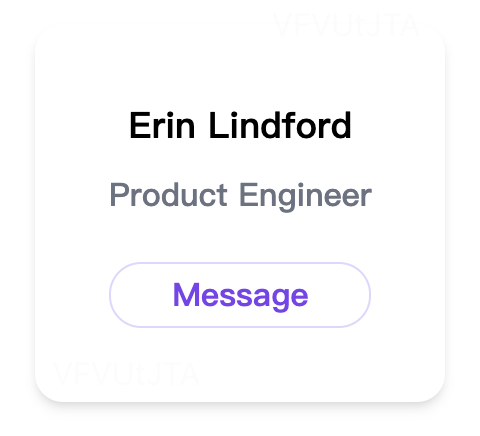
相较于传统的自定义类编写样式的方式,使用原子类能给你带来以下这些好处:
* **不用再烦恼于为自定义类取类名**,传统样式开发中,我们仅仅是为某个元素定义样式就需要绞尽脑汁发明一些抽象的类名,还得提防类名冲突,使用原子类可以完全将你从这种琐碎无趣的工作中解放;
* **停止css体积的无序增长**,传统样式开发中,css体积会随着你的迭代不断增长,而在原子类中,一切样式都可以复用,你几乎不需要编写新的css;
* **让调整样式变得更加安全**,传统css是全局的,当你修改某个样式时无法保障其不会破坏其他地方的样式,而你在模板中使用的原子类是本地的,你完全不用担心修改它会影响其他地方。
而相较于使用内联样式,原子类也有一些重要的优势:
* **约束下的设计**,使用内联样式时,里面的每一个数值都是魔法数字(magic number)
,而通过原子工具类,你可以选择一些符合预定义设计规范的样式,便于构筑具有视觉一致性的UI;
* **响应式设计**,你无法在内联样式中使用媒体查询,然而通过原子类框架中提供的响应式工具,你可以轻而易举地构建出响应式界面;
* **Hover、focus和其他状态**,使用内联样式无法定义特定状态下的样式,如hover和focus,通过原子类框架的状态变量能力,我们可以轻松为这些状态定义样式。
看到这里相信你已经迫不及待地想要在 Mpx 中体验原子类开发了吧,可以根据下面的指南开启你的原子类之旅。
## 原子类环境配置 {#compile-config}
如果你想在新项目中使用原子类,可以使用最新版本的 `@mpxjs/cli` 创建项目,在 prompt 中选择使用原子类,就可以在新创建的项目模版中直接使用 unocss 的原子类,关于可使用的工具类可参考 [unocss 交互示例](https://unocss.dev/interactive/)及本指南下方的[工具类支持范围](#工具类支持范围)。
> 与 web 中使用 unocss 不同,在 Mpx 中使用 unocss 不需要显式引入虚拟模块 `import 'uno.css'` 来承载生成的样式内容,这是由于在
> Mpx 中,我们充分考虑到小程序分包架构的特殊性和主包体积的重要性,结合 Mpx
> 强大的分包构建能力,对生成的原子工具类的使用情况进行分析,将其自动注入到合适的主包或者分包中,来达到全局体积分配的最优(在没有内容冗余的情况下尽可能输出到分包)。
对于使用 `@mpxjs/cli@3.0` 新版脚手架创建的项目,可以在项目初始化时选择`需要使用原子类`
选项,或在已有项目下执行`mpx add @mpxjs/vue-cli-plugin-mpx-utility-first-css`以激活原子类相关编译配置。
对于使用旧版脚手架创建的项目,可以通过修改项目编译配置以激活原子类支持:
1. 安装相关依赖:
```json5
{
//...
"devDependencies": {
"@mpxjs/unocss-base": '^2.9.0',
"@mpxjs/unocss-plugin": '^2.9.0'
}
}
```
2. 新建uno.config.js,基础配置内容如下:
```js
const { defineConfig } = require('unocss')
const presetMpx = require('@mpxjs/unocss-base')
module.exports = defineConfig({
presets: [
presetMpx()
]
})
```
3. 注册`MpxUnocssPlugin`,在`build/getPlugins`中添加如下代码:
```js
const MpxUnocssPlugin = require('@mpxjs/unocss-plugin')
// ...
plugins.push(new MpxUnocssPlugin())
```
即可在项目模版中使用基于`unocss`的原子类功能,`unocss`默认的preset兼容`tailwindcss`/`windicss`
,可以通过查阅[tailwindcss文档](https://tailwindcss.com/docs/installation)、[windicss文档](https://windicss.org/utilities/general/colors.html)或[unocss可交互文档](https://unocss.dev/interactive/)进行探索使用。
关于`uno.config.js`可用配置项及`@mpxjs/unocss-plugin`及`@mpxjs/unocss-base`的配置项请参考[API文档](../../api/compile.md#mpxunocssplugin-配置)。
### vscode插件支持 {#vscode-plugin-support}
1. 安装 [unocss 官方插件](https://unocss.dev/integrations/vscode)。
2. 修改 VSCode 设置中的 `unocss.languageIds` 选项(或者直接修改 VSCode JSON 配置文件),添加 "mpx",实现智能提示等功能。
> *使用最新版本 [@mpxjs/cli](../basic/start.md#install-scaffold) 脚手架创建的项目会自动生成,可忽略这一步。*
```json
// .vscode/settings.json
{
"unocss.languageIds": [
"mpx"
]
}
```
3. 修改 `uno.config.js` 支持 Mpx 预设。
> *使用 [@mpxjs/cli](../basic/start.md#install-scaffold) 脚手架创建的项目会自动生成,可忽略这一步。*
```js
// uno.config.js
const { defineConfig } = require('unocss')
const presetMpx = require('@mpxjs/unocss-base')
const { defineConfig } = require("unocss")
const presetMpx = require("@mpxjs/unocss-base")
module.exports = defineConfig({
content: {
pipeline: {
include: [/\.mpx($|\?)/],
},
},
presets: [presetMpx()],
})
```
## 功能支持范围 {#config-supports}
我们支持了`unocss`大部分的配置项及功能,并针对小程序技术规范提供了一些额外的功能支持,如分包输出和样式隔离等功能,以下为详细功能支持范围。
| 功能 | 支持度 | 备注 |
|:------------------|:-----|:----------------------------------------------------------|
| Load Config | 支持 | 支持windi默认的全部配置文件路径,并支持在plugin options中手动传入配置对象或配置文件路径 |
| Rules | 支持 | |
| Shortcuts | 支持 | |
| Theme | 支持 | |
| Variants | 支持 | |
| Extractors | 不支持 | |
| Transformers | 部分支持 | 内建支持variant groups、directives和alias,不支持自定义transformers |
| Preflights | 支持 | 支持内建和自定义preflight配置 |
| Presets | 支持 | |
| Safelist | 支持 | 支持全局配置和模版注释语法局部配置声明safelist |
| Value Auto-infer | 支持 | |
| Variant Groups | 支持 | |
| Directives | 支持 | |
| Alias | 支持 | |
| Attributify Mode | 不支持 | 小程序模版不支持不识别的自定义属性 |
| Responsive Design | 支持 | |
| Dark Mode | 支持 | |
| Important Prefix | 支持 | |
| Layers Ordering | 支持 | |
| 分包输出/公共样式抽离 | 支持 | 可通过设置`@mpxjs/unocss-plugin`配置项`minCount`决定公共样式范围 |
| 组件分包异步/组件样式隔离 | 支持 | 可通过全局配置和模版注释语法局部配置`styleIsolation='isolated'`支持相关场景的原子类使用 |
| Rpx样式单位 | 支持 | |
| 小程序类名特殊字符转义 | 支持 | 静态类名和动态类名均以支持 |
| 跨平台输出 | 支持 | 支持输出Mpx已支持的所有小程序平台及Web |
## 工具类可用范围 {#utility-supports}
经过我们的详细测试,大部分`unocss`
提供的工具类都能在小程序环境下正常工作,但是也有部分工具类由于小程序底层环境差异无法正常运行,以下是详细的测试结果,参考[windicss文档](https://windicss.org/utilities/general/colors.html)
进行分类组织。
### General
| 功能 | 支持度 | 备注 |
|:-----------|:-----|:------------------------------------|
| Colors | 支持 | |
| Typography | 部分支持 | 不支持子项:Font Variant Numeric Tab Size |
| SVG | 不支持 | 小程序不支持svg标签 |
| Variants | 部分支持 | 不支持子项:Child Selectors,因为小程序不支持\*选择器 |
### Accessibility
| 功能 | 支持度 | 备注 |
|:---------------|:----|:---|
| Screen Readers | 支持 | |
### Animations
| 功能 | 支持度 | 备注 |
|:------------|:----|:---|
| Animation | 支持 | |
| Transforms | 支持 | |
| Transitions | 支持 | |
### Backgrounds
| 功能 | 支持度 | 备注 |
|:----------------------|:----|:------------------------|
| Background Attachment | 支持 | |
| Background Clip | 支持 | |
| Background Color | 支持 | |
| Background Opacity | 支持 | 需要和Background Color一起使用 |
| Background Position | 支持 | |
| Background Repeat | 支持 | |
| Background Size | 支持 | |
| Background Origin | 支持 | |
| Gradient Direction | 支持 | |
| Gradient From | 支持 | |
| Gradient Via | 支持 | |
| Gradient To | 支持 | |
| Background Blend Mode | 支持 | |
### Behaviors
| 功能 | 支持度 | 备注 |
|:---------------------|:-----|:-----------------------------------------------------|
| Box Decoration Break | 支持 | |
| Image Rendering | 部分支持 | image-render-edge 真机不支持 |
| Listings | 支持 | |
| Overflow | 支持 | |
| Overscroll Behavior | 支持 | |
| Placeholder | 不支持 | 微信小程序 input 需要通过 placeholder-style 设置 placeholder 样式 |
### Borders
| 功能 | 支持度 | 备注 |
|:------------------|:----|:----------------|
| Border Radius | 支持 | |
| Border Width | 支持 | |
| Border Color | 支持 | |
| Border Opacity | 支持 | |
| Border Style | 支持 | |
| Divider Width | 不支持 | 小程序不支持生成的css选择器 |
| Divider Color | 不支持 | 小程序不支持生成的css选择器 |
| Divider Opacity | 不支持 | 小程序不支持生成的css选择器 |
| Divider Style | 不支持 | 小程序不支持生成的css选择器 |
| Outline | 支持 | |
| Outline Solid | 支持 | |
| Outline Dotted | 支持 | |
| Ring Width | 支持 | |
| Ring Color | 支持 | |
| Ring Opacity | 支持 | |
| Ring Offset Width | 支持 | |
| Ring Offset Color | 支持 | |
### Effects
| 功能 | 支持度 | 备注 |
|:---------------|:----|:---|
| Box Shadow | 支持 | |
| Opacity | 支持 | |
| Mix Blend Mode | 支持 | |
### Filters
| 功能 | 支持度 | 备注 |
|:----------------|:----|:---|
| Filter | 支持 | |
| Backdrop Filter | 支持 | |
### Interactivity
| 功能 | 支持度 | 备注 |
|:----------------|:----|:------------|
| Accent Color | 不支持 | 小程序不支持生成的样式 |
| Appearance | 不支持 | 小程序不支持生成的样式 |\
| Cursor | 不支持 | 小程序不支持生成的样式 |\
| Caret | 不支持 | 小程序不支持生成的样式 |\
| Pointer Events | 支持 | |\
| Resize | 不支持 | 小程序不支持生成的样式 |\
| Scroll Behavior | 不支持 | 小程序不支持生成的样式 |\
| Touch Action | 支持 | |\
| User Select | 不支持 | 小程序不支持生成的样式 |\
| Will Change | 不支持 | 小程序不支持生成的样式 |
### Layout
| 功能 | 支持度 | 备注 |
|:------------|:-----|:-------------------------------|
| Columns | 支持 | |
| Container | 支持 | |
| Display | 支持 | |
| Flex | 支持 | |
| Grid | 支持 | |
| Positioning | 部分支持 | 小程序图片设置object-fit 无效,可使用mode代替 |
| Sizing | 支持 | |
| Spacing | 部分支持 | Space Between小程序不支持生成的css选择器 |
| Tables | 部分支持 | 小程序不支持部分table样式 |
## 小程序原子类使用注意点 {#attentions}
小程序由于底层环境差异,我们在支持和使用原子类时有一些特殊的注意点。
### 特殊字符转义 {#escape}
基于`unocss`的原子类支持`value auto-infer`(值自动推导),可以在模版中根据相关规则书写灵活的自定义值原子类,如`p-5px bg-[hsl(211.7,81.9%,69.6%)]`等,针对原子类中出现的`[` `(` `,`等特殊字符,在web中会通过转义字符`\`进行转义,由于小程序环境下不支持css选择器中出现`\`转义字符,我们内置支持了一套不带`\`的转义规则对这些特殊字符进行转义,同时替换模版和css文件中的类名,内建的默认转义规则如下:
```js
const classEscapeMap = {
'(': '_pl_',
')': '_pr_',
'[': '_bl_',
']': '_br_',
'{': '_cl_',
'}': '_cr_',
'#': '_h_',
'!': '_i_',
'/': '_s_',
'.': '_d_',
':': '_c_',
',': '_2c_',
'%': '_p_',
'\'': '_q_',
'"': '_dq_',
'+': '_a_',
$: '_si_'
}
```
该转义规则同时用于编译产物与运行时处理,为保证两端结果一致,不支持自定义。对于映射表以外的特殊字符,能够被 UnoCSS 规则正常处理的类名会使用内建兜底规则转义;未被 UnoCSS 处理的类名会输出编译错误。
模板命中 `@mpxjs/unocss-plugin` 的 `scan` 规则时,`wx:class` 对象字面量中的 key 会和静态 `class` 使用相同的转义规则。插件会在扫描模板时将转义后的 key 转换为小程序可用的标识符,无法转换为合法标识符时会输出编译错误。
未使用 `@mpxjs/unocss-plugin` 或模板未命中 `scan` 规则时,`wx:class` 对象字面量的 key 仅支持合法标识符以及包含空格或 `-` 的类名,其他无法转换为合法标识符的特殊字符会输出编译错误。如需在这类模板中使用 UnoCSS 特殊类名,需要通过 `scan.include` 将对应文件加入扫描范围。
### 原子类分包输出 {#subpackage}
在web中,原子类会被全部打包输出单个样式文件,一般会放置在顶层样式表中以供全局访问,但在小程序中这种全量的输出策略并不是最优的,主要原因在于小程序中可供全局访问的主包体积存在**2M大小限制**,主包体积十分紧缺珍贵,Mpx在构建输出时遵循着分包优先的原则,尽可能充分利用分包体积从而减少对主包体积的占用,再进行原子类产物输出时,我们也遵循了相同的原则。
在Mpx中,我们在收集原子类时同时记录了每个原子类的引用分包,在收集结束后根据每个原子类的分包引用数量决定该原子类应该输出到主包还是分包当中,我们在`@mpxjs/unocss-plugin`中提供了[`minCount`配置项](../../api/compile.md#mincount)来决定分包的输出规则,该配置项的默认值为2,即当一个原子类被2个或以上分包引用时,会被作为公共原子类抽取到主包中,否则输出到所属分包中,这也是全局最优的策略。当我们想要让原子类输出产物更少地占用主包体积时,我们也可以将`minCount`值调大,让原子类抽取到主包的条件更加苛刻,不过这样也会伴随着原子类分包冗余的增加。
`unocss.config.js`配置中定义的`safelist`原子类默认会输出到主包,为了组件局部使用的`safelist`有输出到分包的机会,我们在模版中提供了[`注释配置`](../../api/compile.md#commentconfig)(comments config),灵感来源于`webpack`中的魔法注释(magic comments),用户可以在组件模版中通过`注释配置`声明当前组件所需的`safelist`,对应的原子类也会根据上述的规则输出到主包或分包中,使用示例如下:
```html
test
```
### 样式隔离与组件分包异步 {#style-isolation}
在小程序中,自定义组件的样式默认是隔离的,web中通过全局样式访问原子类的方式不再生效,不过由于小程序提供了[样式隔离配置](https://developers.weixin.qq.com/miniprogram/dev/framework/custom-component/wxml-wxss.html#%E7%BB%84%E4%BB%B6%E6%A0%B7%E5%BC%8F%E9%9A%94%E7%A6%BB),我们可以将该组件样式隔离配置调整为`apply-shared`来获取页面或app中定义的原子类,但是当我们在使用传统类名和原子类混合开发或者迁移原子类的过程中,我们往往希望保留原本自定义组件的样式隔离。
针对这种情况,我们在`@mpxjs/unocss-plugin`中提供了[`styleIsolation`配置项](../../api/compile.md#styleisolation),可选设置为`isolated`|`apply-shared`,当设置为`isolated`时每个组件都会通过`@import`独立引用主包或者分包的原子类样式文件,因此不会受到样式隔离的影响;当设置为`apply-shared`时,只有app和分包页面会引用对应的原子类样式文件,自定义组件需要通过配置样式隔离为`apply-shared`使原子类生效。
在组件分包异步的情况下对应组件即使将样式隔离配置为`apply-shared`的情况下,`@mpxjs/unocss-plugin`也需要将`styleIsolation`设置为`isolated`才能正常工作,原因在于组件分包异步的情况下,组件被其他分包的页面所引用渲染,由于上述原子类样式分包输出的规则,其他分包的页面中可能并不包含当前组件所需的原子类,只有在`isolated`模式下由组件自身引用所需的原子类样式才能保证正常work,类似于`safelist`,我们也提供了[`注释配置`](../../api/compile.md#commentconfig)的方式对组件的`styleIsolation`模式进行局部配置,示例如下:
```html
```
---
---
url: /guide/advance/ssr.md
---
# SSR
近些年来,SSR/SSG 由于其良好的首屏展现速度和SEO友好性逐渐成为主流的技术规范,但过去 Mpx 对 SSR 的支持不完善,使用 Mpx 开发的跨端页面一直无法享受到 SSR 带来的性能提升,在 2.9 版本中,我们对 Mpx 输出 web 流程进行了大量适配改造,解决了 SSR 中常见的内存泄漏、跨请求状态污染和数据预请求等问题,完整支持了基于 Vue 和 Pinia 的 SSR 技术方案。
## 配置使用 SSR {#ssr-config}
在 Vue SSR 项目中,我们一般需要提供 server entry 和 client entry 两个文件作为 webpack 的构建入口,然后通过 webpack 构建出 server bundle 和 client bundle。在用户访问页面时,在服务端使用 server bundle 渲染出 HTML 字符串,作为静态页面发送到客户端,然后在客户端使用 client bundle 通过水合(hydration)对静态页面进行激活,实现可交互效果,下图展示了 Vue SSR 的大致流程。
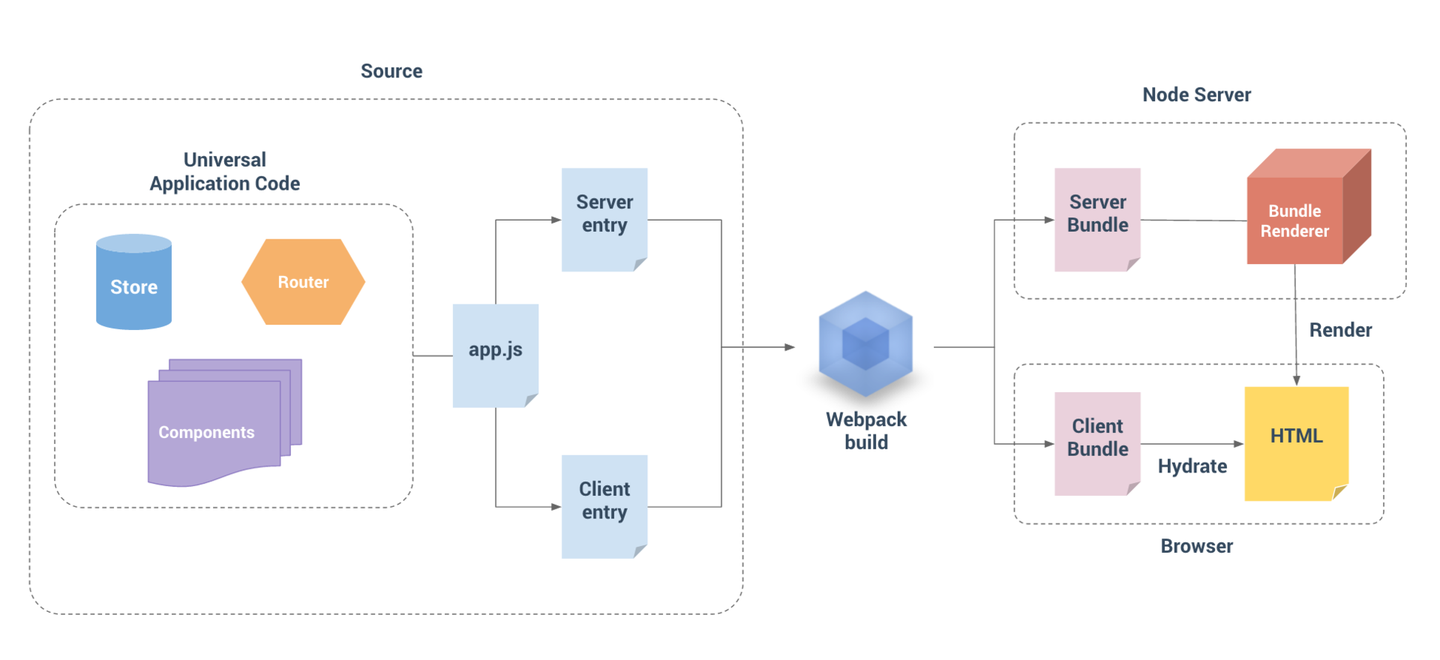
Mpx SSR 核心基于 Vue SSR 实现,大致流程思路与 Vue 一致,不过为了保持与小程序代码的兼容性,在配置使用上有一些改动差异,下面我们详细展开介绍:
### 构建server/client bundle {#build-server-client-bundle}
SSR项目中,我们需要分别构建出 server bundle 和 client bundle,对于不同环境的产物构建,我们需要进行不同的配置。
在 Vue 中,我们需要提供 `entry-server.js` 和 `entry-client.js` 两个文件分别作为 server 和 client 的构建入口,与 Vue 不同,在 Mpx 中我们通过编译处理与运行时增强生命周期实现了使用 `app.mpx` 作为统一构建入口,无需区分 server 和 client。
#### 服务端构建配置 {#server-build-config}
服务端配置中除了将 entry 制定为 `app.mpx` 及其它基础配置外,最重要的是安装 `vue-server-renderer` 包中提供的 `server-plugin` 插件,该插件能够构建产出 `vue-ssr-server-bundle.json` 文件供 `renderer` 后续消费。
```js
// webpack.server.config.js
const VueSSRServerPlugin = require('vue-server-renderer/server-plugin')
module.exports = merge(baseConfig, {
// 将 entry 指向项目的 app.mpx 文件
entry: './app.mpx',
// ...
plugins: [
// 产出 `vue-ssr-server-bundle.json`
new VueSSRServerPlugin()
]
})
```
更加详细的配置说明可参考 [Vue SSR的服务端配置](https://v2.ssr.vuejs.org/guide/build-config.html#server-config)
#### 客户端构建配置 {#client-build-config}
类似服务端构建配置,在客户端构建中我们需要使用 `vue-server-renderer` 包中 `client-plugin` 插件来帮助我们生成客户端环境的资源清单 `vue-ssr-client-manifest.json`,并供 `renderer` 后续消费。
```js
// webpack.client.config.js
const VueSSRClientPlugin = require('vue-server-renderer/client-plugin')
module.exports = merge(baseConfig, {
// 将 entry 指向项目的 app.mpx 文件
entry: './app.mpx',
// ...
plugins: [
// 产出 `vue-ssr-client-manifest.json`。
new VueSSRClientPlugin()
]
})
```
更加详细的配置说明可参考 [Vue SSR的客户端配置](https://v2.ssr.vuejs.org/guide/build-config.html#client-config)
### 准备页面模版 {#prepare-page-template}
SSR 渲染中,我们创建 `renderer` 需要一个页面模板,简单的示例如下:
```html
Hello
```
与 CSR 渲染模版不同,SSR 渲染模版中需要提供一个特殊的 ``注释,标记 SSR 渲染产物的插入位置,如使用 `@mpxjs/cli` 脚手架创建 SSR 项目,该模版已经内置于脚手架中。
### 集成启动 SSR 服务 {#integrate-ssr-server}
当我们准备好页面模版和双端构建产物后,我们就可以创建 `renderer` 并与 Node 服务进行集成,启动 SSR 服务,下面以 `express` 为例:
```js
//server.js
const app = require('express')()
const { createBundleRenderer } = require('vue-server-renderer')
// 通过 vue-server-renderer/server-plugin 生成的文件
const serverBundle = require('../dist/server/vue-ssr-server-bundle.json')
// 通过 vue-server-renderer/client-plugin 生成的文件
const clientManifest = require('../dist/client/vue-ssr-client-manifest.json')
// 页面模版文件
const template = require('fs').readFileSync('../src/index.template.html', 'utf-8')
// 创建 renderer 渲染器
const renderer = createBundleRenderer(serverBundle, {
runInNewContext: false,
template,
clientManifest,
});
// 注册启动 SSR 服务
app.get('*', (req, res) => {
const context = { url: req.url }
renderer.renderToString(context, (err, html) => {
if (err) {
res.status(500).end('Internal Server Error')
return
}
res.end(html);
})
})
app.listen(8080)
```
## SSR 生命周期 {#ssr-lifecycle}
在 Mpx 2.9 的版本中,我们提供了三个全新用于 SSR 的生命周期,分别是`onAppInit`、`serverPrefetch` 和 `onSSRAppCreated`,以统一服务端与客户端的构建入口,下面展开介绍:
### onAppInit
> 该生命周期仅可在 App 中使用
在 SSR 中用户每发出一个请求,我们都会为其生成一个新的应用实例,`onAppInit` 生命周期会在应用创建 `new Vue(...)` 前被调用,其执行的返回结果会被合并到创建应用的 `options` 中
很常见的使用场景在于返回新的全局状态管理实例,Mpx 中提供了 `@mpxjs/pinia` 作为全局状态管理工具,我们可以在 `onAppInit` 中返回全新的 `pinia` 示例避免产生跨请求状态污染,示例如下:
```js
// app.mpx
import mpx, { createApp } from '@mpxjs/core'
import { createPinia } from '@mpxjs/pinia'
createApp({
// ...
onAppInit () {
const pinia = createPinia()
return {
pinia
}
}
})
```
> SSR 中仅支持使用 `@mpxjs/pinia` 作为状态管理工具,`@mpxjs/store` 暂不支持
### serverPrefetch
> 该生命周期可在 App/Page/Component 中使用,只在服务端渲染时执行
当我们需要在 SSR 使用数据预拉取时,可以使用这个生命周期进行,使用方法与 Vue 一致, 示例如下:
选项式 API:
```js
import { createPage } from '@mpxjs/core'
import useStore from '../store/index'
createPage({
//...
serverPrefetch () {
const query = this.$route.query
const store = useStore(this.$pinia)
// return the promise from the action, fetch data and update state
return store.fetchData(query)
}
})
```
组合式 API:
```js
import { onServerPrefetch, getCurrentInstance, createPage } from '@mpxjs/core'
import useStore from '../store/index'
createPage({
setup () {
const store = userStore()
onServerPrefetch(() => {
const query = getCurrentInstance().proxy.$route.query
// return the promise from the action, fetch data and update state
return store.fetchData(query)
})
}
})
```
关于数据预拉取更详细的说明可以查看[这里](https://v2.ssr.vuejs.org/guide/data.html)。
### onSSRAppCreated
> 该生命周期仅可在 App 中使用,只在服务端渲染时执行
在 Vue SSR 项目中,我们会在 `entry-server.js` 中导出一个工厂函数,在该函数中实现创建应用实例、路由匹配和状态同步等逻辑,并返回应用实例 `app`。
在 Mpx SSR 中,我们将这部分逻辑整合在 `onSSRAppCreated` 中执行,该生命周期执行时用户可以从参数中获取应用实例 `app`、路由实例 `router`、数据管理实例 `pinia` 和 SSR 上下文 `context`,在完成必要的操作后,该生命周期需要返回一个 `resolve(app)` 的 promise。
通常我们会在 `onSSRAppCreated` 中进行路由路径设置和数据预拉取后的状态同步工作,示例如下:
```js
// app.mpx
createApp({
// ...,
onSSRAppCreated ({ pinia, router, app, context }) {
return new Promise((resolve, reject) => {
// 设置服务端路由路径
router.push(context.url)
router.onReady(() => {
// 应用完成渲染时执行
context.rendered = () => {
// 将服务端渲染后得到的 pinia.state 同步到 context.state 中,
// context.state 会被自动序列化并通过 `window.__INITIAL_STATE__`
// 注入到 HTML 中,并在客户端运行时再读取同步
context.state = pinia.state.value
}
// 返回应用程序实例
resolve(app)
}, reject)
})
}
})
```
上述示例代码等价于 Vue 中的 `entry-server.js`
```js
// entry-server.js
import { createApp } from './app'
export default context => {
return new Promise((resolve, reject) => {
const { app, router, store } = createApp()
router.push(context.url)
router.onReady(() => {
// This `rendered` hook is called when the app has finished rendering
context.rendered = () => {
// After the app is rendered, our store is now
// filled with the state from our components.
// When we attach the state to the context, and the `template` option
// is used for the renderer, the state will automatically be
// serialized and injected into the HTML as `window.__INITIAL_STATE__`.
context.state = store.state
}
resolve(app)
}, reject)
})
}
```
如用户没有配置 onSSRAppCreated,框架内部会执行兜底逻辑,以保障 SSR 的正常运行。
## 其他注意事项 {#other-notes}
1. Mpx SSR 渲染支持 i18n 的功能,但为了防止内存泄漏,当前 i18n 实例不会随着每次请求而重新创建,这是由于 Vue2.x 版本插件机制的设计缺陷所造成的,因此在使用 i18n 进行 SSR 时可能会产生跨请求状态污染的问题,这个问题会在未来 Mpx 输出 web 切换为 Vue3 后完全解决。
2. 在服务端渲染阶段,对于 global 全局对象访问修改,如__mpx, \_\_mpxRouter, \_\_mpxPinia 都可能导致全局状态污染,所以在服务端渲染阶段请尽量避免进行相关操作;对于存在全局访问修改的方法,如 getApp(), getCurrentPages() 等在服务端渲染中被调用时,会产生相关报错提示。
3. 由于服务器无法收到 URL 中的 hash 信息,使用 SSR 时需要通过修改 `mpx.config.webConfig.routeConfig` 将路由模式设置成 `history` 模式。
---
---
url: /guide/advance/cli.md
---
# 脚手架工具 {#cli}
Mpx 提供了一个基于 [@vue/cli](https://cli.vuejs.org/zh/) 的脚手架工具 `@mpxjs/cli`,用于快速初始化和管理 Mpx 项目。它继承了 Vue CLI 的强大功能,如零配置原型开发、插件系统、图形化界面等,并针对小程序开发进行了深度定制。
## 安装 {#install}
请确保你的环境中有 Node.js (>= 10)。
```bash
# 全局安装 @mpxjs/cli
npm install -g @mpxjs/cli
```
## 初始化项目 {#create}
使用 `create` 命令创建一个新项目:
```bash
mpx create my-project
```
在创建过程中,CLI 会通过交互式问答引导你配置项目:
1. **项目描述/作者**:基础元信息。
2. **跨平台支持**:选择是否需要支持 支付宝/百度/头条/QQ 等小程序平台,以及 Web 和 React Native 平台。
3. **TypeScript**:是否使用 TypeScript 进行开发。
4. **CSS 预处理器**:选择 Stylus, Less 或 Sass。
5. **Linter / Formatter**:选择 ESLint 配置。
6. **测试支持**:是否需要单元测试 (Jest) 或 E2E 测试。
7. **云开发**:是否使用微信云开发。
初始化完成后,进入项目目录并安装依赖:
```bash
cd my-project
npm install
```
## 常用命令 {#commands}
### 开发模式 {#serve}
启动开发服务器,监听文件变化并自动重新构建:
```bash
npm run serve
```
默认情况下,构建产物会输出到 `dist/wx` 目录(以微信小程序为例)。你可以使用微信开发者工具打开该目录进行预览和调试。
如果你需要调试其他平台,可以使用对应的 script,例如:
```bash
npm run serve:ali # 支付宝小程序
npm run serve:swan # 百度小程序
npm run serve:tt # 字节跳动小程序
npm run serve:web # Web 平台
```
### 生产构建 {#build}
构建用于生产环境的代码(压缩、混淆、去除冗余代码等):
```bash
npm run build
```
同样支持不同平台的构建命令:
```bash
npm run build:ali
npm run build:web
# ...
```
### 审查项目配置 {#inspect}
查看项目最终生成的 webpack 配置:
```bash
npm run inspect
```
## 配置文件 {#config}
由于 `@mpxjs/cli` 是基于 Vue CLI 的,项目的主要配置文件为根目录下的 `vue.config.js`。你可以在这里配置 webpack、Mpx 插件选项等。
### 示例配置
```javascript
// vue.config.js
module.exports = {
outputDir: `dist/${process.env.MPX_CURRENT_TARGET_MODE || 'wx'}`,
pluginOptions: {
mpx: {
// Mpx 插件配置
srcMode: 'wx', // 源码模式,默认为 wx
plugin: {
// mpx-webpack-plugin 配置
hackResolve: true
},
loader: {
// mpx-loader 配置
}
}
},
configureWebpack: {
// 自定义 webpack 配置
resolve: {
alias: {
'@': 'src'
}
}
}
}
```
## 插件系统 {#plugins}
`@mpxjs/cli` 使用了 Vue CLI 的插件架构。这意味着你可以使用现有的 Vue CLI 插件,也可以使用 Mpx 专属插件。
在项目初始化时选择的特性(如 TypeScript、Transpilation 等)都是以插件的形式注入到项目中的。
更多关于插件开发的文档,请参考 [Vue CLI 插件开发指南](https://cli.vuejs.org/zh/dev-guide/plugin-dev.html)。
## 旧版迁移 {#migration}
如果你之前使用的是 `mpx init` (基于 `mpx-cli` 2.x 或更早版本),建议升级到新的 `@mpxjs/cli`。
1. 卸载旧版:`npm uninstall -g mpx-cli`
2. 安装新版:`npm install -g @mpxjs/cli`
3. 新版使用 `mpx create` 代替 `mpx init`。
## 参考文档 {#reference}
* [@mpxjs/cli GitHub 仓库](https://github.com/mpx-ecology/mpx-cli)
* [Vue CLI 官方文档](https://cli.vuejs.org/zh/)
---
---
url: /guide/cross-platform/basic.md
---
# 跨端输出配置 {#cross-platform-output-config}
Mpx以微信增强DSL为基础,支持跨端输出至多端小程序、web和客户端,包括支付宝、百度、抖音、京东、QQ等多端小程序平台,基于Vue的web平台,和基于react-native的ios、android及鸿蒙平台。
## 跨端输出配置 {#cross-platform-output-config-1}
配置mpx进行跨端输出十分简单,找到项目构建的webpack配置,在@mpxjs/webpack-plugin的配置参数中设置mode和srcMode参数即可。
```javascript
new MpxwebpackPlugin({
// mode为mpx编译的目标平台,可选值有(wx|ali|swan|qq|tt|jd|web|ios|android|harmony)
mode: 'ali',
// srcMode为mpx编译的源码平台,目前仅支持wx
srcMode: 'wx'
})
```
对于使用 @mpxjs/cli 创建的项目,可以通过在 `npm script` 当中定义 `targets` 来设置编译的目标平台,多个平台标识以`,`分隔。
```javascript
// 项目 package.json
{
"script": {
"build:cross": "mpx-cli-service build --targets=wx,ali,ios,android"
}
}
```
## 支持的平台 {#supported-platforms}
### 小程序平台 {#miniprogram-platform}
* 微信小程序 (wx)
* 支付宝小程序 (ali)
* 百度小程序 (swan)
* QQ小程序 (qq)
* 抖音小程序 (tt)
* 京东小程序 (jd)
### Web平台 {#web-platform}
* 基于Vue的Web应用 (web)
### 客户端平台 {#client-platform}
* iOS应用 (ios)
* Android应用 (android)
* 鸿蒙应用 (harmony)
## 支付宝文本与滚动条兼容 {#ali-text-scrollbar-compat}
当 `mode` 为 `ali` 时,Mpx 会在 App 全局样式之前加载支付宝兼容样式,其中包含 `text { white-space: inherit }`。因此,`text` 默认会继承父节点的换行方式;业务在 App 样式、页面样式、组件样式或行内样式中显式声明 `white-space` 时,后加载的业务规则仍可覆盖该默认值。
该默认值只处理换行继承。省略号布局仍需由业务设置宽度、`overflow`、`text-overflow` 等必要样式。
使用微信语法开发并输出支付宝小程序时,`scroll-view` 的 `show-scrollbar` 支持以下布尔契约:
```html
列表内容
```
* `show-scrollbar="{{false}}"` 会为当前节点添加滚动条隐藏样式。
* 动态值仅在结果严格等于布尔值 `false` 时隐藏;`undefined`、`null`、`0` 和字符串 `"false"` 均不会触发隐藏。
* `true` 只移除 Mpx 添加的隐藏样式,恢复宿主默认行为,不会强制宿主显示滚动条。
* 支付宝原生语法源码(`srcMode: 'ali'`)不会转换该属性。
滚动条最终是否可见仍受支付宝客户端、基础库、系统和设备影响,建议在目标真机上验证横向、纵向及嵌套滚动场景。该兼容样式由完整 App 构建的全局样式入口提供;独立分包、插件产物及单独编译的页面或组件不在自动覆盖范围内。
支付宝与 Web 的 `.mpx-root-view { display: initial }`、`page { line-height: normal }` 也作为框架默认样式先于用户 App 样式加载。业务同优先级声明可以覆盖这些默认值。
## 构建命令 {#build-command}
### 单平台构建 {#single-platform-build}
```bash
# 构建微信小程序 {#build-wechat-miniprogram}
npm run build:wx
# 构建支付宝小程序 {#build-alipay-miniprogram}
npm run build:ali
# 构建Web应用 {#build-web-app}
npm run build:web
# 构建iOS应用 {#build-ios-app}
npm run build:ios
```
### 多平台构建 {#multi-platform-build}
```bash
# 构建所有支持的平台 {#build-all-platforms}
npm run build:cross
# 构建指定的多个平台 {#build-specific-platforms}
mpx-cli-service build --targets=wx,ali,web
```
## 项目结构 {#project-structure}
跨端项目的典型目录结构:
```
src/
├── components/ # 公共组件
├── pages/ # 页面文件
├── utils/ # 工具函数
├── styles/ # 样式文件
├── app.mpx # 应用入口
└── app.json # 应用配置
```
## 下一步 {#next-step}
* [条件编译机制](conditional.md) - 了解如何处理平台差异
* [平台差异处理](./differences.md) - 掌握差异抹平技巧
---
---
url: /guide/cross-platform/conditional.md
---
# 条件编译机制 {#conditional-compile-mechanism}
Mpx跨端输出时在框架内针对不同平台的差异进行了大量的转换抹平工作,但框架能做的工作始终是有限的,对于框架无法抹平的部分我们会在编译和运行时进行报错提示,同时提供了完善的跨平台条件编译机制,便于用户自行进行差异化处理,该能力也能够用于实现区分平台进行业务逻辑实现。
Mpx中我们支持了几种维度的条件编译,分别是文件维度、区块维度、代码维度和属性维度,其中,文件维度和区块维度主要用于处理一些大块的平台差异性逻辑,而代码维度和属性维度主要用于处理一些局部简单的平台差异。
> 文件和区块维度的 `mode` 只负责选择目标平台内容,不会改变源码方言。命中的文件或区块默认继承资源 `srcMode` 并继续参与跨平台转换;完整目标平台原生文件使用 `srcModeRules` 声明源码方言,完整目标平台原生 SFC 区块使用 `src-mode` 声明源码方言。
## 文件维度条件编译 {#file-conditional-compile}
文件维度条件编译简单的来说就是以文件为维度编写跨平台差异代码。例如在微信 -> 支付宝项目中存在一个业务地图组件 `map.mpx`,可以在相同位置新建 `map.ali.mpx`;编译系统在 `mode` 为 `ali` 时优先加载 `map.ali.mpx`,其他 `mode` 加载 `map.mpx`。`map.ali.mpx` 默认仍按照资源 `srcMode` 编写并参与转换;若文件完整使用支付宝原生语法,需通过 `srcModeRules.ali` 显式声明源码方言。
### 文件命名规则 {#file-naming-rule}
```
原文件名.平台标识.扩展名
```
支持的平台标识:
* `wx` - 微信小程序
* `ali` - 支付宝小程序
* `swan` - 百度小程序
* `qq` - QQ小程序
* `tt` - 抖音小程序
* `jd` - 京东小程序
* `web` - Web平台
* `ios` - iOS平台
* `android` - Android平台
* `harmony` - 鸿蒙平台
### 示例 {#example}
```
components/
├── map.mpx # 默认实现
├── map.ali.mpx # 支付宝专用实现
├── map.web.mpx # Web专用实现
└── map.ios.mpx # iOS专用实现
```
### RN平台文件兜底逻辑 {#rn-platform-fallback}
在RN平台(即mode为 ios/android/harmony)中,文件维度的条件编译存在一个兜底逻辑:
* 当编译目标为 `harmony` 平台时,如果找不到 `.harmony.mpx` 文件,会自动兜底查找 `.ios.mpx` 文件
* 当编译目标为 `android` 平台时,如果找不到 `.android.mpx` 文件,也会自动兜底查找 `.ios.mpx` 文件
因此,在开发RN跨端应用时,可以只编写一份 `index.ios.mpx` 文件,它将同时适用于iOS、Android和鸿蒙平台,除非你需要为特定平台提供不同实现。
### 与webpack alias结合使用 {#webpack-alias-usage}
文件维度条件编译能够与webpack alias结合使用,对于npm包的文件我们并不方便在原本的文件位置创建.ali的条件编译文件,但我们可以通过webpack alias在相同位置创建一个`虚拟的`.ali文件,并将其指向项目中的其他文件位置。
```js
// 对于npm包中的文件依赖
import npmModule from 'somePackage/lib/index'
// 配置以下alias后,当mode为ali时,会优先加载项目目录中定义的projectRoot/somePackage/lib/index文件
// vue.config.js
module.exports = defineConfig({
configureWebpack() {
return {
resolve: {
alias: {
'somePackage/lib/index.ali': path.resolve(__dirname, 'src/adapters/ali/somePackage-index.js')
}
}
}
}
})
```
## 区块维度条件编译 {#block-conditional-compile}
在.mpx单文件中一般存在template、js、style、json四个区块。`mode` 只选择目标平台区块,命中后仍继承资源 `srcMode` 并执行平台转换。完整目标平台原生 SFC 区块需额外声明 `src-mode`;仅当 `src-mode` 等于当前输出 `mode` 时生效,否则忽略并继续继承资源 `srcMode`:
```html
支付宝环境(仍按资源 srcMode 转换)
完整支付宝原生区块
其他环境
```
当 RN 区块声明 `src-mode="ios"` 时,区块会按照 RN 原生源码处理,模板应使用已注册的 `View`、`Text` 等 RN 原生组件,而不是依赖 `view`、`text` 的 Mpx2RN 转换。RN 原生组件的注册方式参见 [Mpx 与 RN 混合开发](../rn/hybrid-with-react-native.md)。
```html
RN 原生区块
```
`.mpx` 文件的 `` 仍属于 SFC 模板区块:默认继承当前资源的 `srcMode`,并读取区块显式声明的 `src-mode`。模板区块内部的 `` 定义同样继承当前区块 `srcMode`;`` / `` 引用的是独立模板资源,不继承引用方 `srcMode`,若其使用目标平台原生语法,应通过 `srcModeRules` 对被引用资源本身进行声明。
## 代码维度条件编译 {#code-conditional-compile}
代码维度条件编译主要用于处理一些局部简单的平台差异,用户可以在js代码和template插值中访问`__mpx_mode__`获取当前编译mode,进行平台差异逻辑编写。
除了 `__mpx_mode__` 这个默认插值以外,有别的环境变量需要的话可以在mpx.plugin.conf.js里通过defs进行配置。
### JS代码条件编译 {#js-conditional-compile}
```js
if(__mpx_mode__ === 'ali') {
// 执行支付宝环境相关逻辑
} else {
// 执行其他环境相关逻辑
}
```
#### async/await 注意事项 {#async-await-notes}
在使用条件编译时,如果涉及到 async/await 语法,需要注意以下问题:
有些开发者会编写如下代码,但会发现编译时 false block 内的模块也会被加载解析:
```js
async function someMethod() {
if (__mpx_mode__ === 'ios' || __mpx_mode__ === 'android') {
return {}
} else{
const mod = await require.async('./index.js?root=main')
console.log('mod', mod)
}
}
```
这是因为经过babel处理之后,async/await 会被处理为 @babel/runtime-corejs3/regenerator 的 switch 语法,从而导致静态分析删除代码失效,false block 内的模块被正常加载索引:
```js
function _someMethod() {
_someMethod = _asyncToGenerator(/*#__PURE__*/_regeneratorRuntime.mark(function _callee() {
var mod;
return _regeneratorRuntime.wrap(function _callee$(_context) {
while (1) switch (_context.prev = _context.next) {
case 0:
if (!(__mpx_mode__ === 'ios' || __mpx_mode__ === 'android')) {
_context.next = 4;
break;
}
return _context.abrupt("return", {});
case 4:
if (!(__mpx_mode__ === 'ali')) {
_context.next = 9;
break;
}
_context.next = 7;
return require.async('./index.js?root=main');
case 7:
mod = _context.sent;
console.log('mod', mod);
case 9:
case "end":
return _context.stop();
}
}, _callee);
}));
return _someMethod.apply(this, arguments);
}
```
遇到这种情况,可以修改为 if block 整体包裹 async await 语句,或者使用 Promise:
```js
function someMethod() {
if (__mpx_mode__ === 'ios' || __mpx_mode__ === 'android') {
return {}
} else if (__mpx_mode__ === 'ali') {
let mod = {}
(async () => {
mod = await require.async('./index.js?root=main')
})();
console.log('mod', mod)
}
}
```
### 模板条件编译 {#template-conditional-compile}
```html
支付宝环境
其他环境
```
### JSON条件编译 {#json-conditional-compile}
注意,这个依赖JSON的动态方案,得通过name="json"这种方式来编写,其实写的是js代码,最终module.exports导出一个可json化的对象即可:
```html
```
### 样式条件编译 {#style-conditional-compile}
```css
/*
@mpx-if (__mpx_env__ === 'someEvn')
*/
/* @mpx-if (__mpx_mode__ === 'wx') */
.backColor {
background: green;
}
/*
@mpx-elif (__mpx_mode__ === 'qq')
*/
.backColor {
background: black;
}
/* @mpx-endif */
/* @mpx-if (__mpx_mode__ === 'swan') */
.backColor {
background: cyan;
}
/* @mpx-endif */
.textSize {
font-size: 18px;
}
/*
@mpx-else
*/
.backColor {
/* @mpx-if (__mpx_mode__ === 'swan') */
background: blue;
/* @mpx-else */
background: red;
/* @mpx-endif */
}
/*
@mpx-endif
*/
```
## 属性维度条件编译 {#attr-conditional-compile}
属性维度条件编译允许用户在组件上使用 `@` 和 `|` 符号来指定某个节点或属性只在某些平台下有效。
对于同一个 button 组件,微信小程序支持 `open-type="getUserInfo"`,但是支付宝小程序支持 `open-type="getAuthorize" `。如果不使用任何维度的条件编译,则在编译的时候会有警告和报错信息。
比如业务中需要通过 button 按钮获取用户信息,虽然可以使用代码维度条件编译来解决,但是增加了很多代码量:
```html
```
而用属性维度的编译则方便很多:
```html
```
属性维度的编译也可以对整个节点进行条件编译,例如只想在支付宝小程序中输出某个节点:
```html
this is view
```
`@mode` 只负责筛选节点。节点命中后会继承资源 `srcMode`,节点自身及其子节点都会执行正常的平台语法转换,条件属性不会保留在输出中。例如 `srcMode` 为 `wx`、输出 `ali` 时:
```html
tap click
tap click
```
`@_mode` 是 `@mode` 的历史兼容别名,两者的筛选和转换行为完全一致。例如下面的写法也会将 `bindtap` 转换为 `onTap`,但新代码建议统一使用 `@mode`:
```html
test
```
有时候我们不仅需要对节点属性进行条件编译,可能还需要对节点标签进行条件编译。
为此,我们支持了一个特殊属性 `mpxTagName`,如果节点存在这个属性,我们会在最终输出时将节点标签修改为该属性的值,配合属性维度条件编译,即可实现对节点标签进行条件编译,例如在百度环境下希望将某个 view 标签替换为 cover-view,我们可以这样写:
```html
will be cover-view in swan
```
## 通过 env 实现自定义目标环境的条件编译{#use-env}
除了基于平台标识(mode)的条件编译外,Mpx 还支持通过自定义环境变量(env)实现在不同业务环境下编译产出不同的代码。这使得我们可以在同一平台下为不同的业务场景提供差异化实现。
### 配置自定义环境变量 {#config-custom-env-vars}
在实例化 MpxWebpackPlugin 时,通过配置 env 参数来指定目标环境:
```javascript
// vue.config.js
module.exports = defineConfig({
pluginOptions: {
mpx: {
srcMode: 'wx', // srcMode为mpx编译的源码平台,目前仅支持wx
plugin: {
env: "didi" // env为mpx编译的目标环境,需自定义
}
}
}
})
```
### 文件维度条件编译与 env {#file-conditional-compile-env}
在文件维度条件编译中,可以结合 mode 和 env 来命名文件,编译系统会根据当前编译的 mode 和 env 来加载对应模块。
例如,在一个微信转支付宝的项目中,如果地图组件在不同业务环境中也有差异,可以创建如下文件:
```
components/
├── map.mpx # 默认实现
├── map.ali.mpx # 支付宝通用实现
└── map.ali.qingju.mpx # 支付宝青桔业务环境实现
```
加载优先级如下:
* 当 mode 为 ali,env 为 qingju 时,优先加载 map.ali.qingju.mpx
* 如果找不到特定 env 的文件,则加载 map.ali.mpx
* 如果都找不到,则加载默认的 map.mpx
### 区块维度条件编译与 env {#block-conditional-compile-env}
在 .mpx 单文件的区块中,可以同时使用 `mode` 和 `env` 属性来定义条件编译,优先级从高到低如下:
```html
支付宝滴滴环境专用模板
支付宝通用模板
滴滴业务环境通用模板
默认模板
```
注意:如果定义了多个具有相同 mode 和 env 的区块,默认会使用最后一个。
### 代码维度条件编译与 env {#code-conditional-compile-env}
在代码中,可以通过访问 `__mpx_env__` 获取当前编译环境,与 `__mpx_mode__` 的用法相同:
```js
if (__mpx_env__ === 'didi') {
// 滴滴业务环境相关逻辑
} else if (__mpx_env__ === 'qingju') {
// 青桔业务环境相关逻辑
} else {
// 其他业务环境逻辑
}
```
### 属性维度条件编译与 env {#attr-conditional-compile-env}
env 属性维度条件编译使用 `:` 符号与 mode 进行组合,格式为 `attr@mode:env:env|mode:env`。当只有 env 条件时,需要添加 `:` 前缀,如 `attr@:env`。
```html
仅在滴滴业务环境显示
在滴滴业务环境中变为 cover-view
```
当只声明了 env 而没有声明 mode 时,跨平台输出时框架会对节点属性进行正常转换:
```html
this is a view component
this is a view component
```
通过结合使用 mode 和 env 的条件编译,我们可以更精细地控制代码在不同平台和不同业务环境下的行为,实现真正的一套代码多端多环境运行。
---
---
url: /guide/rn/start.md
---
# 快速开始 {#quick-start}
Mpx 可通过输出为 React Native 代码实现直接在 iOS、Android 中作为 App 运行。
### 1. 创建新项目 {#create-new-project}
```sh
# 使用 Mpx CLI 创建支持 RN 的项目 {#create-rn-project-cli}
npx @mpxjs/cli@latest create my-rn-app
# 选择包含 React Native 支持的模板 {#select-rn-template}
# ? 是否需要输出react-native Yes {#output-rn-yes}
```
> \[!tip] 注意
>
> 框架仅负责将 Mpx 项目输出为 React Native 代码,而后 React Native 代码的编译构建完全由 React Native 项目完成。
>
> 选择 “是否需要输出 react-native” 后,默认 Mpx 项目将包含一个由 `@react-native-community/cli` 创建的名为 ReactNativeProject 的 React Native 项目,以便用于对 React Native 代码的开发调试和编译。
### 2. 项目结构 {#project-structure}
```sh
my-rn-app/
├── src/ # 源码目录
│ ├── pages/ # 页面目录
│ ├── components/ # 组件目录
│ ├── utils/ # 工具函数
│ ├── store/ # 状态管理
│ ├── app.mpx # 应用入口
│ └── app.json # 应用配置
├── ReactNativeProject/ # React Native 项目目录
│ ├── android/ # Android 项目
│ ├── ios/ # iOS 项目
│ ├── index.js # RN 入口文件(同时也是Mpx的输出产物)
│ └── package.json # RN 依赖
├── dist/ # 编译输出
│ └── react-native/ # RN 编译结果
└── mpx.config.js # 构建配置
```
### 3. 开发调试 {#dev-debug}
::: code-group
```sh [iOS]
# 运行 IOS 应用 {#run-ios}
npm run serve:ios
```
```sh [Android]
# 运行 Android 应用 {#run-android}
npm run serve:android
```
:::
### 4. 构建 {#build}
::: code-group
```sh [iOS]
# 编译到 IOS {#build-ios}
npm run build:ios
```
```sh [Android]
# 编译到 Android {#build-android}
npm run build:android
```
:::
---
---
url: /guide/rn/component.md
---
# 组件使用与开发 {#component-usage-development}
本节提供 Mpx RN 环境下的组件支持说明,详细列出了支持的基础组件及其可用属性、方法,以及自定义组件的相关配置。
### 目录概览 {#directory-overview}
* #### 基础组件
**容器组件**:[view](#view) · [scroll-view](#scroll-view) · [swiper](#swiper) · [swiper-item](#swiper-item) · [movable-area](#movable-area) · [movable-view](#movable-view) · [root-portal](#root-portal) · [sticky-section](#sticky-section) · [sticky-header](#sticky-header) · [cover-view](#cover-view)
**媒体组件**:[image](#image) · [video](#video) · [canvas](#canvas)
**表单组件**:[input](#input) · [textarea](#textarea) · [button](#button) · [checkbox](#checkbox) · [checkbox-group](#checkbox-group) · [radio](#radio) · [radio-group](#radio-group) · [switch](#switch) · [picker](#picker) · [picker-view](#picker-view) · [picker-view-column](#picker-view-column) · [form](#form) · [label](#label)
**基础组件**:[text](#text) · [icon](#icon) · [progress](#progress) · [navigator](#navigator) · [rich-text](#rich-text) · [cover-image](#cover-image)
**其他组件**:[web-view](#web-view)
* #### 自定义组件
[组件属性配置](#component-props-config) · [生命周期钩子](#lifecycle-hooks) · [实例属性和方法](#instance-props-methods)
### 使用原则 {#usage-principles}
> \[!important] 重要说明
>
> * **支持范围**:仅支持文档中明确列出的组件和属性
> * **平台特性**:某些属性和功能仅在 RN 环境下可用
> * **性能考量**:按需开启高级功能,避免不必要的性能开销
## 基础组件 {#basic-components}
目前 Mpx 输出 React Native 仅支持以下组件,文档中未提及的组件以及组件属性即为不支持,具体使用范围可参考如下文档
### 基础组件通用属性 {#basic-component-common-props}
| 属性名 | 类型 | 默认值 | 说明 |
| ----------------------- | ------- | ------------- | ---------------------------------------------------------- |
| enable-offset | boolean | `false` | 设置是否要获取组件的布局信息,若设置了该属性,会在 e.target 中返回组件的 offsetLeft、offsetWidth 信息|
| enable-var | boolean | `true` | 默认支持使用 css variable,若想关闭该功能可设置为 false |
| enable-text-pass-through | boolean | `false` | RN 环境特有属性,开启文本样式和文本属性透传上下文,请在动态添加文本样式或文本属性时开启 |
| parent-width | number | | 父组件宽度,主要用于百分比计算的场景,如 width: calc(100% - 20px),需要在外部传递父组件的宽度|
| parent-height | number | | 父组件高度,主要用于百分比计算的场景,如 height: calc(100% - 20px),需要在外部传递父组件的高度|
以上基础组件的通用属性仅在 React Native 环境中支持。在跨平台输出到小程序或 Web 时,这些属性将无法使用。
由于 view、text、scroll-view、image 和 input 组件都是基于 React Native 原生组件实现的,因此这些组件默认继承原生组件支持的属性。
与微信小程序一致,React Native 输出支持只传递属性名不传递属性值的布尔写法,例如 `` 等价于 ``。
### view
视图容器。
属性
| 属性名 | 类型 | 默认值 | 说明 |
| ----------------------- | ------- | ------------- | ---------------------------------------------------------- |
| hover-class | string | | 指定按下去的样式类。当 `hover-class="none"` 时,没有点击态效果。 |
| hover-start-time | number | `50` | 按住后多久出现点击态,单位毫秒|
| hover-stay-time | number | `400` | 手指松开后点击态保留时间,单位毫秒 |
| animation | object | | 传递动画的实例, 可配合mpx.createAnimation方法一起使用|
| enable-background | boolean | `false ` | RN环境特有属性,是否要开启background-image、background-size和background-position的相关计算或渲染,请根据实际情况开启 |
| enable-animation | boolean | `false` | RN环境特有属性,开启要开启动画渲染,请根据实际情况开启 |
| enable-fast-image | boolean | `false` | RN环境特有属性,开启后将使用 react-native-fast-image 进行图片渲染,请根据实际情况开启 |
| is-simple | - | - | RN环境特有标记,设置后将使用简单版本的 view 组件渲染,该组件不包含 css var、calc、ref 等拓展功能,但性能更优,请根据实际情况设置 |
事件
| 事件名 | 说明 |
| ----------------| ------------------ |
| transitionend| 动画结束时触发,`event.detail = { elapsedTime, finished, current }` |
> \[!tip] 注意
>
> * 如果从未使用背景图、动图或动画,请不要开启`enable-background`、`enable-animation`或`enable-fast-image`属性,会有一定的性能消耗。
> * 若开启`enable-background`需要给当前 view 组件设置一个唯一 key。
> * `background-image`、`background-size`、`background-position` 等背景图相关 css 属性,仅 view 组件支持
> * 出于性能考虑,view 的样式增强能力(如 `enable-background`、`enable-animation`)采用按需启用策略。view 组件仅在**首次**渲染时检测样式并决定是否开启对应能力。由于 React Hooks 的一致性约束,增强能力无法在后续更新阶段再动态启用,因此当组件生命周期内**可能**使用相关能力时,需在首次渲染时**显式声明**启用,比如 `enable-animation="{{ true }}"`。
### text
文本。
属性
| 属性名 | 类型 | 默认值 | 说明 |
| ----------------------- | ------- | ------------- | ---------------------------------------------------------- |
| user-select | boolean | `false` | 文本是否可选。 |
| selectable | boolean | `false` | 文本是否可选。该属性已废弃,请使用 user-select |
| decode | boolean | `false` | 是否解码 |
| is-simple | - | - | RN环境特有标记,设置后将使用简单版本的 text 组件渲染,该组件不包含 css var、calc、ref 等拓展功能,但性能更优,请根据实际情况设置 |
> \[!tip] 注意
>
> * 未包裹 text 标签的文本,会自动包裹 text 标签。
> * text 组件开启 enable-offset 后,offsetLeft、offsetWidth 获取时机仅为组件首次渲染阶段
### scroll-view
可滚动视图区域。
属性
| 属性名 | 类型 | 默认值 | 说明 |
| ----------------------- | ------- | --------- | -------------------------------------------------- |
| scroll-x | boolean | `false` | 允许横向滚动 |
| scroll-y | boolean | `false` | 允许纵向滚动 |
| upper-threshold | number | `50` | 距顶部/左边多远时(单位 px),触发 scrolltoupper 事件 |
| lower-threshold | number | `50` | 距底部/右边多远时(单位 px),触发 scrolltolower 事件 |
| scroll-top | number | `0` | 设置纵向滚动条位置 |
| scroll-left | number | `0` | 设置横向滚动条位置 |
| scroll-with-animation | boolean | `false` | 在设置滚动条位置时使用动画过渡 |
| enable-back-to-top | boolean | `false` | 点击状态栏的时候视图会滚动到顶部,仅 iOS环境支持 |
| enhanced | boolean | `false` | scroll-view 组件功能增强 |
| bounces | boolean | `true` | iOS 下 scroll-view 边界弹性控制 (同时开启 enhanced 属性后生效) |
| refresher-enabled | boolean | `false` | 开启自定义下拉刷新,iOS 下需要把 enhanced 和 bounces 都设置为 true |
| refresher-threshold | number | `45` | 设置自定义下拉刷新阈值 |
| scroll-into-view | boolean | `false` | 值应为某子元素id(id不能以数字开头) |\
| scroll-into-view-offset | number | `0` | 跳转到 scroll-into-view 目标节点时的额外偏移 |
| refresher-default-style | string | `'black'` | 设置下拉刷新默认样式,支持 `black`、`white`、`none`,仅安卓支持 |
| refresher-background | string | `'#fff'` | 设置自定义下拉刷新背景颜色,仅安卓支持 |
| refresher-triggered | boolean | `false` | 设置当前下拉刷新状态,true 表示已触发 |
| paging-enabled | number | `false` | 分页滑动效果 (同时开启 enhanced 属性后生效),当值为 true 时,滚动条会停在滚动视图的尺寸的整数倍位置 |
| show-scrollbar | number | `true` | 滚动条显隐控制 (同时开启 enhanced 属性后生效)|
| enable-trigger-intersection-observer | boolean | `false` | RN环境特有属性,是否开启intersection-observer |
| simultaneous-handlers | array\